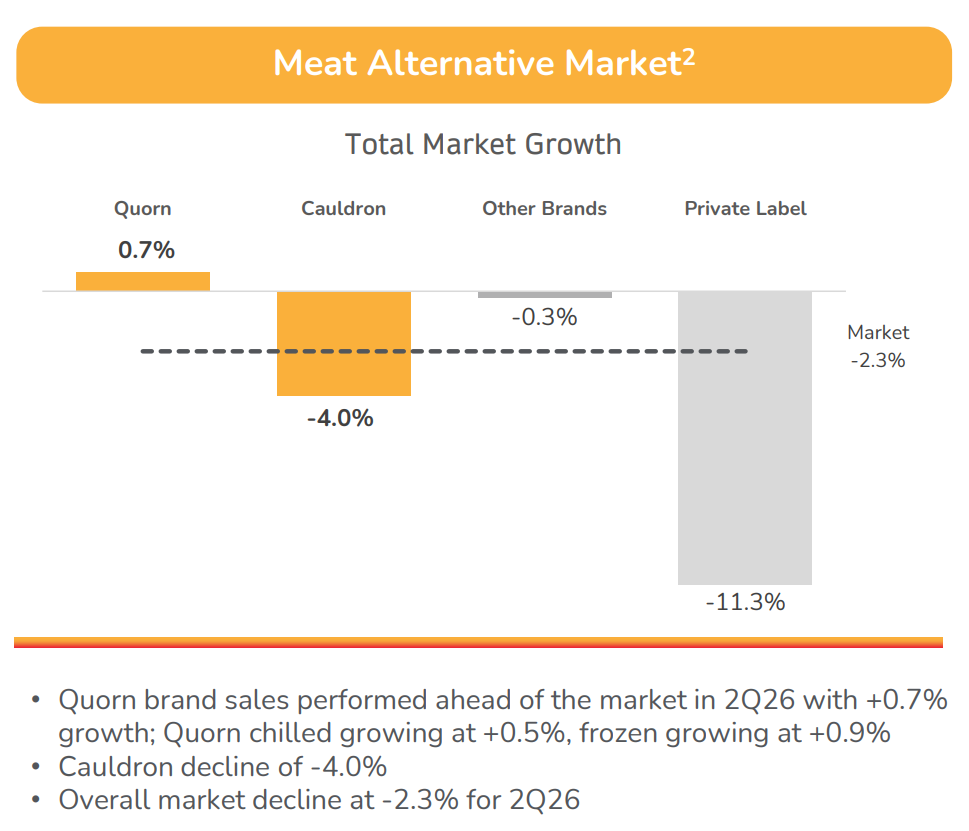
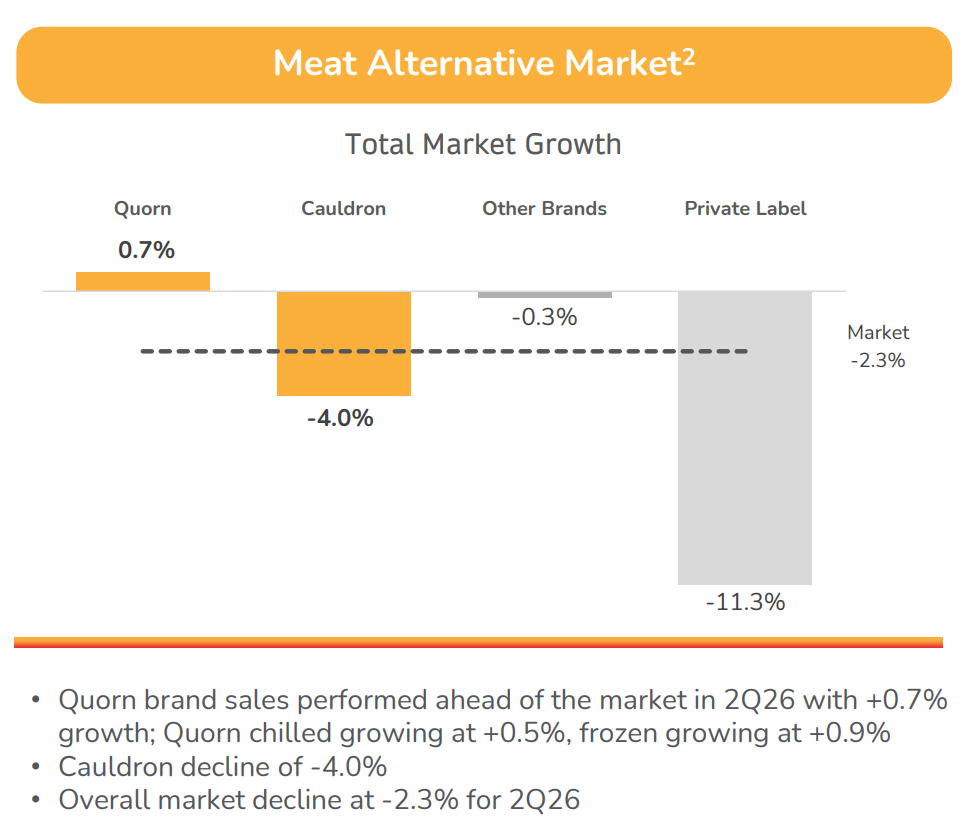
Meat alternatives maker Quorn Foods is beginning to emerge from a prolonged slump, with sales growing modestly in Q2 and margins rebounding as restructuring measures and a stronger performance in UK retail offset weaker sales in foodservice.
The firm—which is owned by instant noodles giant Monde Nissin—said its protein segment comprising the Quorn and Cauldron brands generated revenues of ₱7.38 billion ($120 million) in the first half of 2026, up 2.2% on a constant-currency basis vs the first half of 2025.
Core net income was ₱106 million ($1.7 million), vs a ₱215 million ($3.5 million) core net loss in H1 2025, said CFO Nick Cooper on the firm’s earnings call.
“We see growing momentum in UK retail, and I expect the second half of the year in UK retail to be as strong as, or even stronger than the first half. But at the same time, we have a lot of work to do in foodservice, and that will be a drag in the second half of the year, and is likely to get worse before it gets better.”
New products tap into protein snacking trend
CEO David Flochel highlighted the early performance of recent launch Protein Bites, which Quorn has placed both in meat-free fixtures and food-to-go sections in UK retail, and is now introducing into the foodservice channel:
“It’s early days, but the rate of sale is very good and very promising to a point that has been helping us to unlock even further distribution for the second half of the year. This is a key driver of the continuous double-digit growth in snacking that we’ve been enjoying in Q2,”
The format is particularly attractive because it can reach consumers beyond the traditional meat-free category while commanding higher price points and improving margins, added Monde Nissin CEO Henry Soesanto.
“We are seeing these new [snacking] products [such as Protein Bites] building good potential, playing into new convenient retail formats for single consumption, catering to a much wider audience even beyond the UK and Europe. We also believe that this is a scalable new part of the portfolio, where taste, convenience, and health are rewarded with higher price points, which will be accretive to the gross margin of the protein portfolio as a whole.”
Foodservice remains the problem child
Quorn has made meaningful progress on two of the three pillars of its “Transform to Win Together” plan: fixing UK retail and rebuilding gross margins through supply-chain improvements.
However, sales in the foodservice channel, which accounts for 18% of the protein business, fell 5% in Q2, a “disappointing” result, said Quorn Foods CEO David Flochel, a CPG industry veteran brought into the business in 2024 to lead a turnaround.
Quorn is now applying the same “back-to-basics” approach in foodservice as the team has deployed in UK retail and seeks to diversify beyond education and healthcare into higher margin business and industry channels, said Flochel. It is also unlocking new opportunities through Protein Bites and its blended meat offering enabling foodservice partners to combine meat and mycoprotein to create hybrid products, which are now gaining traction in several markets.
“In the long term, I remain convinced and confident that we can drive positive contribution and growth for that [foodservice] channel. However, in the short term, there’s still a lot to be fixed.”
‘Organizational right-sizing’
Looking ahead, CFO Nick Cooper cautioned that the improving sales trajectory will not be linear: Q2 benefited from a relatively weak prior-year comparison, while higher input costs due to the Iran war are expected to hit gross margins more heavily in Q3 and Q4.
Nevertheless, management expects further supply-chain savings to offset much of that pressure, said the firm, which has gone through several rounds of restructuring and layoffs as part of an “organizational right-sizing” process over the past couple of years.
US sales account for 5.5% of Quorn Foods business
High in protein and fiber and low in saturated fat and calories, Quorn mycoprotein is an edible filamentous fungus called Fusarium Venenatum first discovered growing in soil in Buckinghamshire in the UK in the late 1960s and grown at a commercial scale using a controlled fermentation process in large steel tanks.
Launched in the UK in 1985, Quorn was introduced to the US in 2002. Its parent company Marlow Foods was acquired by Monde Nissin—one of the leading consumer packaged foods companies in the Philippines— in late 2015 for £550 million ($695 million). Cauldron Foods, a UK-based brand founded in the early 1980s, was acquired as part of the same deal.
According to Monde Nissin’s 2025 annual report, the UK accounted for 79.1% of sales in its meat alternatives business in full-year 2025, with 5.5% coming from the US and the remainder from the Republic of Ireland, mainland Europe, Southeast Asia, and Australasia.
In UK grocery retail, Cauldron was the #6 alt meat brand with a 3.5% value share in 2025, while Quorn was No. 1 with 27.8%, according to Circana data cited in the report.
Further reading:
Offbeast develops ‘world’s first’ beef-plant hybrid whole cuts
Millow raises $2.3m, gears up for commercial launch of minimally processed alt meat
Swiss alt meat startup Planted scales fermented whole-cut platform, eyes B2B partnerships
Black Sheep Foods bets on ‘TVP 2.0’ as hybrid meat gains traction
Beyond Meat leans into Europe, Canada, as US sales continue to slide
The post Quorn Foods’ UK retail recovery gathers pace, but foodservice ‘likely to get worse before it gets better’ appeared first on AgFunderNews.