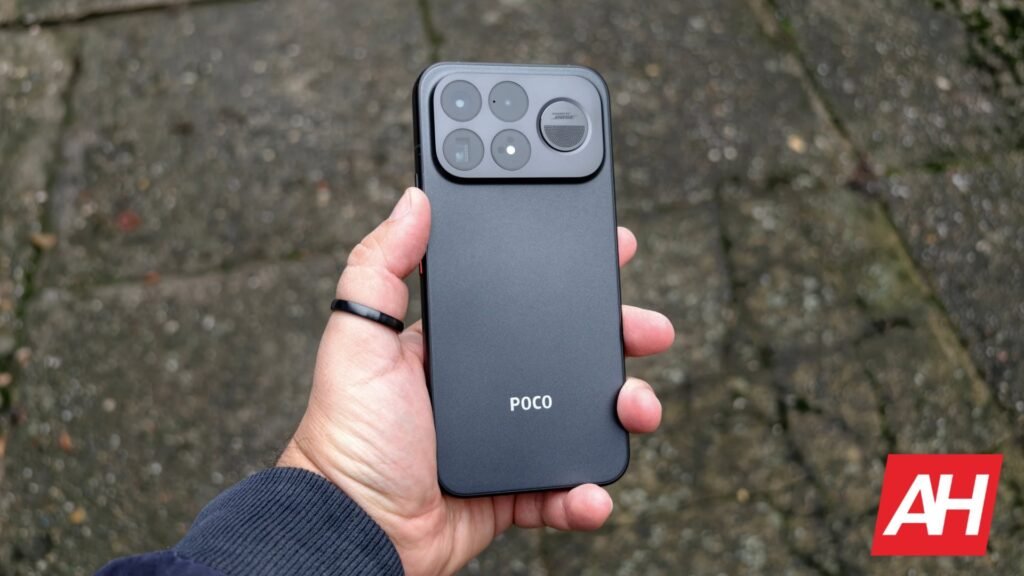

The POCO F9 Ultra is the most powerful smartphone the company has to offer. As many of you know, POCO is owned by Xiaomi, so you can expect HyperOS on this device. Furthermore, some of you may have instantly noticed some design similarities with the Xiaomi 17T series. This phone basically looks like the Xiaomi 17T with an extended camera bar on the back. That’s not a bad thing, though; we’ll talk about that soon.
I’ve had the pleasure of using this phone for well over a week now, and I’ve had a nice time with it. The POCO F9 Ultra is not perfect, of course, and we’ll talk about why in this review. There is plenty to love here, though, and it’s a nice alternative to some more expensive flagship smartphones out there. In any case, let’s get down to specifics.
POCO F9 Ultra

A big, bright, great-sounding flagship alternative that cuts very few corners.
Pros
- Great build quality, premium feel
- Bright and vivid display
- Very good performance
- HyperOS feels smoother than ever before
- Outstanding battery life
- Very good main and periscope telephoto cameras
- Excellent sound quality
Cons
- Notably pricier than its predecessor
- Runs hot under heavy load
- Ultrawide camera could be better, the lack of autofocus is the main issue
POCO supplied us with a review unit of the POCO F9 Ultra, but didn’t have a say in our opinion, nor did they see this review before you. We’ve been using the device for over a week before forming an opinion.
Specs
POCO F9 Ultra Specs
| Display Size | 6.9 inches |
| Display Resolution | 2608 x 1200 |
| Refresh Rate | Up to 185Hz |
| Dimensions | 163.5 x 77.9 x 8.7 mm |
| Weight | 235 grams |
| Chipset | Qualcomm Snapdragon 8 Elite Gen 5 |
| RAM | 12GB/16GB |
| Storage | 256GB/512GB/1TB (UFS 4.1) |
| Battery | 8,050mAh |
| Charging | 100W wired, 50W wireless, 27W reverse wired, 22.5W reverse wireless (charger not included) |
| OS | Android 16 with HyperOS 3 |
| Main Camera | 200MP (f/1.7 aperture, 1/1.56-inch sensor size, PDAF, OIS)) |
| Ultrawide Camera | 50MP (f/2.4 aperture, 1/2.88-inch sensor size, 102-degree FoV) |
| Telephoto Camera | N/A |
| Periscope Telephoto Camera | 50MP (f/3.0 aperture, 1/2.76-inch sensor size, PDAF, OIS, 5x optical zoom) |
| Front-Facing Camera | 32MP (f/2.2 aperture, 1/3.4-inch sensor size) |
| Network and Connectivity | Wi-Fi 7, GPS, Bluetooth 6.0, NFC |
| Water Resistance | IP68 |
| Colors | Black, Dark Cherry |
POCO F9 Ultra Review: Design
The POCO F9 Ultra is heavier than both Xiaomi 17T series phones, while it’s about the size of the Xiaomi 17T Ultra. As I said in the intro, there are a lot of design similarities here. The only true differentiating factor is the camera bar on the back. The POCO F9 Ultra features a flat display with thin, uniform bezels, and a centered display camera hole up top. Its power/lock and volume rocker buttons are on the right, and those are the only buttons on the phone.
Familiar, and yet great design
The phone’s corners are rounded, and the device is made out of aluminum, glass, and a glass-fiber-reinforced back. Many people will think it’s glass on the back, though, as you really can’t tell the difference. So that plastic back is not exactly a bad thing, as it can’t shatter like glass can, not to mention that it makes the phone lighter than it would otherwise be. The device is also IP68 certified for water and dust resistance. Its backplate is flat.

The frame is mostly flat, though it curves towards the sides, which makes the phone quite pleasant to hold. Yes, the device is very slippery, as you’d expect considering the build materials. That’s the case for the vast majority of modern flagships, though. It is what it is. The back camera plateau does protrude a bit, but the phone does not wobble on the table due to the design of that camera bar. You don’t really see the wobbling as a problem until it keeps annoying you day in and day out, so I’m glad this phone doesn’t have that issue. On that camera bar, in addition to the cameras themselves, you’ll find an LED flash and a Bose-powered speaker and woofer. More on that later.
Good weight distribution, but it’s slippery
The weight distribution is good. In all honesty, the only thing that bothered me about the device is the slippery factor, but most of you will probably use a case, so that won’t be a problem. All in all, POCO did a really nice job of adapting the Xiaomi 17T design for this device.


POCO F9 Ultra Review: Accessories
What’s the situation with accessories? Well, POCO could have done better in that regard, in all honesty. First and foremost, you do not get a charger in the box. There is a Type-A to Type-C cable, but no charging brick. So, you’ll need to get one on the side if you don’t already own it. There is a case included in the box, but… it’s a basic, hardshell plastic case. I much prefer soft-touch silicone cases over this, as it really does feel cheap, it’ll get scratched like crazy, and it’s more slippery than silicone cases. That’s better than nothing, though. Many OEMs don’t include a case at all, so…
POCO F9 Ultra Review: Display
The POCO F9 Ultra features a 6.9-inch HyperRGB AMOLED display. That display offers a refresh rate of up to 185Hz, and its brightness goes up to 4,500 nits. The resolution here is 2608 x 1200 pixels, and the Gorilla Glass 7i protects the panel. Dolby Vision is supported, as is HDR10+. The display is flat, and it has very thin bezels around it, as you can see in the provided images. Those bezels are also uniform, thus completing the phone’s premium look.
The default display calibration is actually really good
The display, by default, is set to the ‘Original color PRO’ scheme. You can change that to ‘Vivid’, or set everything manually. The point is, you have options. The default option is perfect, in my opinion, though, so I didn’t really mess with that. The colors are vivid in that color mode, and everything seems well-balanced. The colors are not too warm or too cool. In the ‘Xiaomi Vision Care’ menu, you can enable reading mode, enable nighttime eye comfort, and more. This display offers quadruple TUV Rheinland eye comfort certifications, including flicker-free DC dimming.

The bottom line is, this display is great. It’s well-balanced right out of the box, but you do have additional options for fine-tuning if you need them. It has great viewing angles, and it can get immensely bright if you need it to. By default, it’s vibrant enough, and the touch response is quite good too. It does have high refresh rate support as well, so scrolling and navigating it is very smooth. All in all, it’s very good.
POCO F9 Ultra Review: Performance
The POCO F9 Ultra is fueled by the exact same chip as the POCO F8 Ultra, the Snapdragon 8 Elite Gen 5. That’s a 3nm chip from Qualcomm, and the company’s former flagship chip at this point. The model POCO sent us comes with 16GB of RAM and 1TB of internal storage. The company is using LPDDR5X RAM and UFS 4.1 flash storage here, by the way. The storage is not expandable. Other versions are also available; there’s a 12GB RAM model with 256GB of storage, and a 16GB RAM variant with 512GB of storage.
It does run a bit hotter than I’d like
When it comes to benchmarks, we were able to test out Geekbench only. The phone still doesn’t allow us to run 3DMark Wildlife Extreme Stress Test or AnTuTu, unfortunately. It seems to be blocking both benchmarks. The phone did reach nice results in Geekbench, though, as you’d expect from that processor. What we’ve also noticed is that the phone does get quite toasty under duress. I’ve specifically run demanding tasks to see how it’ll handle them, and the phone did get very warm during gaming with hotspot included, followed by plenty of camera use.
The good news is that while you’ll feel the heat on your hands, the games were not affected by it at all. Also, you really do have to push the phone to its limit for the heat to be noticeably annoying. I specifically put it in duress, though that’s not my normal use. In my normal use, the phone was perfectly fine in terms of heat; it did not feel that warm to the touch at all. That’s probably what you can expect as well.
Smooth sailing
It is capable of flying through anything you throw at it. Day-to-day use is incredibly smooth, and it also does a fantastic job when it comes to games, heat aside. The performance itself is great, as long as you don’t mind a bit of heat.
Benchmarks:
Geekbench 7:
| Device | Single-Core | Multi-Core | GPU |
| POCO F9 Ultra | 1,812 | 8,390 | 16,476 |
| Samsung Galaxy S26 Ultra | 3,261 | 10,964 | 19,835 |
| OPPO Find X10 Pro Max | 2,453 | 9,927 | 19,560 |
3DMark (Wildlife Extreme Stress Test):
| Device | Best Loop | Lowest Loop | Stability |
| POCO F9 Ultra | N/A | N/A | N/A |
| Samsung Galaxy S26 Ultra | 7,115 | 4,056 | 57% |
| OPPO Find X10 Pro Max | 6,088 | 3,505 | 50.9& |
AnTuTu:
| Device | Result |
| POCO F9 Ultra | N/A |
| Samsung Galaxy S26 Ultra | 3,824,993 |
| OPPO Find X10 Pro Max | 3,832,543 |
Thermals:
3DMark (Wildlife Extreme Stress Test) thermals:
| Device | Temperature (F) |
| POCO F9 Ultra | N/A |
| Samsung Galaxy S26 Ultra | 102.9 |
| OPPO Find X10 Pro Max | 112.1 |
Genshin Impact thermals:
| Device | Temperature (F) |
| POCO F9 Ultra | 107.5 |
| Samsung Galaxy S26 Ultra | 95.1 |
| OPPO Find X10 Pro Max | 104.3 |
POCO F9 Ultra Review: Battery Life
POCO equipped this phone with a truly beefy 8,050mAh battery, so it’s not surprising that the battery life is great here. This is, of course, a silicon-carbon battery, as the phone is not thick at all, nor heavy. You’ll be glad to know that the phone delivers when it comes to battery life. Our battery life benchmarks are visible below, but what most of you are interested in is actual day-to-day use, how did the phone hold up?
The battery life is outstanding
It held up great, actually. I was able to cross the 8-hour screen-on time on two occasions, and the phone still had plenty of juice left in the tank. It had over 30% left on those days, and I really didn’t pull back punches. What I did notice, however, is that the battery does drop noticeably faster during more demanding gaming sessions and camera use, especially if you’re shooting 4K content at 60 FPS. That is the case with almost every phone out there, so it’s not surprising.
The point is, even if you’re a demanding user, there’s a good chance this phone will be able to last you a full day without a problem. In fact, for some people, this could easily be a two-day phone, even a three-day phone for people who don’t use their phones much. The battery life is that good.
There is no charger in the box, but the phone supports blazing-fast charging
The charger is, unfortunately, not included in the retail box. However, we did have a 100W Xiaomi charger at hand, and it was able to fully charge this smartphone in 55 minutes. So, under an hour for an 8,000mAh+ battery, that’s not bad at all. In 30 minutes, you can reach around a 60% charge, by the way. The phone also supports PD3.0, QC3+, and PPS charging, so finding a charger for it should be fairly easy, if you don’t grab the official one. Do note that the phone may not charge at full speed with an unofficial charger.
| Device | Battery life | Charging |
| POCO F9 Ultra | 24:44:42 | 0:55:09 |
| Samsung Galaxy S26 Ultra | 23:45:00 | 0:45:00 |
| OPPO Find X10 Pro Max | 26:43:21 | 1:18:33 |
POCO F9 Ultra Review: Camera
The POCO F9 Ultra has three cameras on the back, and only the main one is different in comparison to the POCO F8 Ultra. The new model uses a 200-megapixel main camera with a 1/1.56-inch sensor size and an f/1.7 aperture. There is also a 50-megapixel ultrawide camera with an f/2.4 aperture and a 1/2.88-inch sensor size. That camera offers a 102-degree FoV. The third camera is a 50-megapixel periscope telephoto snapper with an f/3.0 aperture and a 1/2.76-inch sensor size. It also offers a 5x optical zoom.
The main camera stands out, along with the periscope telephoto one
The thing is, despite the fact that the phone is now using a higher-res sensor, it is smaller than the one in the POCO F8 Ultra. I’m talking about the main camera, of course. With that being said, the main camera is good when it comes to daytime photos. The colors are good, images don’t end up oversaturated, and the dynamic range is spot on as well. There’s plenty of detail provided, and the images are sharp, but not too sharp. The images, by default, are getting pixel-binned, and that’s the ideal mode to take pictures in, in my opinion. There is a full 200MP mode, but despite the added detail, your subject will have to be perfectly still, and there’s a good chance you’ll need to do some light editing as well.

When it comes to low-light, the main camera takes good photos overall. It has good highlight control, and the images overall end up looking good in terms of shadows and the general feel. They don’t end up looking too bright or too dark. There’s enough detail in them, and the colors also look good… well, most of the time. While the camera is rather consistent in low light, I did have several situations where the highlights did get blown out a bit, and the details were not as great as they usually are.
Its ultrawide camera lacks autofocus, unfortunately
The ultrawide camera does a good job, but the lack of autofocus is an issue. That’s by far the most obvious problem with it. Other than that, it does well in terms of colors and dynamic range. Ultrawide images do look notably softer in low-light, and the representations of shadows is not that great either. The same goes for colors, especially if we’re talking bright neon lights. The periscope telephoto camera is the best performer right after the main camera. It provides plenty of detail, good colors, and good dynamic range. 5x is the sweet spot for it, but even photos at 10x end up looking good most of the time. In low light, there’s plenty of detail, good colors, and good dynamic range. A slightly brighter exposure wouldn’t hurt, though. 10x images do look notably worse in low-light, though.
Camera samples:


4K video recording thermals:
| Device | 5 minutes | 10 minutes |
| POCO F9 Ultra | 103.1 | 109.2 |
| Samsung Galaxy S26 Ultra | 94.5 | 97.8 |
| OPPO Find X10 Pro Max | 97.8 | 105 |
POCO F9 Ultra Review: Software
The POCO F9 Ultra comes with Android 16 out of the box, with HyperOS 3 on top. Do note that POCO promised to start updating the device to Android 17 and HyperOS 4 in mid-November, but that hasn’t happened yet. If you’ve used the POCO F8 series, you’ll be right at home, as this is basically the same software. It’s also worth noting that POCO promised 4 major Android OS updates for the device, along with 6 years’ worth of security patches.
HyperOS is getting smoother and smoother
In general, the feel of the software is quite good. It feels very responsive, with great animations. They’re quick and nice-looking in general. The OS is filled with various features, such as the Hyper Island, which is inspired by Apple’s Dynamic Island. It does a good job of providing contextual information and a number of other things, but it is limited, as is on any other Android phone. Third-party app support is not great for it, which is the main problem. First-party apps from Xiaomi will work great with it, though.

HyperAI is also a part of the package. It can help with your writing, translation, transcription, and more. There are some gestures you can take advantage of as well, such as a swipe down with three fingers to take a screenshot, and many more. All the usual features you’re used to in HyperOS will be here, basically. You can also choose whether you want an app drawer or to have all the installed apps spread across the home screens. There’s some customization on offer here as well, though this is definitely not the most customizable Android skin.
Xiaomi focused on optimization, and it shows
Notifications worked well, and you can actually feel an improvement in the optimization of the software. It simply feels smoother and more polished than it did before. There are still some issues here and there, though. I would love to see more customization options for HyperOS, and one of the main ones is… third-party launchers. The phone flat-out blocks you from using a third-party launcher if you’re using navigation gestures. Third-party launchers don’t play nice with many Chinese phones, but none other than Xiaomi (including POCO and Redmi) flat-out blocks them if you’re using navigation gestures. It’s about time the company optimizes for third-party launchers.
You do get a number of first-party apps pre-installed here, along with some additional third-party ones. For example, TikTok comes pre-installed, as do WPS Office and Prime Video. Those are just some examples. You can easily remove all of them, though, if you don’t intend on using them, so I don’t really see that as a negative. First-party ones are mostly non-removable, which is to be expected. The situation is better than it was in the past, though. You can remove some of them.
All in all, HyperOS 3 is better now. It was buggier when it first launched, but it’s obvious that it has been improved. Even when compared to the Xiaomi 17 series I’ve reviewed. The Xiaomi 17T was already an improvement, but this is even better than it was earlier this year. I’m really wondering about HyperOS 4 at this point. I hope it will keep evolving in the right direction.
POCO F9 Ultra Review: Audio
The POCO F9 Ultra has stereo speakers. IN fact, it has Bose-tuned speakers. There are two symmetrical stereo speakers included, both 1115D in size. That’s basically the same as last year. POCO refers to these speakers as “master-grade,” and there is a separate subwoofer included. That woofer fires toward the back. Now, this phone may not have the loudest speakers out there, but they’re very good.

Don’t get me wrong, they’re plenty loud, but not the loudest around. However, the overall sound quality is excellent. The mids and the highs in particular are very clear, and we enjoyed these speakers very much. I don’t remember the last time I enjoyed speakers on a phone this much, so kudos to POCO.
POCO F9 Ultra Review: Should you buy it?
Should you buy it? Well, if the price tag ended up being lower by around €300, this would be a great value. At €1,099, it’s a harder sell, that’s for sure. Still, it’s more affordable than a number of its competitors, and it’s worth considering, that’s for sure. It offers very good performance, an excellent display, outstanding battery life, very good camera performance, and better sound than you’ll find with its competitors. There’s plenty to like when it comes to the POCO F9 Ultra, as even HyperOS is better than it was.

You should buy the POCO F9 Ultra if you:
- Want a flagship phone with outstanding battery life
- Need a fast-charging device
- Want very capable main and telephoto cameras
- Enjoy HyperOS
- Appreciate a quality display
You shouldn’t buy the POCO F9 Ultra if you:
- Are on a budget
- Want a light phone
- Use an ultrawide camera often
The post POCO F9 Ultra Review: Last Year’s Chip, This Year’s Endurance appeared first on Android Headlines.