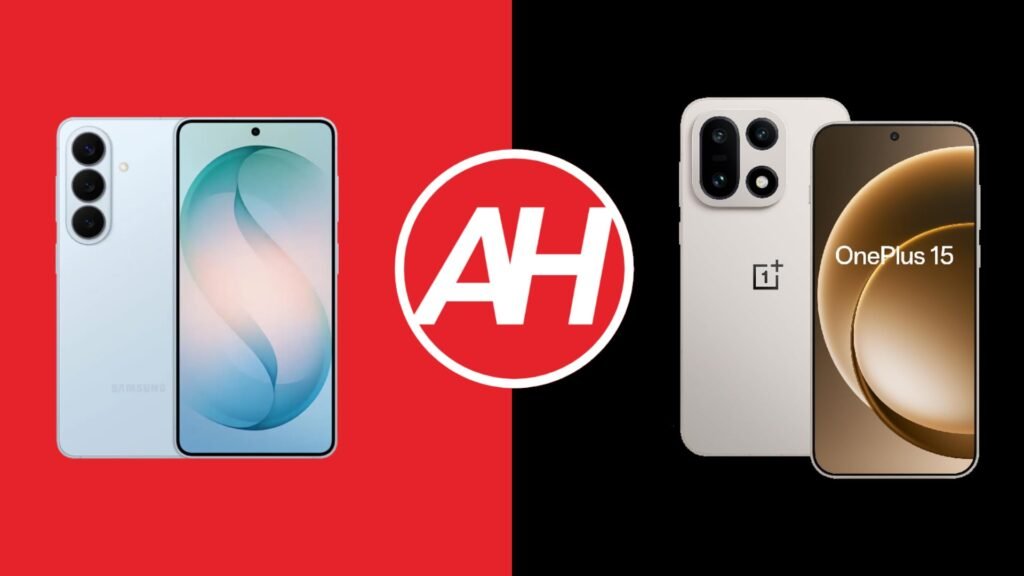

This time around, we’ll be comparing a high-end compact phone vs a larger format flagship. Samsung announced three phones at the end of February, and the Galaxy S26 is the smallest and cheapest of them, despite being a high-end offering. Well, in this article, we’ll compare it with the best from OnePlus. In other words, this will be a Samsung Galaxy S26 vs OnePlus 15 comparison.
These two phones are quite different. Sure, there are some similarities, but for the most part, they are different. As we usually do, we will first list the specs of both smartphones, and then we’ll move to comparing their designs, displays, performance, battery life, cameras, and audio output. Let’s get to it, shall we?
Specs

Samsung Galaxy S26

OnePlus 15
| Samsung Galaxy S26 | OnePlus 15 | |
|---|---|---|
| Dimensions | 149.6 x 71.7 x 7.2 mm | 161.42 x 76.67 x 8.10-8.20mm |
| Weight | 167 grams | 211/215 grams |
| Display | 6.3-inch Dynamic LTPO AMOLED 2X | 6.78 AMOLED |
| Refresh rate | 1-120Hz | 1-120Hz (adaptive), up to 165Hz for gaming |
| Resolution | 2340 x 1080 | 2772 x 1272 |
| Chipset | Qualcomm Snapdragon 8 Elite Gen 5 for Galaxy / Samsung Exynos 2600 | Qualcomm Snapdragon 8 Elite Gen 5 |
| RAM | 12GB (LPDDR5X) | 12GB/16GB (LPDDR5X) |
| Storage | 256GB/512GB (UFS 4.0) | 256GB/512GB (UFS 4.1), non-expandable |
| Main camera | 50MP (wide, f/1.8 aperture, 1/1.56-inch sensor size, 1.0um pixel size, dual pixel PDAF, OIS) | 50MP (f/1.8 aperture, 1/1.56-inch sensor size, OIS, 84-degree FoV) |
| Ultra-wide camera | 12MP (f/2.2 aperture, 1/2.55-inch sensor size, 120-degree FoV, 1.4um pixel size) | 50MP (OV50D sensor, 1/2.88-inch sensor size, f/2.0 aperture, 116-degree FoV, 6P lens) |
| Telephoto camera | 10MP (f/2.4 aperture, 1/3.94-inch sensor size, 1.0um pixel size, PDAF, OIS, 3x optical zoom) | N/A |
| Periscope telephoto camera | N/A | 50MP (S5KJN5 sensor, 1/2.76-inch sensor size, 3.5x optical zoom, 4P lens, OIS, f/2.8 aperture, 30-degree FoV) |
| Selfie camera | 12MP (f/2.2 aperture, 1/3.2-inch sensor size, 1.12um pixel size) | 32MP (Sony IMX709 sensor, 1/2.74-inch sensor size, f/2.4 aperture, 5P lens) |
| Battery size | 4,300mAh | 7,300mAh |
| Charging | 25W wired, 15W wireless (Qi2 Ready), 4.5W reverse wireless (charger not included) | 120W wired, 50W wireless, 5W reverse wired |
| Colors | Cobalt Violet, Sky Blue, Black, White, Silver Shadow, Pink Gold | Infinite Black, Ultra Violet, Sand Storm |
Samsung Galaxy S26 vs OnePlus 15: Design
Even when they’re placed side by side from the front, these two phones are easy to tell apart. The Galaxy S26 is considerably smaller and has less of a curve on its corners. Both phones do include flat displays, though, and a centered display camera hole up top. Their bezels are both thin and uniform. The frame on both smartphones is flat all around, though it does curve a bit towards the edges, for comfort’s sake.
The Galaxy S26 has a standard set of physical buttons. The power/lock and volume up and down buttons sit on the right-hand side. The OnePlus 15 has all those, yes, but also an action key on the left side. The OnePlus 15 is considerably taller, wider, and a bit thicker, which is not surprising considering it has a much larger display. It is also over 40 grams heavier than the Galaxy S26.
Both of these phones are made out of aluminum and glass. Their backplates are flat, but their camera setups look different. The Galaxy S26 has three vertically-aligned cameras in the top-left corner, which sit on top of a camera island. The OnePlus 15 has three cameras as well, but they’re split in two rows and sit on top of a camera island in the top-left corner. That camera island is squarish in terms of design.
The Galaxy S26 comes with an IP68 certification for water and dust resistance. The OnePlus 15 is better in that regard, as it offers IP66, IP68, IP69, and IP69K certifications. Both phones are quite slippery in the hand.
Samsung Galaxy S26 vs OnePlus 15: Display
The Samsung Galaxy S26 includes a 6.3-inch Dynamic LTPO AMOLED 2X display. That panel is flat, and it has an adaptive refresh rate of up to 120Hz. HDR10+ content is supported, while the phone’s display goes up to 2,600 nits in terms of brightness. The screen-to-body ratio is at around 90%. The resolution here is 2340 x 1080, while the display aspect ratio is 19.5:9. Corning’s Gorilla Glass Victus 2 protects this display.

The OnePlus 15, on the flip side, has a 6.78-inch LTPO AMOLED display. That panel is flat, and it supports up to 1 billion colors. It has an adaptive refresh rate of up to 165Hz. High-frequency PWM dimming is also included, as is Dolby Vision, HDR10+, and HDR Vivid support. The display gets very bright, and the screen-to-body ratio here is at around 91%. The resolution the phone offers is 2772 x 1272, while the display aspect ratio is 19.5:9. Corning’s Gorilla Glass Victus 2 protects this panel.
Now, both of these displays are quite good. They’re vivid, have great viewing angles, and they’re also sharp. The OnePlus 15’s panel is sharper, but considering the size of the Galaxy S26’s display, you won’t really notice a difference. If you have sensitive eyes, the OnePlus 15’s PWM dimming will certainly help. Overall, the OnePlus 15 does have more to offer in the display department, but most of you will be happy with either one, in all honesty. Choose which size suits you best.
Samsung Galaxy S26 vs OnePlus 15: Performance
The Samsung Galaxy S26 comes in two SoC variants. One variant is fueled by the Snapdragon 8 Elite Gen 5 for Galaxy, an overclocked version of Qualcomm’s most powerful chip. The other variant is fueled by the Exynos 2600. These two chips are 3nm and 2nm chips, respectively. The first chip is available in the US and China, for example, while the latter is used in European models. 12GB of LPDDR5X RAM is included in both variants, along with UFS 4.0 flash storage, which is not expandable.
What about the OnePlus 15? Well, that phone also utilizes the Snapdragon 8 Elite Gen 5 from Qualcomm. That’s the only chip that the phone uses; you’ll get that one worldwide. That chip is backed by either 12GB or 16GB of LPDDR5X RAM, while OnePlus also opted for UFS 4.1 flash storage. The phone does not offer storage expansion, though.
Both the Galaxy S26 and the OnePlus 15 are immensely powerful smartphones. Do note that we did not use the Exynos version of the Galaxy S26, though. Both of these phones are very snappy during day-to-day use, and lag is basically not present. When it comes to gaming, both phones do a good job. The OnePlus 15 does have more gaming features, though, and it has a display that caters more to gaming.
Samsung Galaxy S26 vs OnePlus 15: Battery
There is a 4,300mAh battery included inside the Samsung Galaxy S26. The OnePlus 15, on the flip side, includes a 7,300mAh battery on the inside. OnePlus went with a silicon-carbon battery, while Samsung is still using regular Li-Ion batteries. This is a huge difference in battery capacity, even having the display sizes in mind. The battery capacity inside the Galaxy S26 is actually very modest by today’s standards.
While the Galaxy S26 offers solid battery life, much better than we’d hope, it simply cannot measure up to the OnePlus 15. These two phones are in completely different tiers when it comes to battery longevity. In our experience, the OnePlus 15 offers 2-3 hours more of screen-on time, at least. Your mileage may vary, though, of course, but the bottom line is, it has much better battery life.
OnePlus’ phone also supports faster charging. It supports 120W wired, 50W wireless, 10W reverse wireless, and 5W reverse wired charging, on top of offering bypass charging. The Galaxy S26, on the other hand, supports 25W wired, 15W wireless (Qi2 Ready), and 4.5W reverse wireless charging. The OnePlus 15 can be fully charged in around 40 minutes with the official charger. It takes the Galaxy S26 around an hour and 5 minutes to get there. Do note that neither phone includes a charger in the box, though.
Samsung Galaxy S26 vs OnePlus 15: Cameras
There are three cameras included on the back of the Galaxy S26. A 50-megapixel main camera (1/1.56-inch sensor size) is backed by a 12-megapixel ultrawide snapper (1/2.55-inch sensor size, 120-degree FoV). The third camera on the back of Samsung’s handset is a 10-megapixel telephoto unit (1/3.94-inch sensor size, 3x optical zoom).

The OnePlus 15, on the other hand, has three cameras as well, but different ones. A 50-megapixel main camera (1/1.56-inch sensor size) is backed by a 50-megapixel ultrawide snapper (1/2.88-inch sensor size, 116-degree FoV). The third camera on the back of the phone is a 50-megapixel periscope telephoto unit (1/2.76-inch sensor size, 3.5x optical zoom).
While both phones do a good job when it comes to photography, we did prefer the results from the OnePlus 15 more often than not. The color tuning is a bit better in our opinion, and the camera was more consistent. Also, low-light performance seems to be better, especially for the periscope telephoto camera. The Galaxy S26 is not far behind, but Samsung really needs to improve the camera hardware; it has been using the same components since the Galaxy S22.
Audio
You will find stereo speakers on both of these smartphones. The ones inside the OnePlus 15 are louder, though, noticeably louder. The loudness from the Galaxy S26 is good, too, though. Both phones also provide good audio output.
There is no audio jack on either of these two smartphones. You can utilize their Type-C ports if you’d like to connect your wired headphones. Alternatively, the Galaxy S26 supports Bluetooth 5.4, while the OnePlus 15 supports Bluetooth 6.0.
The post Phone Comparisons: Samsung Galaxy S26 vs OnePlus 15 appeared first on Android Headlines.