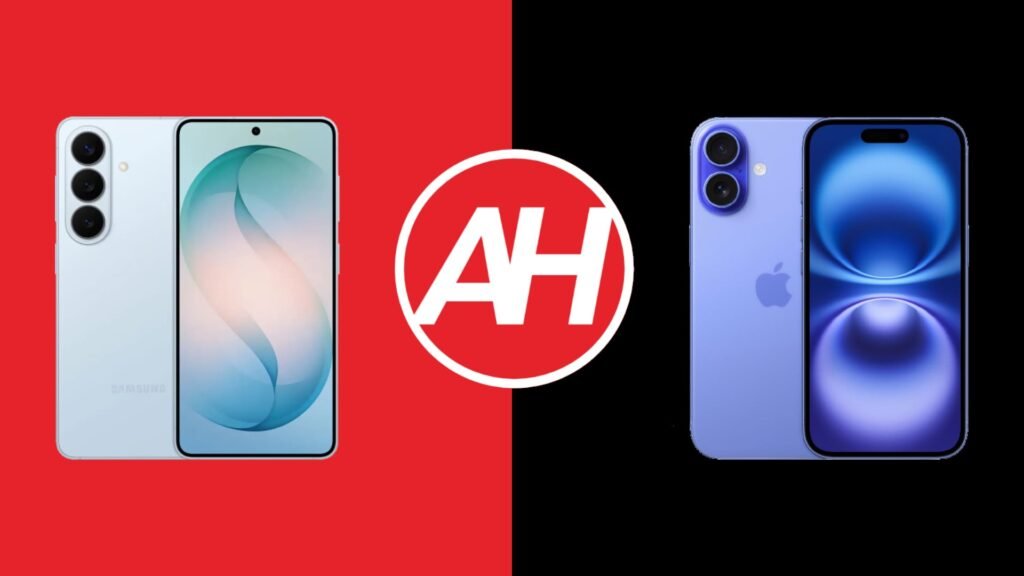

We’ve already compared the Samsung Galaxy S26 with the latest base iPhone offering, the iPhone 17. It’s time to do the same for its predecessor. In this article, we’ll be comparing the Samsung Galaxy S26 vs Apple iPhone 16. Both of these are compact devices, and both are quite compelling, but considerably different at the same time. There are some similarities here, though.
As we usually do when it comes to comparisons, we’ll first list the specs of both smartphones. Following that, we’ll compare their designs, displays, performance, battery life, cameras, and audio output. There are some similarities on the design front, but generally speaking, they’re mostly considerably different devices. Let’s get to it.
Specs

Samsung Galaxy S26

Apple iPhone 16
| Samsung Galaxy S26 | Apple iPhone 16 | |
|---|---|---|
| Dimensions | 149.6 x 71.7 x 7.2 mm | 147.6 x 71.6 x 7.8 mm |
| Weight | 167 grams | 170 grams |
| Display | 6.3-inch Dynamic LTPO AMOLED 2X | 6.1-inch Super Retina XDR OLED |
| Refresh rate | 1-120Hz | 60Hz |
| Resolution | 2340 x 1080 | 2556 x 1179 |
| Chipset | Qualcomm Snapdragon 8 Elite Gen 5 for Galaxy / Samsung Exynos 2600 | Apple A18 |
| RAM | 12GB (LPDDR5X) | 8GB |
| Storage | 256GB/512GB (UFS 4.0) | 128GB/256GB/512GB |
| Main camera | 50MP (wide, f/1.8 aperture, 1/1.56-inch sensor size, 1.0um pixel size, dual pixel PDAF, OIS) | 48MP (f/1.6 aperture, 1/1.56-inch sensor size, 1.0um pixel size, sensor-shift OIS, PDAF) |
| Ultra-wide camera | 12MP (f/2.2 aperture, 1/2.55-inch sensor size, 120-degree FoV, 1.4um pixel size) | 12MP (f/2.2 aperture, 120-degree FoV, 0.7um pixel size, dual pixel PDAF) |
| Telephoto camera | 10MP (f/2.4 aperture, 1/3.94-inch sensor size, 1.0um pixel size, PDAF, OIS, 3x optical zoom) | N/A |
| Periscope telephoto camera | N/A | N/A |
| Selfie camera | 12MP (f/2.2 aperture, 1/3.2-inch sensor size, 1.12um pixel size) | 12MP (f/1.9 aperture, 1/3.6-inch sensor size, 1.0um pixel size, PDAF) |
| Battery size | 4,300mAh | 3,561mAh |
| Charging | 25W wired, 15W wireless (Qi2 Ready), 4.5W reverse wireless (charger not included) | 30W wired, 25W MagSafe wireless, 15W Qi2 wireless, 4.5W reverse wired (charger not included) |
| Colors | Cobalt Violet, Sky Blue, Black, White, Silver Shadow, Pink Gold | Black, White, Pink, Teal, Ultramarine |
Samsung Galaxy S26 vs Apple iPhone 16: Design
While there are several design similarities between them, they’re mostly different. Both smartphones do have a flat display, a flat backplate, and a flat frame. That’s basically it as far as similarities are concerned. The Galaxy S26 has a display camera hole up top, while the iPhone 16 has a much larger pill-shaped cutout, the so-called Dynamic Island. Both devices do have uniform bezels, and those bezels are also quite thin.
Both frames are flat, but they do curve a bit towards the edges, for comfort’s sake. The Galaxy S26 has a power/lock button placed below the volume up and down buttons on the right side. Those are all of its physical buttons. The iPhone 16 has a power/lock key on the right side, along with a Camera Control key. On the left, it has volume rocker buttons and an Action Key as well.
They both also have rounded corners, but the ones on the iPhone 16 have more of a curve. Both phones have vertically-aligned cameras in the top-left corner of their backplates, but the iPhone 16 has one less camera in comparison. Both sets sit on top of a camera island. The devices are made out of aluminum and glass, and they have similar weights. The Galaxy S26 is slightly taller and thinner, while they’re basically the same in terms of width. The Galaxy S26 does have a larger display, though. Both phones are IP68 certified and quite slippery.
Samsung Galaxy S26 vs Apple iPhone 16: Display
The Samsung Galaxy S26 features a 6.3-inch Dynamic LTPO AMOLED 2X display. It has an adaptive refresh rate (1-120Hz). That panel is flat, and it supports HDR10+ content. The peak brightness is 2,600 nits. This panel has a resolution of 2340 x 1080 pixels, and it has a screen-to-body ratio of around 90%. The display aspect ratio is 19.5:9, while the Gorilla Glass Victus 2 from Corning protects this display.

The Apple iPhone 16, on the other hand, has a 6.1-inch Super Retina XDR OLED display, which is flat. That panel supports HDR10 content and Dolby Vision as well. The peak brightness is 2,000 nits, while the screen-to-body ratio is around 87%. The resolution here is 2556 x 1179 pixels, and the display aspect ratio is 19.5:9. This panel is protected by the Ceramic Shield Glass (2024 gen). The refresh rate here is limited to 60Hz.
Both of these panels are quite good. They’re vibrant, have good viewing angles, and they’re sharp. The iPhone 16’s display is sharper, but that’s not something most people will notice. The Galaxy S26’s display has the advantage of a high refresh rate, and that is very much noticeable, especially if you’ve used phones with a 120Hz refresh rate. Both displays do get bright enough when you need them, but they’re not the brightest around, not even close.
Samsung Galaxy S26 vs Apple iPhone 16: Performance
The Samsung Galaxy S26 comes in two SoC versions. In some regions, like Europe, it’s fueled by the Exynos 2600 processor. In other regions, like the US and China, it’s fueled by the Snapdragon 8 Elite Gen 5 for Galaxy chip. These two are 2nm and 3nm chips, respectively. Around 25% of Galaxy S26 series units in general use the Exynos chip. Samsung also included 12GB of LPDDR5X RAM here, and UFS 4.0 flash storage, which is not expandable.
The Apple iPhone 16, on the flip side, is fueled by the Apple A18 processor. That is Apple’s 3nm chip, and it’s combined with 8GB of RAM inside this phone. Apple also offers NVMe flash storage here, and no, that storage is not expandable either. That chip comes with a 5-core graphics chip.
Apple’s device is the older phone here. It has been around a year and a half since it arrived, but it still offers really good performance, to say the least. Both phones are very snappy and responsive, so there’s no problem in day-to-day use, not at all. They both can handle basically any game you throw at them with ease. Yes, they do get quite warm if you’re playing demanding games, but we haven’t encountered overheating issues with either of them.
Samsung Galaxy S26 vs Apple iPhone 16: Battery
The Samsung Galaxy S26 features a 4,300mAh battery on the inside, while the iPhone 16 comes with a 3,561mAh unit. Both phones utilize a Li-Ion battery, as neither company has adopted silicon-carbon tech yet. Apple’s iPhones usually have smaller battery packs, so that doesn’t really need to mean much here. In fact, it doesn’t, as the iPhone 16 has proven to offer better battery life in our experience, but only barely.
Both smartphones do a good job in the battery longevity department. Even power users may find them good enough to use, though they’re not amongst the best battery life phones out there. For regular users, you’ll be able to get through a day of use on a single charge without a problem. Let’s just hope it’ll stay that way, as Samsung managed to mess things up with the Galaxy S25 series via updates.
When it comes to charging, the Galaxy S26 supports 25W wired, 15W wireless (Qi2 Ready), and 4.5W reverse wireless charging. The iPhone 16, on the other hand, supports 30W wired, 25W wireless (MagSafe), and 4.5W reverse wired charging. The Galaxy S26 does charge faster, though, as it can be fully charged in around an hour and 5 minutes. It will take the iPhone 16 over an hour and 40 minutes with a compatible charger. Neither phone comes with a charger, by the way.
Samsung Galaxy S26 vs Apple iPhone 16: Cameras
There are three cameras included on the back of the Galaxy S26. It has a 50-megapixel main camera (1/1.56-inch sensor size), a 12-megapixel ultrawide unit (1/2.55-inch sensor size, 120-degree FoV), and a 10-megapixel telephoto camera (1/3.94-inch sensor size, 3x optical zoom).

The Apple iPhone 16 has one less camera in comparison, as Apple opted for two rear cameras. The main snapper on the phone is a 48-megapixel unit with a 1/1.56-inch sensor size. There is also a 12-megapixel ultrawide camera included on the back of the phone, with a 120-degree FoV.
Both phones do a good job when it comes to taking photos with the main and ultrawide cameras. Their approaches to color processing are different, but they’re both good. We did prefer images from the iPhone 16 more often than not, but it all depends on the scene. The same goes for the ultrawide camera, actually. The Galaxy S26 has a dedicated telephoto snapper, and even though it’s not exactly good, it’s better than nothing. We’re expecting a massive improvement next year, as Samsung has been sticking to the same camera hardware since the Galaxy S22.
Audio
You will find stereo speakers on both of these smartphones. The ones on the iPhone 16 are a bit louder in comparison, though, while the sound output quality is good from both phones, there’s not much to complain about.
There is no audio jack on either of these two smartphones. You have Type-C ports at the bottom of each of them, and you can use them to connect your wired headphones. The Galaxy S26 supports Bluetooth 5.4, while the iPhone 16 supports Bluetooth 5.3.
The post Phone Comparisons: Samsung Galaxy S26 vs Apple iPhone 16 appeared first on Android Headlines.