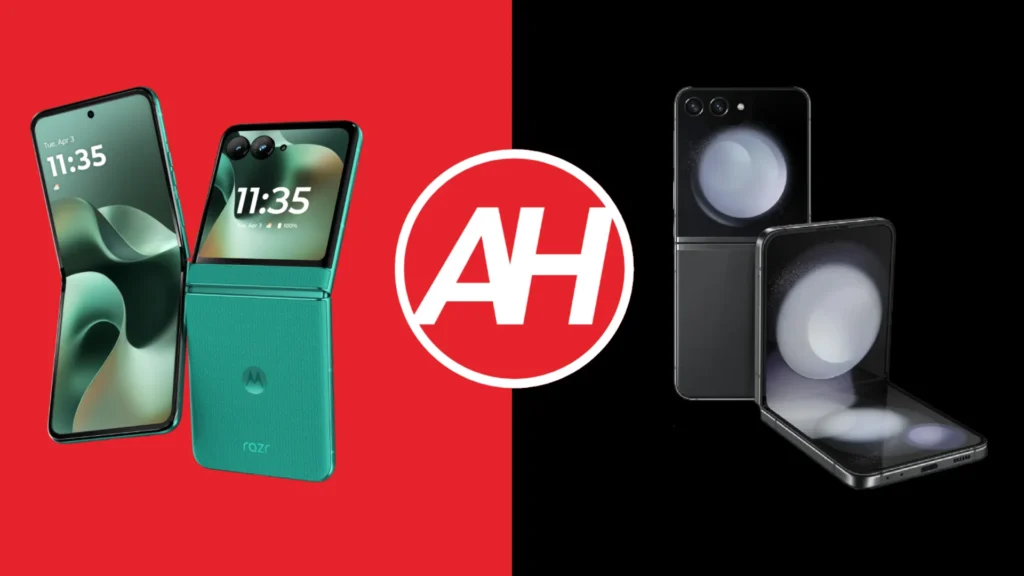

This time around, we’re comparing two flip phone foldables. We’ll compare the newest base model from Motorola with the latest flip foldable from Samsung. In other words, this is a Motorola Razr 2026 vs Samsung Galaxy Z Flip 7 comparison. The Motorola Razr 2026 was announced at the very end of last month, while the Galaxy Z Flip 7 arrived back in July last year.
The Galaxy Z Flip 7 is technically a more powerful device, and also a pricier one. The Motorola Razr Ultra 2026 is the phone that competes directly with it, and we’ve already compared the two phones. With that being said, we’ll first list the specs of these two devices, and then we’ll compare them across a number of categories. That includes design, display, performance, battery, cameras, and audio categories.
Specs

Motorola Razr 2026

Samsung Galaxy Z Flip 7
| Motorola Razr 2026 | Samsung Galaxy Z Flip 7 | |
|---|---|---|
| Dimensions (unfolded/folded) | 171.3 x 74 x 7.3 mm / 88.1 x 74 x 15.9 mm | 166.7 x 75.2 x 6.5 mm / 85.5 x 75.2 x 13.7 mm |
| Weight | 188 grams | 188 grams |
| Main display | 6.9-inch Extreme AMOLED (120Hz) | 6.9-inch Foldable Dynamic LTPO AMOLED 2X (120Hz) |
| Cover display | 3.6-inch Extreme AMOLED (90Hz) | 4.1-inch Super AMOLED (120Hz) |
| Resolution | 2640 x 1080 / 1066 x 1056 | 2520 x 1080 / 1048 x 948 |
| Chipset | MediaTek Dimensity 7400X | Samsung Exynos 2500 |
| RAM | 8GB (LPDDR5X) | 12GB (LPDDR5X) |
| Storage | 128GB/256GB | 256GB/512GB (UFS 4.0) |
| Main camera | 50MP (f/1.7 aperture, 1/1.95-inch sensor size, 0.8um pixel size, OIS) | 50MP (f/1.8 aperture, 1/1.57-inch sensor size, dual pixel PDAF, OIS) |
| Ultra-wide camera | 50MP (f/2.0 aperture, 1/2.76-inch sensor size, 122-degree FoV, 1.28um pixel size) | 12MP (f/2.2 aperture, 1/3.2-inch sensor size, 123-degree FoV) |
| (Periscope) telephoto camera | N/A | N/A |
| Selfie camera | 32MP (f/2.4 aperture, 1/3.14-inch sensor size, 0.7um pixel size) | 10MP (f/2.2 aperture, 1/3.0-inch sensor size, 1.22um pixel size) |
| Battery size | 4,800mAh | 4,300mAh |
| Charging | 30W wired, 15W wireless (charger not included) | 25W wired, 15W wireless, 4.5W reverse wireless (charger not included) |
| Colors | PANTONE Hematite, PANTONE Sporting Green, PANTONE Violet Ice, PANTONE Bright White | Blue Shadow, Jet Black, Coral Red |
Motorola Razr 2026 vs Samsung Galaxy Z Flip 7: Design
As you can see, these two phones do have a similar design language. There are some differences, but for the most part, they’re very similar. Both smartphones have a foldable display with a centered display camera hole up top. The corners are rounded, while the bezels are rather thin on both phones, but thinner on the Galaxy Z Flip 7. Both phones have physical buttons on the right side: the power/lock and volume up and down buttons. That power/lock key doubles as a fingerprint scanner.
The Motorola Razr 2026 has a slightly rounded frame; it’s not exactly flat. The Galaxy Z Flip 7, on the other hand, has a flat frame, which rounds up towards the edges. The in-hand feel is a bit different. Now, we can see more differences when we flip them around. The Galaxy Z Flip 7 comes in a single backplate variant: glass. The Motorola Razr 2026 is available in several different options, depending on your preference.
If you take a look at their cover displays, you’ll notice that the Motorola Razr 2026’s is smaller, and that it does not go all the way down to where the hinge sits. Both phones have cameras inside the cover displays, and they sit in the same spot. They’re horizontally aligned in the top-left corner. Both phones are IP48 certified, and they have the same weight at 188 grams. The Galaxy Z Flip 7 is shorter, wider, and thinner in comparison. The Motorola Razr 2026 also includes a MIL-STD-810H certification, so it’s technically a bit tougher than the Galaxy Z Flip 7.
Motorola Razr 2026 vs Samsung Galaxy Z Flip 7: Display
The Motorola Razr 2026 comes with a 6.9-inch Foldable LTPO AMOLED display. That panel is flat, and it supports up to 1 billion colors. Its refresh rate goes from 1Hz to 120Hz, while Dolby Vision and HDR10+ content are supported. The peak brightness here is 3,000 nits. The screen-to-body ratio is at around 855, while the resolution is 2640 x 1080 pixels. The cover display measures 3.6 inches, and it’s an AMOLED panel. It can project up to 1 billion colors and offers a 90Hz refresh rate. HDR10+ is supported, and the peak brightness is 1,700 nits. The resolution is 1066 x 1056 pixels, and the Gorilla Glass Victus protects this panel.

The Samsung Galaxy Z Flip 7, on the other hand, has a 6.9-inch Foldable Dynamic LTPO AMOLED 2X display. That panel also has an adaptive refresh rate from 1 to 120Hz. HDR10+ content is supported, while the peak brightness is 2,600 nits. The screen-to-body ratio is at around 89%, while the display aspect ratio is 21:9. The cover display measures 4.1 inches, and it’s a Super AMOLED panel. The refresh rate is 120Hz, while the peak brightness is 2,600 nits. The resolution here is 1048 x 948, and the screen is protected by the Gorilla Glass Victus 2.
All of these displays are quite good. They’re vivid, have good viewing angles, and do get bright enough. The Galaxy Z Flip 7’s cover display has the advantage of being brighter than the one on the Motorola Razr 2026, though, noticeably brighter. On top of that, it does have a higher refresh rate, which is in line with the main display. Not all of you will notice it, but we sure did.
Motorola Razr 2026 vs Samsung Galaxy Z Flip 7: Performance
The Motorola Razr 2026 is fueled by the MediaTek Dimensity 7450X processor. That is a 4nm chip from MediaTek, and it’s paired with 8GB of RAM and UFS 3.1 flash storage. The phone comes in 128GB and 256GB storage options. Do note that the storage on the Razr 2026 is not expandable.
The Samsung Galaxy Z Flip 7, on the other hand, is fueled by the Samsung Exynos 2500 processor. That is a 3nm processor, and it is paired with 12GB of LPDDR5X RAM in the case of this phone. You can choose between 256GB and 512GB of UFS 4.0 flash storage here. The storage is not expandable on this phone either.
Now, in terms of performance, the Motorola Razr 2026 does a good job, but the Galaxy Z Flip 7 does beat it, easily. The Exynos 2600 is simply a better processor, not to mention that the Galaxy Z Flip 7 does have faster memory on board. You can see a difference in a side-by-side comparison; the Galaxy Z Flip 7 is snappier. The Galaxy Z Flip 7 is also the better option for gaming, even though the Razr 2026 should be able to do a solid job. Neither is made for gaming, though.
Motorola Razr 2026 vs Samsung Galaxy Z Flip 7: Battery
Motorola’s handset comes with a 4,800mAh battery. The Galaxy Z Flip 7, on the other hand, has a 4,300mAh battery on the inside. We didn’t really get to test the Motorola Razr 2026 yet, fully, so we don’t know if that larger battery translates to better battery life. If the ‘Ultra’ model is any indication, however, it definitely should. That’s quite an advantage, and Motorola usually does a good job with optimization.
The Galaxy Z Flip 7’s battery life is alright, nothing to write home about. It will also depend on how much you use that large 6.9-inch internal display. If you use the cover display a lot, you should be fine. If you rely a lot on the main display, well, the battery life could be an issue for you. That’s a large display, and this battery pack isn’t exactly beefy for today’s standards. With our mixed use, the Galaxy Z Flip 7 was almost always able to keep up.
What about charging? Well, the Motorola Razr 2026 supports 30W wired and 15W wireless charging. The Galaxy Z Flip 7, on the other hand, supports 25W wired, 15W wireless, and 4.5W reverse wireless charging. The charging speed should be similar, but we haven’t tested the Motorola Razr 2026 just yet. The Galaxy Z Flip 7 can be fully charged in an hour and a half with a compatible charger, however. Neither phone ships with a charger in the box.
Motorola Razr 2026 vs Samsung Galaxy Z Flip 7: Cameras
The Motorola Razr 2026 has two cameras on the back. It is equipped with two 50-megapixel cameras. The main camera has an f/1.7 aperture and a 1/1.95-inch sensor size. The pixel size is 0.8µm, while OIS is supported. The other 50-megapixel camera is an ultrawide one, and it offers an f/2.0 aperture. The sensor size is 1/2.76 inches, while the pixel size is 0.64µm. This camera has a 122-degree FoV.

The Samsung Galaxy Z Flip 7 also has two cameras on the back. The main camera is a 50-megapixel unit with an f/1.8 aperture and a 1/1.57-inch sensor size. It also supports dual pixel PDAF and OIS. The other camera is a 12-megapixel ultrawide unit with an f/2.2 aperture and a 1/3.2-inch sensor size. It has a 123-degree FoV and 1.12µm pixel size.
When it comes to camera performance, the Motorola Razr 2026 does have a smaller main sensor, but it does a really good job performance-wise. We didn’t use it for long, but the first impressions were not bad at all. The Galaxy Z Flip 7 does do a better job more often than not, though. Things are a bit different with the ultrawide camera, at least based on our limited use of the Razr 2026. That is not exactly surprising considering the camera hardware, and Motorola is now a lot better when it comes to optimizing camera performance.
Audio
Both of these smartphones have stereo speakers. The ones on the Galaxy Z Flip 7 are fine, but nothing more than that. They trail behind regular flagship smartphones. We’re not sure about the Motorola Razr 2026 yet, but they sounded fine at first.
When it comes to the audio jack, neither of these two phones has one. You can connect your wired headphones to their Type-C ports, if you’d like, however. Both smartphones also support Bluetooth 5.4 for wireless audio connectivity.
The post Phone Comparisons: Motorola Razr 2026 vs Samsung Galaxy Z Flip 7 appeared first on Android Headlines.