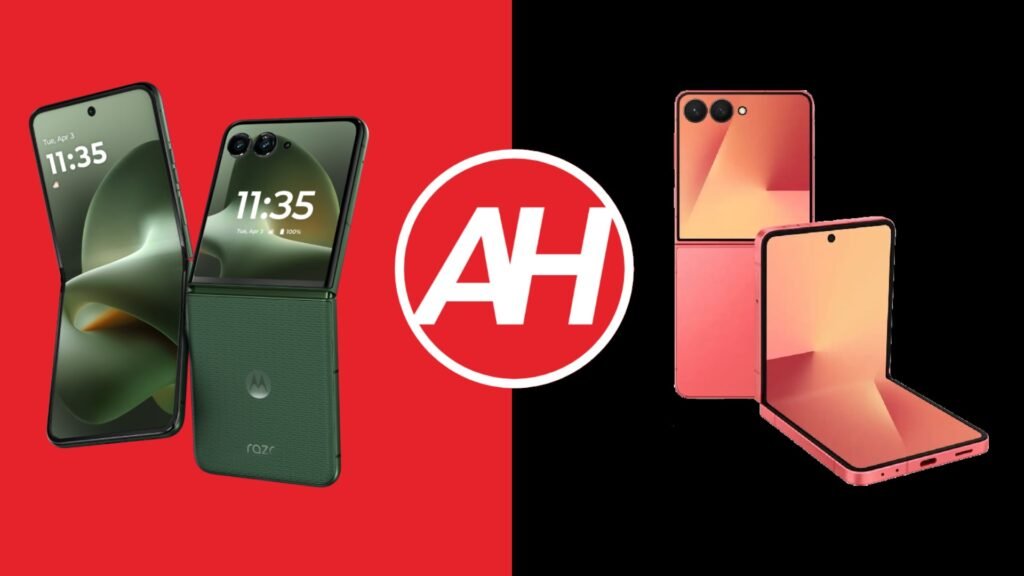

Motorola launched three very compelling flip foldable phones a couple of months ago. In this article, we’ll compare one of them with the best flip foldable from Samsung. We’re comparing the Motorola Razr+ 2026 vs Samsung Galaxy Z Flip 7. These two devices actually look quite similar, but they do feel different in the hand due to material choices. They also differ in a number of other ways.
We will first list the specs of both smartphones. Following that, we’ll compare the two devices over a number of different categories. We’ll be comparing their designs, displays, performance, battery life, cameras, and audio output. There’s plenty to go over, so… let’s get to it, shall we?
Specs

Motorola Razr+ 2026

Samsung Galaxy Z Flip 7
| Motorola Razr+ 2026 | Samsung Galaxy Z Flip 7 | |
|---|---|---|
| Dimensions (unfolded/folded) | 171.4 x 74 x 7.1 mm / 88.1 x 74 x 15.3 mm | 166.7 x 75.2 x 6.5 mm / 85.5 x 75.2 x 13.7 mm |
| Weight | 189 grams | 188 grams |
| Main display | 6.9-inch LTPO AMOLED (165Hz) | 6.9-inch Foldable Dynamic LTPO AMOLED 2X (120Hz) |
| Cover display | 4-inch AMOLED (165Hz) | 4.1-inch Super AMOLED (120Hz) |
| Resolution | 2640 x 1080 / 1272 x 1080 | 2520 x 1080 / 1048 x 948 |
| Chipset | Qualcomm Snapdragon 8s Gen 3 | Samsung Exynos 2500 |
| RAM | 12GB | 12GB (LPDDR5X) |
| Storage | 256GB (UFS 4.0) | 256GB/512GB (UFS 4.0) |
| Main camera | 50MP (f/1.8 aperture, 1/1.95-inch sensor size, OIS, PDAF) | 50MP (f/1.8 aperture, 1/1.57-inch sensor size, dual pixel PDAF, OIS) |
| Ultra-wide camera | 50MP (f/2.0 aperture, 1/2.76-inch sensor size, 122-degree FoV) | 12MP (f/2.2 aperture, 1/3.2-inch sensor size, 123-degree FoV) |
| (Periscope) telephoto camera | N/A | N/A |
| Selfie camera | 32MP (f/2.4 aperture) | 10MP (f/2.2 aperture, 1/3.0-inch sensor size, 1.22um pixel size) |
| Battery size | 4,500mAh | 4,300mAh |
| Charging | 45W wired, 15W wireless, 5W reverse wired (charger not included) | 25W wired, 15W wireless, 4.5W reverse wireless (charger not included) |
| Colors | Pantone Mountain View | Blue Shadow, Jet Black, Coral Red |
Motorola Razr+ 2026 vs Samsung Galaxy Z Flip 7: Design
When you’re looking at them side-by-side, you’ll notice a lot of similarities. They have the same shape and even camera positioning. You’ll notice that a centered display camera hole sits up top on the main display. The corners are rounded on both phones, while the power/lock and volume up and down buttons sit on the right-hand side. Those are the only buttons on both devices, by the way.
Both frames are made out of aluminum, but they’re not the same. The one on the Motorola Razr+ 2026 is slightly rounded, while the Galaxy Z Flip 7’s is flat. That, in addition to a different backplate material, makes for a different in-hand feel. The Motorola Razr+ 2026 has vegan leather on the back, while the Galaxy Z Flip 7 includes glass. Motorola’s phone is way more grippy because of it.
When it comes to the cover display on the back. They’re almost the same size. The Galaxy Z Flip 7 is slightly larger, but they both cover half of the phone’s back side when unfolded. Two rear cameras sit on both phones, and in the same spot. They’re placed in the top-left corner and are vertically aligned. The Motorola Razr+ 2026 is a bit taller, narrower, and thicker in comparison. They weigh the same, basically, as the difference is only 1 gram.
Motorola Razr+ 2026 vs Samsung Galaxy Z Flip 7: Display
The Motorola Razr+ 2026 features a 6.9-inch Foldable LTPO AMOLED main display. It supports Dolby Vision and HDR10+ content, while the peak brightness here is 3,000 nits. This display offers support for a refresh rate of up to 165Hz, and it has a screen-to-body ratio of around 85%. The resolution here is 2640 x 1080. The second display is a 4-inch LTPS AMOLED panel. It supports up to 1 billion colors and has a peak brightness of 2,400 nits. A 165Hz refresh rate is supported here too, and the display is protected by Gorilla Glass Victus. The resolution here is 1272 x 1080.

The Samsung Galaxy Z Flip 7, on the other hand, has a 6.9-inch Foldable Dynamic LTPO AMOLED 2X display. That panel has a refresh rate of up to 120Hz and supports HDR10+ content. The peak brightness here is 2,600 nits. The screen-to-body ratio is around 89%. The resolution this display offers is 2520 x 1080, and the aspect ratio is 21:9. The second panel measures 4.1 inches, and it’s a Super AMOLED display. It supports a refresh rate of 120Hz and a peak brightness of 2,600 nits. The resolution here is 1048 x 948 pixels. The Gorilla Glass Victus 2 protects this panel.
All four of these panels are quite good. They’re all vivid and more than sharp enough. They have good viewing angles as well. Yes, the Motorola Razr+ 2026 technically has a higher refresh rate, but it’s not on at all times, and chances are that most of you won’t even notice the difference between the two. IN all honesty, you’ll be good to go with either of these phones when it comes to displays; they’re all quite good.
Motorola Razr+ 2026 vs Samsung Galaxy Z Flip 7: Performance
The Motorola Razr+ 2026 is fueled by the Snapdragon 8s Gen 3 processor. That is Qualcomm’s 4nm processor. That chip is paired with 12GB of LPDDR5X RAM inside this phone, while Motorola also opted to use UFS 4.0 flash storage here. Do note that the storage is not expandable, while 256GB is included. There’s only one model.
The Samsung Galaxy Z Flip 7, on the flip side, is fueled by the Exynos 2500 processor. That is Samsung’s 3nm chip, and it’s paired with LPDDR5X RAM here: 12GB of RAM. Samsung is offering two storage models, 256GB and 512GB units, both of which use UFS 4.0 flash storage. Do note that the storage is not expandable here either.
Both of these phones are quite snappy in day-to-day use. You won’t notice any lag or anything like that. Multitasking can be done with ease, along with everything else, basically. Even gaming is not a problem for either of these two phones, though there are phones out there that are much better suited for that purpose. Still, you can game here if you want; it’s not a problem. Just note that the most demanding games may not work at full throttle.
Motorola Razr+ 2026 vs Samsung Galaxy Z Flip 7: Battery
The Motorola Razr+ 2026 includes a 4,500mAh battery, while the Galaxy Z Flip 7 comes with a 4,300mAh unit. This is not a big difference in all honesty, but the Razr+ 2026 does offer better battery life. Neither phone has great battery life, but the Motorola Razr+ 2026 will provide you with up to an hour of extra screen-on time. It’ll all depend on how you use your device, of course, but the Razr+ 2026 has noticeably better battery life.
Now, these are not the flip foldables with the best battery life out there, not at all. Still, it’s going to be enough for most people, especially if you utilize the cover display frequently. If you ignore it altogether, you’ll drain the battery rather quickly. These phones are made to be used as hybrid devices.
Motorola also supports faster charging. The phone supports 45W wired, 15W wireless, and 5W reverse wired charging. The Galaxy Z Flip 7, on the flip side, supports 25W wired, 15W wireless, and 4.5W reverse wireless charging. Motorola’s handset will charge faster, but you’ll need a compatible charger, as one does not ship in the box. That goes for both smartphones, actually.
Motorola Razr+ 2026 vs Samsung Galaxy Z Flip 7: Cameras
The Motorola Razr+ 2026 has two cameras on the back. It’s equipped with a 50-megapixel main camera with an f/1.8 aperture and a 1/1.95-inch sensor size. That camera also supports PDAF and OIS. The second camera is a 50-megapixel ultrawide unit, with an f/2.0 aperture and a 1/2.76-inch sensor size.

The Samsung Galaxy Z Flip 7, on the other hand, has two cameras as well, but different ones. Its main camera is a 50-megapixel unit with an f/1.8 aperture and a 1/1.57-inch sensor size. Dual pixel PDAF and OIS are supported here. A 12-megapixel ultrawide camera is also located on the back, and it has an f/2.2 aperture, a 1/3.2-inch sensor size, and a 123-degree FoV.
Both smartphones do a good job with their main cameras. The Galaxy Z Flip 7 provides more saturated images, but we did prefer the Motorola Razr+ 2026 shots most of the time. Their ultrawide cameras are nothing to write home about, but once again, we did prefer the results from the Motorola Razr+ 2026. You’ll want to stick to the main cameras in low light, though.
Audio
The speakers on these two phones are alright. They both include stereo speakers, and they’re loud enough. The ones on the Motorola Razr+ 2026 are a bit louder in comparison. The sound quality is good from both sets of speakers.
There is no audio jack on either of these two phones. You can utilize their Type-C ports to connect your wired headphones, though. Alternatively, Bluetooth 5.4 is available on both phones for wireless audio connectivity.
The post Phone Comparisons: Motorola Razr+ 2026 vs Samsung Galaxy Z Flip 7 appeared first on Android Headlines.