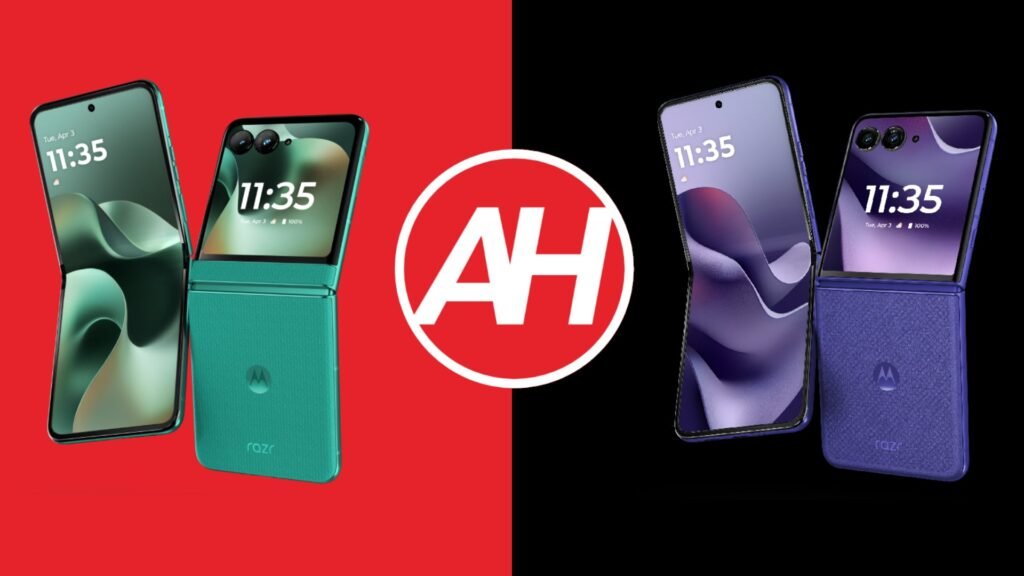

Motorola has announced three new Razr smartphones very recently. In this article, we’ll compare two of them. We’ll be comparing the Motorola Razr 2026 vs Motorola Razr Ultra 2026. In other words, the baseline model is going against the most powerful Razr phone at the moment. These two devices do look similar, but not identical, while there are some differences in the spec department as well.
As we usually do, we will first list the specs for both smartphones. Following that, we will compare their designs, displays, performance, battery life, cameras, and audio output. We did have around an hour of use time with both phones during the Razr event thus far, which took place yesterday. We will review or two coming as well, so that’s where you’ll be able to get more information in the near future. This will be more of a spec comparison.
Specs

Motorola Razr 2026

Motorola Razr Ultra 2026
| Motorola Razr 2026 | Motorola Razr Ultra 2026 | |
|---|---|---|
| Dimensions (unfolded/folded) | 171.3 x 74 x 7.3 mm / 88.1 x 74 x 15.9 mm | 171.48 × 73.99 × 7.19 mm / 88.12 × 73.99 × 15.69 mm |
| Weight | 188 grams | 199 grams |
| Main display | 6.9-inch Extreme AMOLED (120Hz) | 7-inch Extreme AMOLED (165Hz) |
| Cover display | 3.6-inch Extreme AMOLED (90Hz) | 4-inch Extreme AMOLED (165Hz) |
| Resolution | 2640 x 1080 / 1066 x 1056 | 2992 x 1224 / 1272 x 1080 |
| Chipset | MediaTek Dimensity 7400X | Qualcomm Snapdragon 8 Elite |
| RAM | 8GB (LPDDR5X) | 16GB (LPDDR5X) |
| Storage | 128GB/256GB | 512GB |
| Main camera | 50MP (f/1.7 aperture, 1/1.95-inch sensor size, 0.8um pixel size, OIS) | 50MP (LOFIC, f/1.8 aperture, OIS, 2.0um Quad Pixel) |
| Ultra-wide camera | 50MP (f/2.0 aperture, 1/2.76-inch sensor size, 122-degree FoV, 1.28um pixel size) | 50MP (f/2.0 aperture, 122-degree FoV, 1.2um Quad Pixel, macro) |
| (Periscope) telephoto camera | N/A | N/A |
| Selfie camera | 32MP (f/2.4 aperture, 1/3.14-inch sensor size, 0.7um pixel size) | 50MP (f/2.0 aperture, 1.28um Quad Pixel) |
| Battery size | 4,800mAh | 5,000mAh |
| Charging | 30W wired, 15W wireless (charger not included) | 68W wired, 30W wireless, 5W reverse wired (charger not included) |
| Colors | PANTONE Hematite, PANTONE Sporting Green, PANTONE Violet Ice, PANTONE Bright White | PANTONE Orient Blue, PANTONE Cocoa |
Motorola Razr 2026 vs Motorola Razr Ultra 2026: Design
As you can see, the two phones do look very similar. From the front, they’re difficult to tell apart. They both have flat foldable displays, along with a centered display camera hole up top. The ‘Ultra’ model allegedly has thinner bezels, but the difference is very minimal. The corner curvature on the two phones is identical, and both phones have physical buttons on the right-hand side. That’s where the power/lock and volume buttons are placed.
Both smartphones have a slightly rounded frame, so it’s not flat like on a lot of phones these days. The frame is made out of aluminum. Both smartphones are also IP48 certified for water resistance, in case you were wondering. In regards to grip, it all depends on what model you end up buying. They come not only in different colorways, but also in different finishes. The grip factor will depend on the variant you end up getting.
Now, if we flip the two phones around, you’ll see that they have similar backplates as well, but they’re easier to differentiate from this side. Why? Well, the Motorola Razr 2026 has a smaller cover display and more of a bezel between the cover display and where the hinge sits. The Motorola Razr Ultra 2026 definitely looks sleeker in that department. Both smartphones have two horizontally placed cameras in the top-left corner, which sit inside the cover display. The LED flash sits next to those two cameras.
Motorola Razr 2026 vs Motorola Razr Ultra 2026: Display
There are some display differences as well. The Motorola Razr 2026 includes a 6.9-inch Extreme AMOLED display, which is an LTPO panel, with a peak brightness of 3,000 nits. Dolby Vision is supported here as is HDR10+ content. The refresh rate goes up to 120Hz, while the resolution is 2640 x 1080 pixels. The cover display is also an Extreme AMOLED panel with a refresh rate of 90Hz. This display also supports HDR10+ content, and its brightness goes up to 1,700 nits. It measures 3.6 inches, and the resolution is 1066 x 1056.

The Motorola Razr Ultra 2026 has a 7-inch Extreme AMOLED panel, which is an LTPO display, and it supports HDR10+ and Dolby Vision. Its refresh rate is adaptive and goes up to 165Hz, while the peak brightness is 5,000 nits, in theory. The resolution here is 2992 x 1224 pixels. The Cover display on the phone measures 4 inches, and it has a resolution of 1272 x 1080. This is also an Extreme AMOLED panel with a 165Hz refresh rate. Dolby Vision is supported, as is HDR10+. The peak brightness here is 3,000 nits.
All of these displays are very good. They’re vivid, have great viewing angles, and are sharp enough. The Motorola Razr Ultra 2026 panels have the advantage of having a higher refresh rate, while they can also get brighter when needed. Those displays are also a bit sharper, but that’s not something you’ll notice, in all honesty.
Motorola Razr 2026 vs Motorola Razr Ultra 2026: Performance
The Motorola Razr 2026 is fueled by the MediaTek Dimensity 7400X processor from MediaTek. That is a 4nm chip, and it’s paired with 8GB of LPDDR5X RAM. Motorola is also using UFS 3.1 flash storage here. Do note that the storage here is not expandable, so be careful when you choose the model you’re getting. There are 128GB and 256GB storage variants.
The Motorola Razr Ultra 2026, on the flip side, is fueled by the Snapdragon 8 Elite processor. That is a 3nm chip from Qualcomm, and the company’s flagship chip for last year. That processor is backed by 16GB of LPDDR5X RAM, and that RAM Is paired with UFS 4.0 flash storage. There is only a 512GB storage model, it seems. This one also doesn’t support storage expansion.
Now, we did not spend a lot of time with the two phones, so you’ll have to wait for reviews. However, the sheer power of the ‘Ultra’ model is immediately noticeable. The phone is snappier when it comes to performance. That is to be expected considering that it has a considerably more powerful chip, plus faster RAM and flash storage. The Motorola Razr 2026 seemed to do just fine, though.
Motorola Razr 2026 vs Motorola Razr Ultra 2026: Battery
Motorola uses silicon-carbon batteries in both of these smartphones. The Motorola Razr 2026 includes a 4,800mAh battery on the inside, while the Motorola Razr Ultra 2026 has a 5,000mAh battery. Both of those battery capacities dwarf what the Galaxy Z Flip 7 offers, as that device includes a 4,300mAh unit. Both of these battery capacities are an improvement compared to last year’s models.
The thing is, neither device from last generation exactly shone in terms of battery life. We do hope that this year’s models will do a better job when it comes to that. They do offer more capacity, but we also hope that Motorola did its part on optimization. It will all depend on how much time you spend on using the main display vs the cover panel, of course. We’re very interested to see the battery life results.
The Motorola Razr Ultra 2026 also offers more in the charging department. It supports 68W wired, 30W wireless, and 5W reverse wired charging. The Motorola Razr 2026, on the other hand, supports 30W wired and 15W wireless charging. Neither smartphone comes with a charger in the box.
Motorola Razr 2026 vs Motorola Razr Ultra 2026: Cameras
Both of these phones have two cameras on the back, but they’re not the same. In fact, they both have 50-megapixel cameras on the back, but with different hardware. The Motorola Razr 2026 includes a 50-megapixel main camera (1/1.95-inch sensor size, f/1.7 aperture, OIS). In addition to that, a 50-megapixel ultrawide camera is also included (1/2.76-inch sensor size, f/2.0 aperture).

The Motorola Razr Ultra 2026, on the other hand, has a 50-megapixel main camera (1/1.56-inch sensor size, f/1.8 aperture, OIS) on the back. In addition to that, Motorola opted for a 50-megapixel ultrawide snapper (1/2.93-inch sensor size, f/2.0 aperture). So neither phone has a particularly large ultrawide camera sensor.
Considering that we did not review either device at this point, we cannot really talk about camera performance. However, the Motorola Razr Ultra 2026 does have a larger main camera sensor, and it should be able to offer better performance overall. The ultrawide camera is a different story, and based on what we’re seeing hardware-wise, the performance could be similar. Don’t expect too much out of the ultrawide cameras, especially in the dark.
Audio
Motorola does include stereo speakers on both of these smartphones. Both sets sounded fine at first, but that’s not enough to make any sort of conclusion, of course. We’ll have to spend more time with them and properly test them.
There is no audio jack on either of these two smartphones. You can utilize their Type-C ports if you’d like to connect your wired headphones. Alternatively, Bluetooth 5.4 is supported on both smartphones for wireless connectivity.
The post Phone Comparisons: Motorola Razr 2026 vs Motorola Razr Ultra 2026 appeared first on Android Headlines.