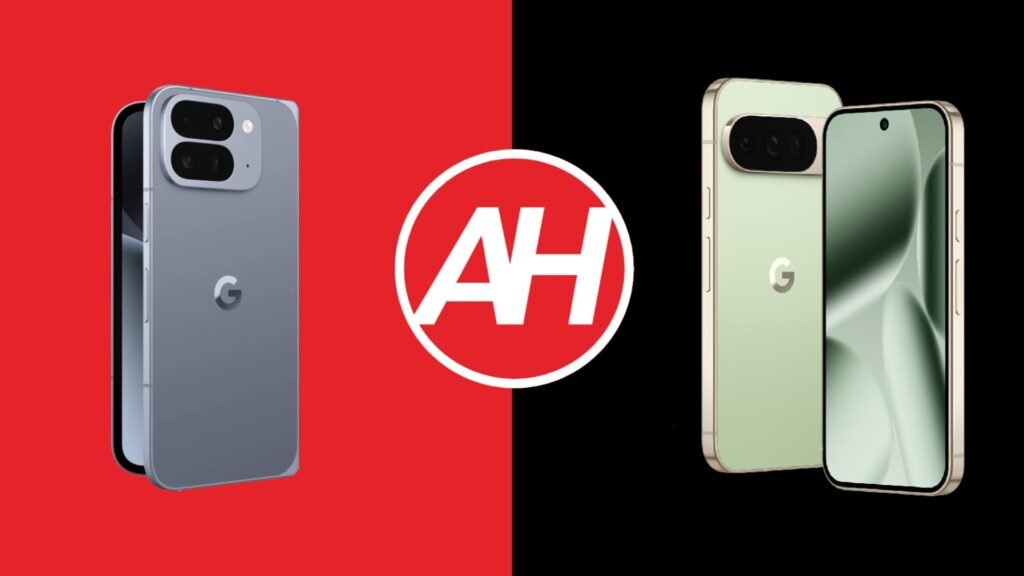

In this article, we’ll be comparing two phones from Google. This time around, we’re comparing the Google Pixel 10 Pro Fold vs Google Pixel 10 Pro. In other words, the company’s latest foldable goes against Google’s compact flagship. Needless to say, these two phones have the same DNA, but they do look different design-wise, as these are two completely different form factors we’re talking about.
The specs are not too different, but there are differences in there, of course. As we usually do, we will first list their specs, and following that, we’ll compare the phones across a number of categories. We’ll be comparing their designs, displays, performance, battery life, cameras, and audio output. Let’s get to it, shall we?
Specs

Google Pixel 10 Pro Fold

Google Pixel 10 Pro
| Google Pixel 10 Pro Fold | Google Pixel 10 Pro | |
|---|---|---|
| Dimensions (unfolded/folded) | 155.2 x 150.4 x 5.2 mm / 155.2 x 76.3 x 10.8 mm | 152.8 x 72 x 8.6mm |
| Weight | 258 grams | 207 grams |
| Main display | 8-inch Foldable LTPO OLED (1-120Hz) | 6.3-inch Super Actual LTPO OLED display (120Hz) |
| Cover display | 6.4-inch OLED (120Hz) | N/A |
| Resolution | 2076 x 2152 / 2364 x 1080 | 2856 x 1280 |
| Chipset | Google Tensor G5 | Google Tensor G5 |
| RAM | 16GB (LPDDR5X) | 16GB (LPDDR5X) |
| Storage | 256GB/512GB/1TB (UFS) | 128GB/256GB/512GB/1TB (UFS 4.0) |
| Main camera | 48MP (f/1.7 aperture, 1/2.0-inch sensor size, 0.8um pixel size, dual pixel PDAF, OIS | 50MP (f/1.68 aperture, 1/1.3-inch sensor size, 82-degree FoV) |
| Ultra-wide camera | 10.5MP (f/2.2 aperture, 1/3.4-inch sensor size, 127-degree FoV, PDAF) | 48MP (f/1.7 aperture, 1/2.55-inch sensor size, 123-degree FoV) |
| (Periscope) telephoto camera | 10.8MP (telephoto, f/3.1 aperture, 1/3.2-inch sensor size, dual pixel PDAF, OIS, 5x optical zoom) | 48MP (f/2.8 aperture, 1/2.55-inch sensor size, 5x optical zoom, 22-degree FoV) |
| Selfie camera | 10MP (f/2.2 aperture, 1/3.94-inch sensor size, PDAF) x2 | 42MP (f/2.2 aperture, 103-degree FoV) |
| Battery size | 5,015mAh | 4.870mAh |
| Charging | 30W wired, 15W wireless (Qi2), Bypass charging (charger not included) | 30W wired, 15W Qi2 wireless (charger not included) |
| Colors | Moonstone, Jade | Moonstone, Jade, Porcelain, Obsidian |
Google Pixel 10 Pro Fold vs Google Pixel 10 Pro: Design
When you look at the two phones from the front, and the Pixel 10 Pro Fold is folded, they do look rather similar. They have considerably rounded corners, with flat displays and a centered display camera up top. The bezels are rather thin and uniform on both phones. On the right side, you’ll find a power/lock key, which sits above the volume up and down buttons. On the Pixel 10 Pro Fold, it also doubles as a fingerprint scanner.
The Pixel 10 Pro Fold’s main display has uniform bezels as well, while its display camera hole sits in the top-right corner. Both devices have a frame made out of aluminum. The Pixel 10 Pro Fold is notably heavier, though. It weighs 258 grams, while the Pixel 10 Pro weighs 207 grams. That’s because the Pixel 10 Pro Fold is a foldable, and also because even its cover display is bigger than the Pixel 10 Pro’s only panel.
If we flip the two phones around, you’ll notice that even their camera setups look different. The Pixel 10 Pro Fold has cameras in two rows, which are included in a square camera island. The Pixel 10 Pro has a single camera bar on the back, which is pill-shaped. Inside it you’ll find three cameras. Camera modules do protrude on both of these devices, but the Pixel 10 Pro has the advantage of not wobbling on the table at all. Both devices also come with an IP68 certification for water and dust resistance, even though the Pixel 10 Pro Fold is a foldable.
Google Pixel 10 Pro Fold vs Google Pixel 10 Pro: Display
The Google Pixel 10 Pro Fold has two displays, of course. It includes an 8-inch Foldable LTPO OLED main panel. That display is flat, and it has an adaptive refresh rate of up to 120Hz. HDR10+ content is supported, while its peak brightness is 3,000 nits. The resolution is 2152 x 2076, while the screen-to-body ratio is around 88%. The cover display here is also flat, and it measures 6.4 inches. It’s an OLED display with a 120Hz refresh rate. It supports HDR content, and it’s protected by the Gorilla Glass Victus 2. The resolution is 2364 x 1080, while the brightness goes up to 3,000 nits.

The Google Pixel 10 Pro, on the other hand, has a 6.3-inch LTPO OLED display. That panel is flat, and it supports HDR10+ content. Its refresh rate is adaptive, and it goes up to 120Hz. The peak brightness here is 3,300 nits. The screen-to-body ratio on this phone is around 88%, while the resolution is 2856 x 1280 pixels. The display aspect ratio here is 20:9, while the display is protected by the Gorilla Glass Victus 2.
All three of these displays are very good. They’re not only more than sharp enough but offer good viewing angles and are quite vivid. The inner display on the Pixel 10 Pro Fold is, of course, more sensitive than the other two, so keep that in mind. It’s the case on every foldable. There are no glaring issues with either display, though, and they’re all also bright enough.
Google Pixel 10 Pro Fold vs Google Pixel 10 Pro: Performance
These two smartphones are actually fueled by the same processor. Google’s Tensor G5 chip fuels both phones, and it’s a 3nm processor. That is the very first Tensor chip made by TSMC, by the way. It’s still notably behind the best flagship processors out there, but it’s made for Pixel phones, and that shows. While it won’t win any races against the very best out there, it makes both of these phones quite fluid.
LPDDR5X RAM and UFS 4.0 flash storage also have something to do with it, of course. Do note that the 128GB storage option of the Pixel 10 Pro uses UFS 3.1 storage, not UFS 4.0. The two phones offer very similar performance. They’re quite fluid in day-to-day use; there’s no problem in that regard whatsoever. Yes, they’re a bit slower than most Snapdragon 8 Elite Gen 5 and Dimensity 9500 phones, but that’s something you’ll notice in direct comparison only. In general, they offer great performance.
Both of these phones can run basically any game out there. When it comes to graphically intensive games, they’re not exactly made for those, but everything we’ve tried worked fine. The phones did get a bit warmer than we’d like at times, with very demanding games, but there was no issue with overheating or anything like that.
Google Pixel 10 Pro Fold vs Google Pixel 10 Pro: Battery
The Google Pixel 10 Pro Fold has a 5,015mAh battery, while the Pixel 10 Pro comes with a 4,870mAh unit. Do keep in mind that the Pixel 10 Pro Fold is not only a foldable, but its cover display is slightly larger than the only panel on the Pixel 10 Pro. That 5,015mAh battery doesn’t exactly look big when you consider that. In fact, neither of these battery packs is big, considering that direct competitors use silicon-carbon tech these days.
In all honesty, neither of these two phones is impressive in terms of battery life. They will be enough for most people, I’d say, but if you’re a power user or something close to it, you may need to charge them up before you’re expecting to. That’s especially true if you’re using the main display on the Pixel 10 Pro Fold a lot.
The Google Pixel 10 Pro Fold supports 30W wired and 15W wireless charging. It also comes with magnets built in, just like the Pixel 10 Pro. The Pixel 10 Pro supports 30W wired and 15W wireless charging as well. Both devices also support bypass charging. The Pixel 10 Pro can reach a full charge in an hour and a half, and it takes a bit longer with the Pixel 10 Pro Fold. Do note that neither phone comes with a charger, so you’ll need to get one separately if you don’t have it at home.
Google Pixel 10 Pro Fold vs Google Pixel 10 Pro: Cameras
The Google Pixel 10 Pro Fold includes three cameras on the back. It has a 48-megapixel main camera with an f/1.7 aperture lens and a 1/2.0-inch sensor size. That camera supports dual pixel PDAF and OIS. There is also a 10.5-megapixel ultrawide unit (f/2.2 aperture, 1/3.4-inch sensor size, 127-degree FoV), and a 10.8-megapixel periscope telephoto camera (f/3.1 aperture lens, 1/3.2-inch sensor size, OIS, 5x optical zoom).

The Google Pixel 10 Pro, on the flip side, also has three cameras on the back, but different ones. There is a 50-megapixel main camera with an f/1.7 aperture lens, 1/1.31-inch sensor size, dual pixel PDAF, and OIS support. A 48-megapixel ultrawide camera (f/1.7 aperture lens, 1/2.55-inch sensor size, 123-degree FoV) is also included, as is a 48-megapixel periscope telephoto camera (f/2.8 aperture lens, 1/2.55-inch sensor size, 5x optical zoom).
The Pixel 10 Pro Fold does a good job of keeping up in the daytime; the Pixel 10 Pro still has the upper hand. More quality differences are visible in low light, however, as the Pixel 10 Pro takes the cake. Neither of these two phones is the best out there, though, nor close to it, but they do a good job. They provide rather contrasty shots.
Audio
You’ll find stereo speakers on both of these phones. They’re loud enough, and the sound quality is also good. The speakers inside the Pixel 10 Pro did sound a bit better to us, though.
There is no audio jack on either device. You can utilize the Type-C ports on the two phones if you’d like to connect your wired headphones, though. Alternatively, Bluetooth 6.0 is supported by both devices.
The post Phone Comparisons: Google Pixel 10 Pro Fold vs Google Pixel 10 Pro appeared first on Android Headlines.