
Motorola has been under a sort of resurgence over the past five years or so. It’s been pretty incredible to watch. Seeing as when Lenovo first bought Motorola in 2014.
Lenovo didn’t seem like they were quite sure what they wanted to do with Motorola at first. They kinda merged them, then kinda kept them as a separate company, watered down their portfolio with a thousand different Moto G models. Then foldables came along. The first Razr was not that great, but neither were any other flip phones at the time, like the Galaxy Z Flip. Lenovo slowly turned Motorola around. Fast-forward to 2023, with the new design for the Razr, which looked less like a Razr and more like a regular flip-foldable phone.
It wasn’t done overnight, and now Motorola is firmly number three in North America, behind Apple and Samsung. Not because of their flagship phones, but because of their mid-range and entry-level phones. The Moto G lineup sells incredibly well. A big reason for this is, the fact that Motorola has the Moto G available at virtually every retailer and carrier, including a lot of prepaid and MVNO carriers.
But that was not Motorola’s biggest move they’ve made in recent years, which has led to their resurgence. It’s working with PANTONE.

PANTONE has made phones fun again
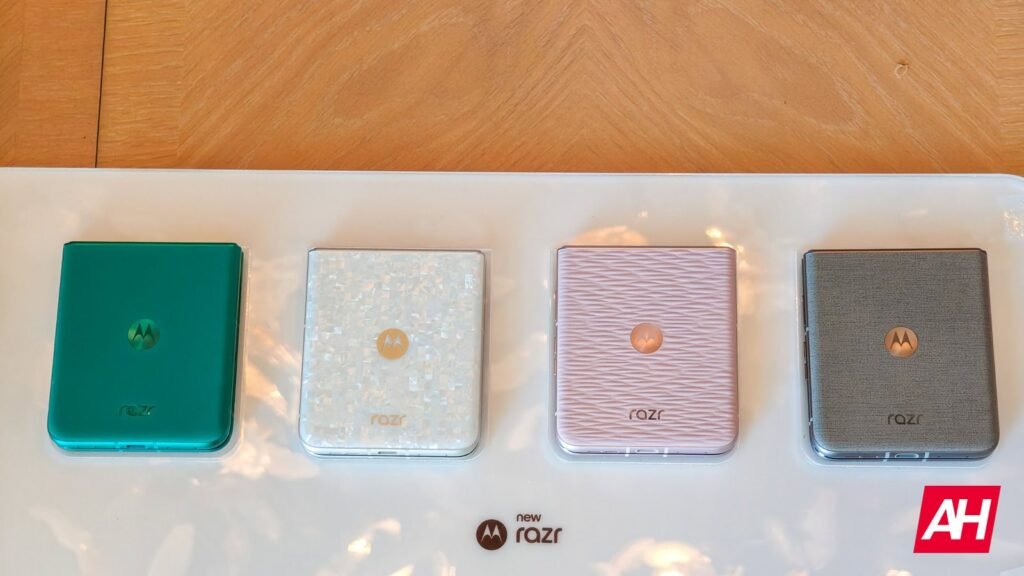
To sort of steal a line from Mr. Mobile, and adapt it, PANTONE has made phones fun again. While we aren’t getting all sorts of different styles and designs that Mr. Mobile covers on his YouTube channel in the “When phones were fun” series. Instead, we’re getting fun colors. We’re getting fun textures, fun materials. In a way, Motorola has brought back the Moto Maker approach that it used under Google with the first couple of generations of the Moto X, but in a faster and more economically feasible approach.
And that’s all thanks to PANTONE. For those who haven’t heard of PANTONE before, here’s what the company does. It’s a color standardization company, which is best known for creating the PANTONE Matching System (PMS), which is a universal language for color. This is a very useful tool for designers to ensure that colors are matched everywhere. As a color red on your laptop in Photoshop, it might not be the same color when printed. PANTONE fixes that.
We’ve seen smartphone brands partner with other legacy brands in the past, and present. Including Xiaomi with Leica, vivo with ZEISS, OPPO with Hasselblad, HONOR with Porsche Design, etc., but none of them have been integrated as deeply and as well as PANTONE and Motorola.
You see, with a lot of those examples I listed, they mostly only pertain to the camera experience, or in HONOR’s case, a specific special edition of their flagship phone, like the HONOR Magic 7 Pro RSR. But Motorola was smart and made its partnership multifaceted.
Of course, PANTONE is responsible for the bright colors and interesting textures we see on Moto phones right now. Like the PANTONE Orient Blue as one of the new Razr Ultra 2026 colors, which is an alcantara finish, and it looks incredible. But the partnership goes much deeper than that.


PANTONE is more than just device colors
Motorola is also using PANTONE to color-validate its displays, and it does make a pretty noticeable difference. It makes the displays show more accurate colors across all of its smartphones, as well as really making them pop. So now you can watch a video on your new Razr Ultra 2026 and see the movie how the director wanted you to see it.
But that’s not even the biggest move with PANTONE, in my opinion. Motorola has started adding PANTONE Validation and PANTONE Skin Tone Validation into its cameras, and this makes a huge difference. When I got my review unit of the Razr Ultra 2025 last year, and took the very first photo, it was the first thing I noticed. It was just a simple photo of my dog at our neighborhood dog park. But what got my attention was how green the grass was, and how accurate that color of green was. It wasn’t oversaturated like some Samsung phones tend to make it look.
This was a huge deal, because let’s face it, Motorola cameras have never been that impressive. They’ve always been a notch or two behind what you’d expect from a flagship phone. And this is one of the reasons why I’m so excited for the new Razr Fold, since it finally has a triple-50MP camera setup on the rear, and it’s a true flagship. Versus the Razr Ultra, which had dual 50MP cameras with ultrawide and wide. DXOMark has already given it a score of 164, which is the highest foldable score DXOMark has given out, and it’s the second-best smartphone ranking of phones available in the US.
PANTONE was only the beginning for Motorola’s partnerships
Last year, at its Razr launch event, Motorola spent a good amount of time talking about its partnerships. Of course, PANTONE is the one we see the most, but Motorola also works with Bose, Meta, Perplexity, and many others. In fact, the new Moto buds 2 plus have Sound by Bose, just like the Moto buds loop that the company announced last year.
Partnerships like these are truly important for Motorola. Of course, they already had a tight partnership with Google and Qualcomm due to Android and Snapdragon. But expanding to other, well-known brands like Bose has been very fruitful for Motorola.

Motorola also told us at that same event last year that most of the phones they sold were not black, white, and neutral colors. Showing us that customers are really going for these bright colors, like the Bright White, which is one of the new Razr 2026 colors.
Motorola has proven to us that partnerships aren’t just about marketing; they can have a real impact. And I don’t think I can think of another partnership that has had a bigger impact on Motorola than PANTONE, right now.
The post PANTONE Has Made Phones Fun Again, and Motorola Is Leading the Way appeared first on Android Headlines.