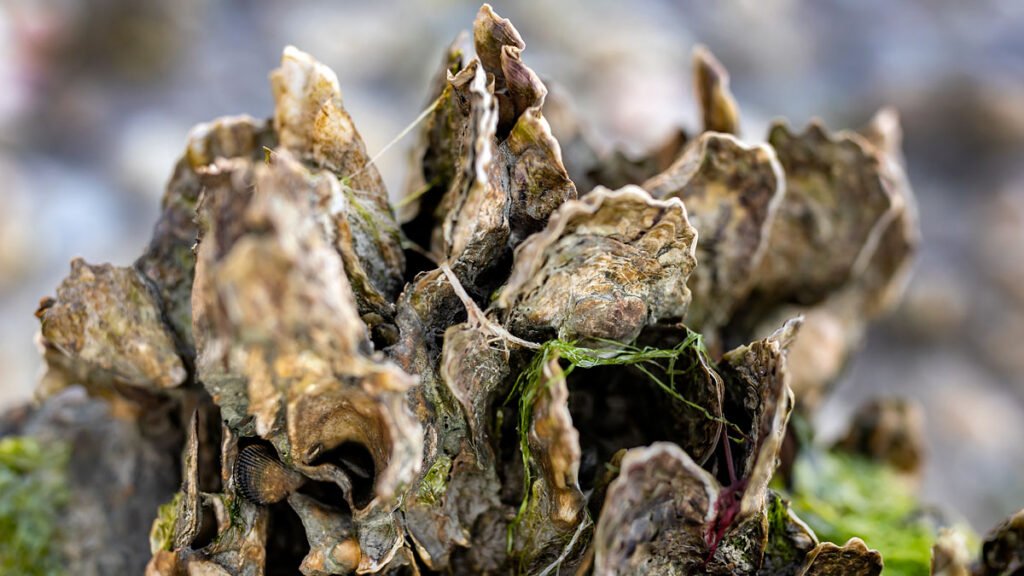
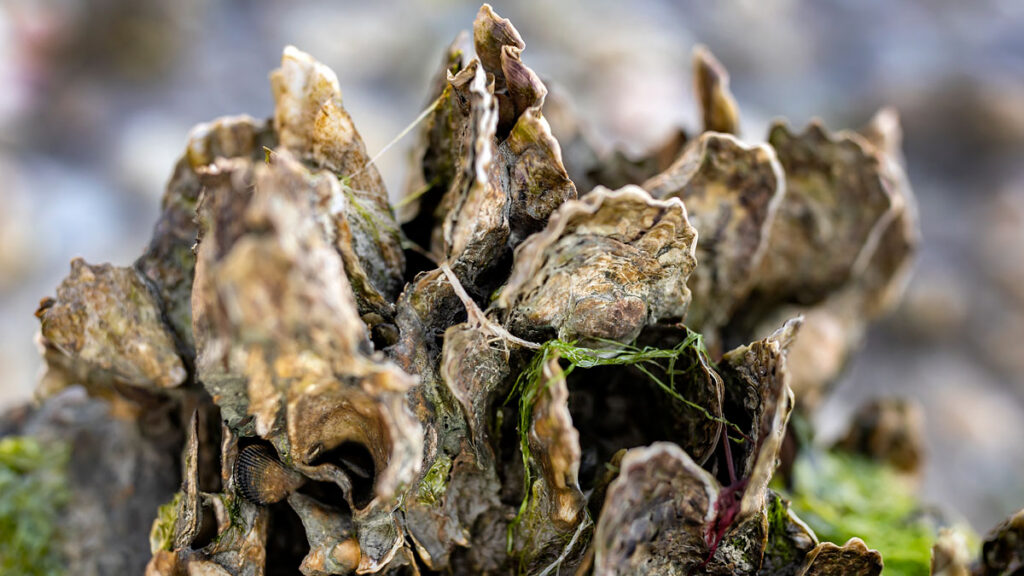
After centuries of overharvesting and environmental degradation reduced the world’s oyster reefs by 85%, restoration is bringing the conglomerations of thick-shelled mollusks back to coastal waters. And their return may have more benefits than scientists realized, new research suggests.
“Oysters build the foundation of an entire ecosystem.”
Oysters were initially restored to boost depleted fisheries, according to Rachel Smith, a marine ecologist at the University of California, Santa Barbara. As oysters cement their shells together into reefs, they create habitats for myriad species, including fish. “Oysters build the foundation of an entire ecosystem,” Smith said.
These days, oyster reefs are restored for reasons extending beyond ecology, including to rid coastal water of excess nutrients such as nitrogen. This pollutant enters coastal waters when wastewater, sewage, and fertilizer wash into the sea.
Past studies of nitrogen removed by oyster reefs largely looked at denitrification, a process in which microbes transform organic nitrogen in dead oysters and their excrement into inert gas. If organic nitrogen evades these microbes, it can be buried in reefs, but measurements of this mechanism are few.
“[Burial] is definitely much less explored,” said Smith.
A study published in PLoS One looked beyond denitrification and found significant amounts of nitrogen become sequestered within oyster reefs as they grow, offering evidence that restored oyster reefs actually remove far more nitrogen than we thought.
Before she started this research, Anne Margaret Smiley, lead author of the new paper and a biogeochemist at the University of North Carolina (UNC) at Chapel Hill, suspected that the amount of nitrogen buried in oyster reefs would be small because organisms at the surface transform so much of it, leaving little left to bury. She was pleasantly surprised by the results.
“We’ve been looking at denitrification all this time, and now we found out that [oysters themselves] are really good at doing this too,” she said. “What an amazing thing to know.”
In Search of Buried Nitrogen
To explore how nitrogen is buried over time, scientists turned to 20 oyster reefs in the Rachel Carson National Estuarine Research Reserve near Beaufort, N.C., that were restored nearly 3 decades ago by UNC scientists.
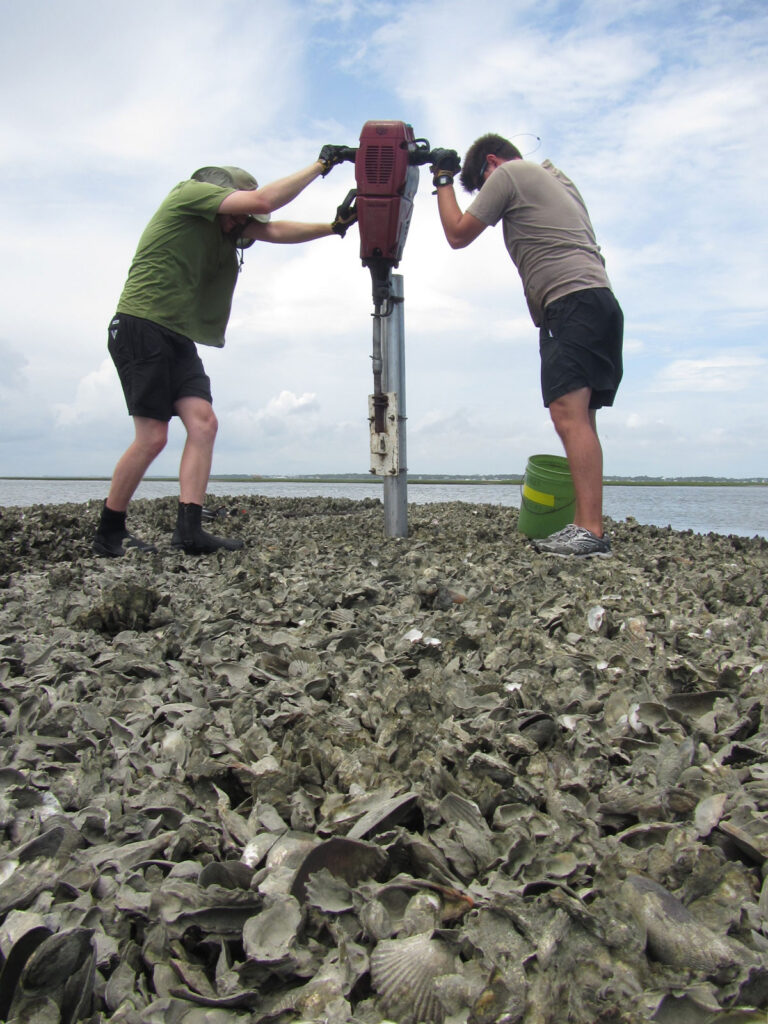
Using a jackhammer and metal pipe, they extracted cores from the oyster reefs in 2011. About 10 centimeters in diameter, the cores sampled the full thickness of each reef, which ranged from 10 to 55 centimeters. Shortly after they were collected, the cores were sectioned off into 5-centimeter increments, sealed, and stored in a walk-in freezer. In the years since, the samples have proved useful for studying oyster reef growth during sea level rise and how much carbon the reefs sequester and in other areas of research. Recently, Smiley measured the nitrogen levels in each of these 5-centimeter sections.
Below the top 10 centimeters or so, where microbes break down organic matter, nitrogen levels increased. Looking at all samples, Smiley found that on average, a square meter of reef buried more than 6 grams of nitrogen each year, which is similar to the rate of nitrogen transformed by denitrification at oyster reefs.
“The more they can build up and out, the more [nitrogen] they can bury underneath.”
However, there was a large range in the amount of nitrogen buried, between 1 and 15 grams of nitrogen per square meter. The variability, the researchers found, was related to where the different oyster reefs grew.
For oyster reefs in sand flats, those in intertidal areas (between high and low tide on a shore) buried more than twice as much nitrogen as subtidal reefs, on average. Intertidal reefs grow faster and so bury more nitrogen. “The more they can build up and out, the more [nitrogen] they can bury underneath,” said Smiley.
But intertidal reefs that fringed the edge of salt marshes buried less nitrogen than other intertidal reefs. “They’re not able to grow as quickly,” she said, speculating that sediment from the neighboring marshes may slow reef growth.
Put Your Money Where Your Mollusk Is
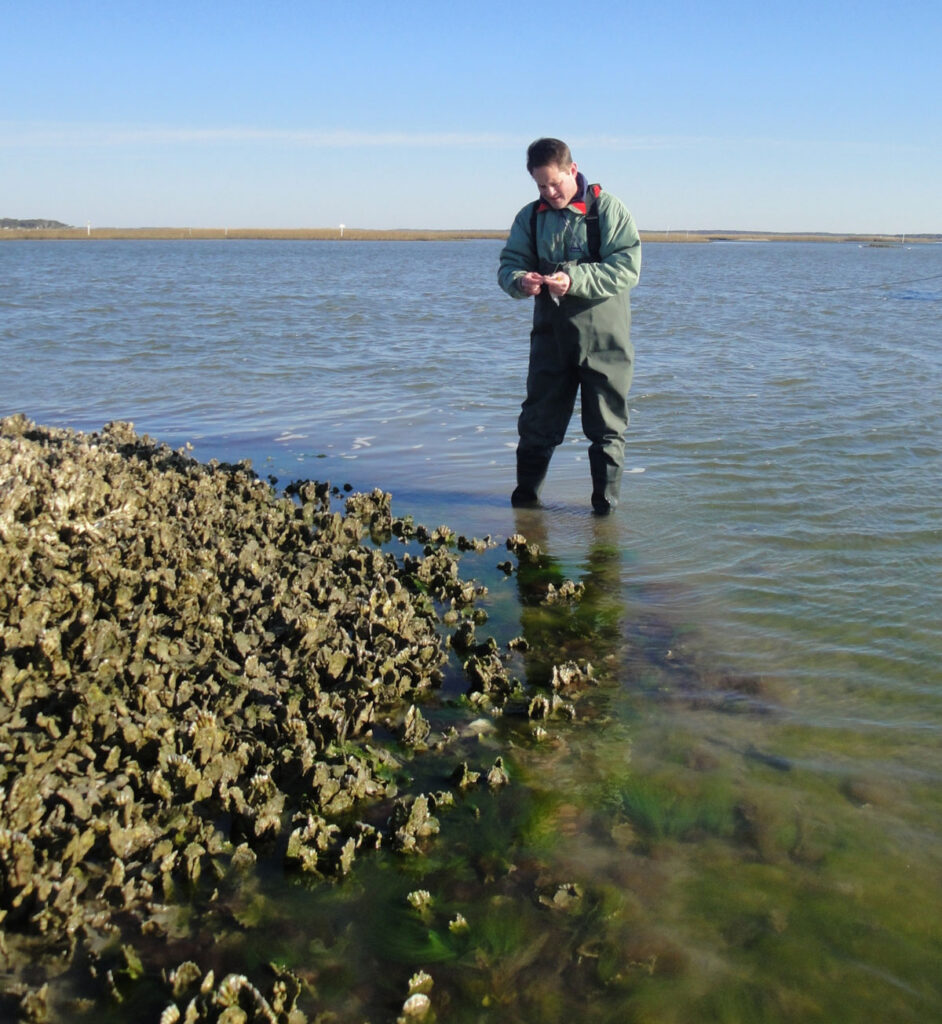
North Carolina’s Department of Environmental Quality places the economic value of each kilogram of nitrogen removed from the environment at $26.39 (in 2024 dollars, which is about $28.50 in 2026). Using this figure, Smiley and her colleagues calculated that nitrogen removed from coastal waters and buried each year by a hectare of oyster reef has a value of $1,700 on average. This finding increases previous estimates of the value of oysters’ nitrogen removal services by 25% to 42%.
“A really valuable part of the study is not just taking those measurements, but then also translating that into valuation,” said Smith, who was not involved with the new study. The value of nitrogen burial can be added to oyster reef ecosystem services—the monetary value of benefits that humans gain from oyster reefs, such as clean water, food, and flood control. “[Buried nitrogen] is definitely an ecosystem service that I think is underappreciated,” she said.
Looking more broadly at the county that is home to the Rachel Carson Reserve, Smiley and her colleagues found that all the oyster reefs countywide bury about 120,000 kilograms of nitrogen each year—more than $3 million of value in the county’s shallow sounds and bays.
—Lisa S. Gardiner (@lisasgardiner.bsky.social), Science Writer
Citation: Gardiner, L. S. (2026), Oysters clean up more nitrogen pollution than we thought, Eos, 107, https://doi.org/10.1029/2026EO260182. Published on 4 June 2026.
Text © 2026. The authors. CC BY-NC-ND 3.0
Except where otherwise noted, images are subject to copyright. Any reuse without express permission from the copyright owner is prohibited.