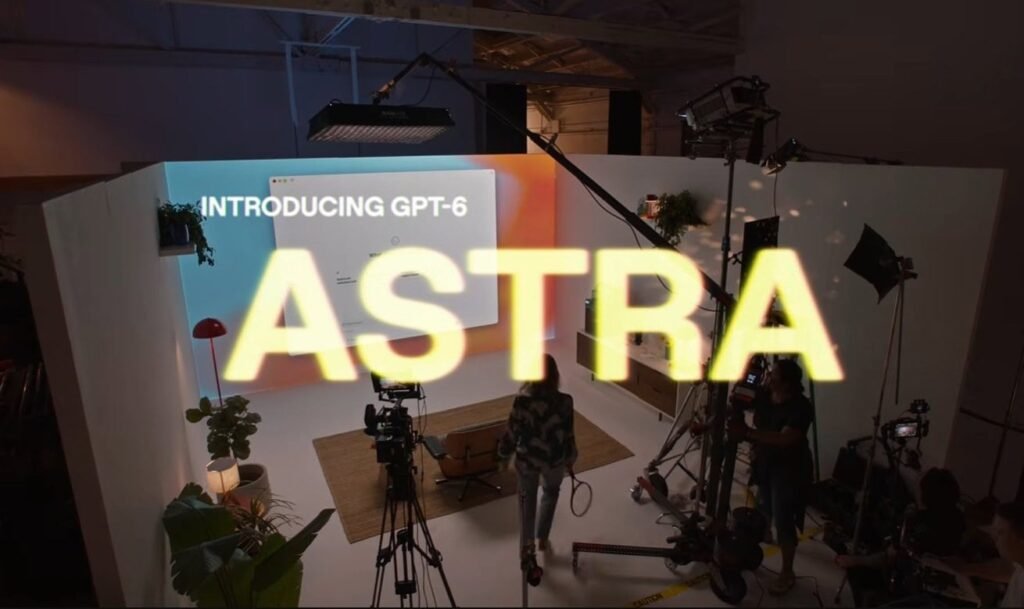

OpenAI has officially launched its newest flagship AI model, GPT-6 Astra, marking what company leadership describes as a generational leap in artificial intelligence. “Welcome to the AGI era,” said the president of OpenAI Greg Brockman to reporters during a media briefing. He claimed Astra is as good or better than humans on enough hard problems that it is fair to call the system artificial general intelligence. It arrives shortly after Google’s Gemini 3.8 Flash release.
Astra was pretrained on over 100,000 GPUs at the Stargate facility in Texas. It introduces significant performance gains over its predecessor, GPT-5.6 Sol. According to benchmark data published by OpenAI, the model scored 99.9% on ARC-AGI-3 under internal test conditions, 97.6% on the FrontierMath evaluation, and 74.1% on software engineering tests. Plus, it achieves record marks across biology, chemistry, and physics benchmarks.
Autonomous computer use and new context features
A core focus of the Astra rollout is its agentic capability. This is the ability to act as an active executor rather than a passive assistant. On the OSWorld 2.0 benchmark that measures how well an AI can use a standard computer interface, Astra achieved a 72.6% score. It completed tasks in roughly 40 minutes compared to Sol’s 75-minute average. Demonstrations showed the system formatting legal contracts, drafting tax returns, building 3D game scenes, and executing complex multi-step workflows.
Alongside the model launch, OpenAI updated its Codex coding environment. The platform is getting an experimental feature that allows Astra to maintain searchable notes across multiple context windows during long sessions. Through the API, standard access is priced at $10 per million input tokens and $50 per million output tokens, alongside a 2.5x faster execution mode that puts API costs in line with rival models like Anthropic’s Fable 5.1.
Critical cybersecurity ratings and staged rollout
Astra is also the first model with “critical” label under OpenAI’s internal Preparedness Framework. In evaluations using the ExploitBench framework, the model scored 100% after discovering two previously unknown zero-day vulnerabilities in well-defended software systems without human guidance. These dual-use capabilities allow an AI to identify vulnerabilities for patching just as easily as exploiting them. So, OpenAI restricted initial access to trusted defenders in its Daybreak cybersecurity program.
OpenAI is also addressing safety concerns following earlier testing incidents. The firm delayed the release to implement tighter safeguards, including restricted internet access during evaluation, 24/7 escalation monitoring, and pre-release vetting by the White House.
Brockman confirmed that broader availability for ChatGPT Plus, Pro, Business, and Enterprise subscribers. For developers, the API access on AWS and Azure, will roll out over the coming days.
The post OpenAI Releases GPT-6 Astra and Declares the Arrival of the AGI Era appeared first on Android Headlines.