
Maskot/Getty Images
- Employment has dropped in white-collar sectors, while output has continued to surge.
- AI and economic uncertainty are two likely reasons for the sluggish white-collar job market.
- Still, how productive AI makes companies remains a question.
The white-collar sector is doing more with less.
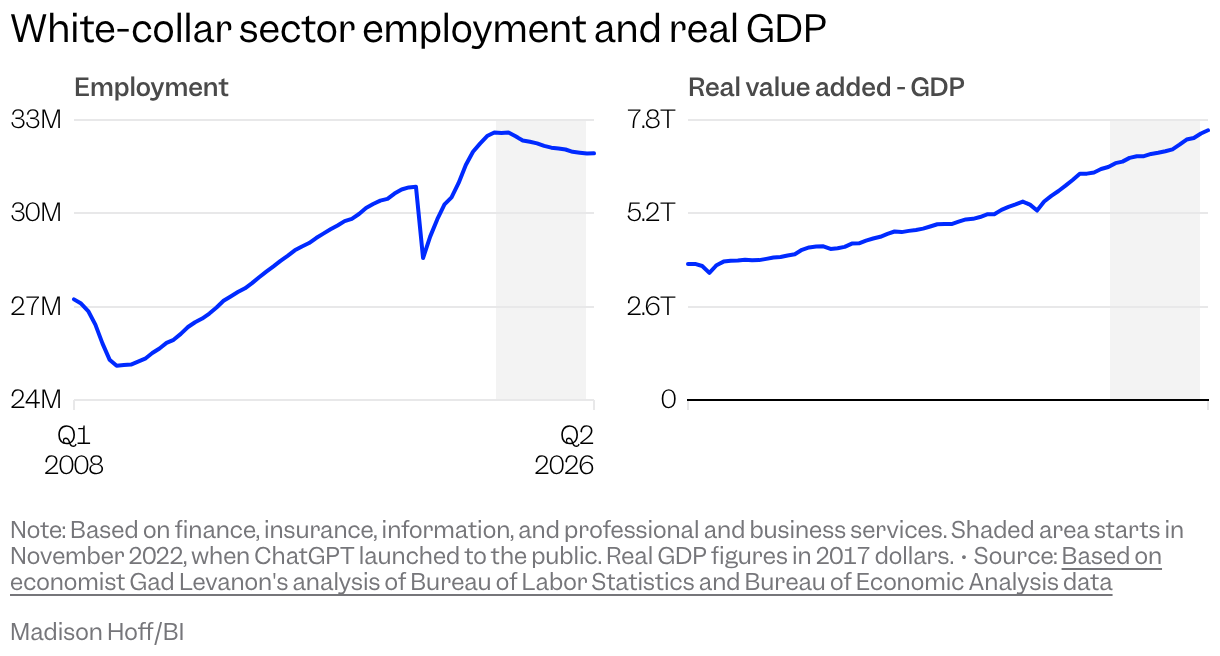
While the number of total jobs has slid in industries like finance, tech, and professional services, output has been on a tear. Gad Levanon, the chief economist at the Burning Glass Institute, examined how employment in white-collar-heavy sectors compares with real gross domestic product.
He wrote in a Substack article that employment in finance, insurance, information, and professional and business services is collectively down roughly 2% since the end of 2022, while real output for these sectors has soared by 16%. The ongoing slow decline in employment for this group goes against historical patterns and highlights how workers and job seekers are facing a largely frozen, low-hire, low-fire job market.
“A growing share of the work businesses used to get done by consultants, contractors, call centers and their own back-office staff is now delivered by software, cloud and IT firms, which produce far more per worker and add almost no staff,” Levanon told Business Insider. “That is why the sector’s output keeps rising while its hiring has stopped.”
The divergence also risks breaking the traditional link between economic growth and rising fortunes for everyday Americans. “Even a strong, continual growth in GDP may not translate into jobs for people, may not translate into a higher quality of life for people as well,” said Cory Stahle, an economist at the Indeed Hiring Lab.
People looking in these kinds of sectors may be having a challenging time. “It’s important to remember for these job seekers that a career is not necessarily built over the course of two or three years,” Stahle said. “It’s usually built over the course of two or three decades. So what the pattern is now could easily shift a couple of years from now. So it’s important to be reactive but not overreact to what we’re seeing in the data, either.”
Levanon said on Substack that there’s demand in these white-collar fields, but firms can meet it with fewer workers. Part of that could be due to employers shifting their priorities toward leveraging AI. Levanon said “the back-office and junior tasks” that AI performs best at are concentrated in the white-collar sectors he looked at.
Dante DeAntonio, senior director at Moody’s Analytics, previously told Business Insider that the lack of hiring in white-collar fields is largely due to uncertainty around economic policy and AI. Other job market experts have noted that in Big Tech, employers pulled back after the pandemic-era hiring surge. The job market’s woes can be especially difficult for people who lack years of experience.
“Firms, I think, are certainly diving in with both feet, trying to find ways to gain efficiency from AI,” DeAntonio said. “And certainly the first domino to fall is likely to be a pullback in hiring amongst younger workers, new college grads, positions where firms think they might be able to get some uptick from AI, and some sort of replacement value from AI.”
Whether companies are actually more productive because they’re incorporating AI tools remains a question. Eric Kutcher, a senior partner and chair of McKinsey North America, recently said that there are individual productivity increases, rather than institutional-level gains.
“You have people that are getting more productive as individuals, but they’re just changing some of the work that they’re doing,” he said.
Bureau of Labor Statistics data showed general labor productivity has increased, but not at a wildly accelerated clip.
“We have seen that things have slowed down in the last few years, but output per worker and productivity was climbing even before we saw ChatGPT and AI starting to come onto the scene,” Stahle said. “To me, that says that AI is part of the story here, but not the complete story. This is part of a longer-term trend.”
Have you been job searching in these white-collar sectors? Have you had to make a career pivot? Reach out to this reporter to share what that’s been like at mhoff@businessinsider.com.