Throughout the hot and arid soils of the San Joaquin Valley hide patches of an infectious fungus known as Coccidioides. When something disturbs those patches of soil and lofts dust, the airborne fungal spores can drift and travel on the wind—sometimes for miles. Should someone inhale one of those spores, they run the risk of contracting a little-known, often misdiagnosed disease called valley fever.
This transmission pathway has long been known to scientists and medical professionals. A new study has shown that living near an oil or gas well as it’s being constructed significantly raises a person’s risk of contracting the disease.
This is the first study that has looked at individual cases and was able to say, “Is the risk of this person getting this case higher if an oil and gas site [were] put in?”
“This is the first study that has looked at individual cases and was able to say, ‘Is the risk of this person getting this case higher if an oil and gas site [were] put in before [diagnosis], versus the same time of year for that same person when there was no oil and gas construction?’” said Alexandra Heaney, an environmental epidemiologist at the University of California, San Diego who was not involved in the study.
Publicly available data on valley fever, provided on an annual, countywide scale, can be used to make only the coarsest of generalizations. But through a unique partnership with the California Department of Public Health, a group of researchers out of University of California, Berkeley received a more robust set of data. The fully anonymized dataset covers every case of valley fever recorded in the state and provides the latitude and longitude of a patient’s residence, as well as the date their case was reported.
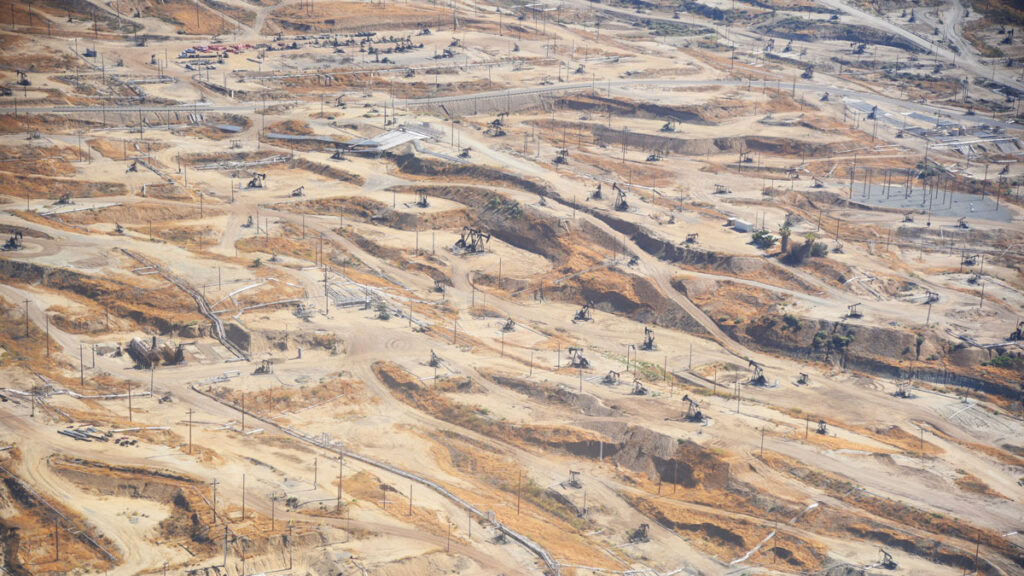
The team then compared those public health data against information on the precise location and timing of new oil and gas well developments in Kern County from 2007 to 2022. Located at the south end of California’s Central Valley, Kern is among the nation’s most polluted counties.
The researchers concluded that individuals who live within 3 miles of a well—which nearly three in four Kern County residents do—have a 12.5% higher risk of contracting valley fever during the 90 days after well construction began. This is likely because of all the dust that’s stirred up as sites are leveled, heavy machinery is moved in, well pads are built, waste pits are dug, and boreholes are drilled, the researchers suggest.
Construction with Caution
“Ideally, that buffer zone would be even larger because we’re finding these effects up to 5 kilometers away.”
In 2024, California passed a law requiring that no new oil and gas operations be built within 1 kilometer, or roughly 0.6 mile, of a home, school, or hospital. “I think a big takeaway of this study is that that buffer distance is needed,” said Lisa Couper, a disease epidemiologist at UC Berkeley and the study’s lead author. “And ideally, that buffer zone would be even larger because we’re finding these effects up to 5 kilometers away.”
Though these results show yet another way that oil and gas developments are a detriment to public health, this challenge isn’t solely a problem of the fossil fuel industry, Couper added. Rather, it’s a problem of construction more generally in regions where the fungus is present. In 2016 and 2017, the installation of a solar farm in Monterey County, California, led to an outbreak of valley fever even among the construction workers.
Researchers at the UC Davis Center for Valley Fever emphasized that the study highlights the importance of taking precautions to prevent dust from being stirred up in the first place and to protect the public when dust is present by equipping people with protective devices, such as home air filters and N95 masks.
Right now, no vaccine exists to inoculate against valley fever, and only a half dozen antifungal medications work to treat the disease if it’s detected early. So preventative measures in at-risk regions are critical for public health: Though in most cases valley fever mimics the symptoms of COVID-19 and the flu, should the fungus migrate outside of the lungs—as happens in rare instances—it has the potential to be fatal.
—Syris Valentine (@shapersyris.bsky.social), Science Writer
Citation: Valentine, S. (2026), Oil and gas development heightens risk of valley fever, Eos, 107, https://doi.org/10.1029/2026EO260330. Published on 19 October 2026.
Text © 2026. The authors. CC BY-NC-ND 3.0
Except where otherwise noted, images are subject to copyright. Any reuse without express permission from the copyright owner is prohibited.