
Foldable phones are getting really, really good. These days, you can pick up a recent foldable, and you might not even realize that it unfolds. Because it is the same thickness as a regular phone, and about the same weight too.
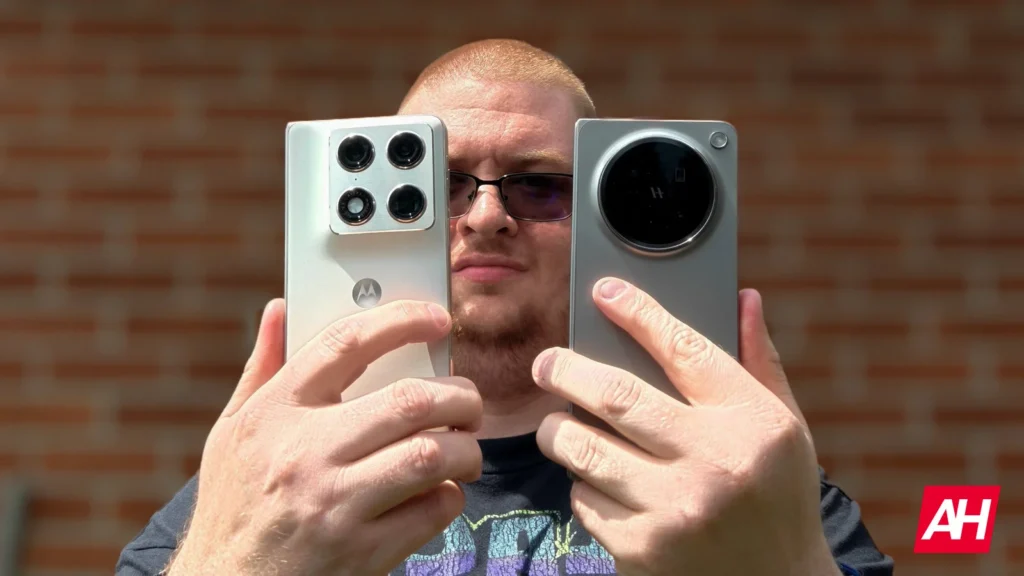
Now with the Motorola Razr Fold finally being made official, after five months of teasers, I’ve been putting it through its paces and comparing it to my most recent daily driver, the OPPO Find N6. I really, really like the Find N6, because it does just about everything I want, as well as having great battery life and cameras. Two areas that foldables typically skimp out on. But that’s not the case for either one of these foldables.
I’ve been reviewing Android phones since 2012, and have reviewed just about every foldable since the first Galaxy Fold. So I definitely know what I’m talking about here.
Let’s get started with comparing the two newest foldables on the market, the Motorola Razr Fold vs. the OPPO Find N6.
Specs

Motorola Razr Fold

OPPO Find N6
| Motorola Razr Fold | OPPO Find N6 | |
|---|---|---|
| Dimensions (unfolded/folded) | 160.1 x 144.5 x 4.5 mm; 160.1 x 73.6 x 9.89 mm | 159.9 x 145.6 x 4.2 mm;159.9 x 74.1 x 8.9 mm |
| Weight | 243 grams | 225 grams |
| Main display | 8.1-inch Foldable LTPO P-OLED (120Hz) | 8.12-inch Foldable LTPO OLED (1-120Hz) |
| Cover display | 6.6-inch LTPO P-OLED (165Hz) | 6.62-inch LTPO OLED (1-120) |
| Resolution | 2484 x 2232 / 2520 x 1080 | 2248×2480; 2616×1140 |
| Chipset | Qualcomm Snapdragon 8 Gen 5 | Qualcomm Snapdragon 8 Elite Gen 5 |
| RAM | 12GB/16GB (LPDDR5X) | 16GB |
| Storage | 256GB/512GB/1TB (UFS 4.1) | 512GB/1TB |
| Main camera | 50MP (f/1.6 aperture, 1/1.28-inch sensor size, OIS, multi-directional PDAF) | 200MP (f/1.8, 1/1.56″ sensor size, PDAF, OIS) |
| Ultra-wide camera | 50MP (f/2.0 aperture, 1/2.76-inch sensor size, 122-degree FoV) | 50MP (f/2.0, 15mm, 1/2.75″ sensor size, AF) |
| (Periscope) telephoto camera | 50MP (f/2.4 aperture, 1/1.95-inch sensor size, 3x optical zoom, OIS, dual-pixel PDAF) | 50MP (f/2.7, 70mm, 1/2.75″ sensor size, PDAF, OIS, 3x optical zoom) |
| Selfie camera | 20MP (main) / 32MP (cover) | 20MP (f/2.4, 1/3.42″ sensor size) |
| Battery size | 6,000mAh | 6,000mAh Silicon Carbon |
| Charging | 80W wired, 50W wireless, 5W reverse wireless | 80W wired, 55W PPS, 50W wireless |
| Colors | PANTONE Blackened Blue, PANTONE Lily White | Blossom Orange, Stellar Titanium, Pearl Black |
Same same, but different: These two phones share a lot of similarities, but both have key advantages over the other
Now that we’ve gotten the specs out of the way, let’s talk about a few of the key differences that the OPPO Find N6 has over the Motorola Razr Fold.
What the OPPO Find N6 does better
First up is that processor, it’s running the Snapdragon 8 Elite Gen 5, though it is the 7-core version. This makes it a full-on flagship, versus the Snapdragon 8 Gen 5 that Motorola is using. So while we’re on this topic, let’s talk about benchmarks between these two.
| Device | Geekbench 6 – CPU Single-Core | Geekbench 6 – CPU Multi-Core | Geekbench 6 – GPU |
|---|---|---|---|
| OPPO Find N6 | 3,578 | 9,510 | 21,027 |
| Motorola Razr Fold | 2,590 | 8,779 | 17,159 |
Here on Geekbench, we can see that there is a pretty big difference in the single-core score. This is essentially the difference between a 3.8GHz prime core and a 4.6GHz prime core on the Snapdragon 8 Gen 5 and Snapdragon 8 Elite Gen 5, respectively. Things get much closer in the multi-core and GPU, around 8-10%, and in actuality, you won’t see a massive difference in performance here. Unless you’re using your phone as a desktop computer, both of these chips are going to be more than powerful enough.
While I’d much prefer to have the Snapdragon 8 Elite Gen 5 on the Razr Fold, especially at that price, I’m willing to forgive Motorola a little bit because of the ongoing RAMagedon with RAM and storage prices going through the roof right now.
Next, the physical size of the Find N6. It’s thinner, though the rest of the phone is about the same size. We’re talking within 0.2mm in both height and width. However, the Find N6 is quite a bit lighter. It’s about 8% lighter at 225g, and you likely won’t notice this difference, but it is something that’s hard to skip over. Even holding both, it’s hard for me to notice the difference in weight. Motorola just seems to distribute the weight better.
Of course, we can’t forget about the display. OPPO has that “Zero Feel” crease on its main display, which does make a difference. After using this as my daily driver since early February, it’s still tough to see the crease, and almost impossible to see. Yes, it’s still there, it will always be there, but compared to other foldables, it’s basically non-existent.
Finally, the design. Now this is something that could be a toss-up; some will prefer the Find N6 design over the Razr Fold. I honestly like both, and for different reasons. The Find N6 looks great in this Stellar Titanium color, and with the camera module being round and in the middle, it doesn’t wobble very much at all – a big complaint I have with the Fold 7. Then there’s the Razr Fold, which is a very different design, with a soft finish on the back that makes it really easy to hold onto. With a square camera bump in the corner, which is not as thick as the Find N6, and also doesn’t have any wobble issues.

What the Motorola Razr Fold does better
Now, let’s talk about what the Razr Fold does better. First up is definitely charging. Motorola is also using fast charging here, 80W, just like the Find N6. But where things stand out is the charging method. You see, a lot of the Chinese phones use USB-A for these crazy fast charging speeds. This means you need to use their charger to get this speed; using a USB-C or even a USB-A charger from another brand doesn’t result in the same speeds. With Motorola, it does, because it’s USB-C PD.
I’ve also noticed in my testing that the Razr Fold maintains higher charging speeds for longer. Even past 90%, it’s still charging at over 30W, which is pretty incredible. Most phones would be under 20W and usually closer to 10W by then. Because of this, the Razr Fold does charge faster, with the same charging peak speed and the same size battery.
Motorola also has lighter software on board. Motorola is about as close to stock Android as you’re ever going to get these days. As even the Pixel is not really “stock Android” anymore. Some people will love it, while others will want more features. I really like Motorola’s software, but I also love the extra features OPPO provides in ColorOS 16. So it’s a bit of a toss-up for me.
Then there’s the brightness. Motorola definitely wins on the brightness front, with peak brightness of 6,000 nits on the cover display and 6,200 nits on the main display. Those are incredible numbers, but they’re also inflated by such glossy, reflective displays. Obviously, a plastic display will always be glossy and super reflective, but Motorola could follow OPPO’s lead with an anti-reflective layer on the Find N6, which does make a meaningful difference.

Battery life is very, very similar
Testing both of these devices, I was honestly expecting a bigger difference in battery life than I got. The Razr Fold runs on the more efficient and lower-clock-speed Snapdragon 8 Gen 5, while the Find N6 runs on the 7-core version of the Snapdragon 8 Elite Gen 5 (essentially, one of its performance cores is disabled, so there are 5 performance cores and 2 prime cores), with both devices having a 6,000mAh capacity battery.
In our benchmarking, we found that the Motorola Razr Fold was able to last just under 20 hours, at 19 hours and 58 minutes. That’s 13 minutes longer than the Find N6 in the same test. That is quite impressive for Motorola. This benchmark runs a YouTube video at the same brightness, around 200lux, on every device that we review. Going from 100% down to 1%. Then we charge it up to 100% with the included charger, or a charger that can max out its charging speed. Here are the results:
| Device | Battery Life | Charging |
|---|---|---|
| Motorola Razr Fold | 19 hours, 58 mins | 42 minutes |
| OPPO Find N6 | 19 hours, 45 mins | 58 minutes |
On the charging side, it’s impressive that the Razr Fold charges so much quicker, despite having the same size battery and the same max charging speed. The difference? USB-C PD. That’s right, Motorola uses USB-C PD to hit that 80W charging speed, and it also stays at a higher charging speed longer, versus what OPPO has. In fact, it’ll continue charging above 35W at 90%, where most phones would drop to around 10W. Now, this does have a drawback, which is the fact that the Razr Fold does get quite warm while charging, much warmer than other phones. So if you’re one who charges your phone at night, you may want to disable the “Charging Boost” feature to help with the heat.
But the bottom line here is that the Razr Fold has better battery life and better charging. However, you really can’t go wrong with either one.
How do the cameras stack up?

Both of these phones have pretty impressive camera systems for foldables. The main difference between these two is that Motorola uses larger sensors, while OPPO has a much higher-resolution primary sensor. Here’s how the two camera systems stack up, spec-wise:
| Camera | Motorola Razr Fold | OPPO Find N6 |
|---|---|---|
| Primary | 50MP, f/1.6, 1/1.28″, multi-directional PDAF, OIS | 200MP, f/1.8, 1/1.56″, PDAF, OIS |
| Telephoto (3x) | 50MP, f/2.4, 1/1.95″, dual-pixel PDAF, OIS | 50MP, f/2.7, 1/2.75″, PDAF, OIS |
| Ultrawide | 50M, f/2.0, 1/2.76″, 122˚, PDAF | 50MP, f/2.0, 1/2.75″, 120˚, AF |
As we can see from the specs, the Razr Fold is brighter, with wider apertures on the primary and telephoto lenses. While the ultrawide is virtually identical, with the Razr Fold being a bit wider at 122˚ vs 120˚ for the Find N6.
But the real question is, how does this translate to actual photos? Well, the good thing is, I’ve been taking comparison photos for this exact comparison. In the gallery below, you can see how things have turned out. These photos were taken in as close to the same settings as possible. It’s not 100% apples-to-apples here, as the sensors are all different focal lengths (23mm vs 24mm on the primary, 70mm vs 71mm on the periscope, and 12mm vs 15mm on the ultrawide).
The biggest thing I’ve noticed is actually the sensor size difference. Motorola typically has more bokeh in photos, particularly from the primary sensor. Though surprisingly, OPPO seems to be brighter in some situations, despite the Razr Fold having a brighter aperture on the periscope and primary cameras.


Here are a couple of scenarios I want to highlight from these comparisons. The first one here is the same photo from the same position, taken with the ultrawide, the primary camera, and then the 3x telephoto camera. So we can see the difference between the three cameras.
In these photos, they both look very, very similar. But if you look closely, you will see some changes in the colors. The Razr Fold does make it look more natural, basically what the colors looked like to my eyes when I took the photo. But that doesn’t make the Find N6 bad, by any means. I’d be perfectly happy with either photo, to be honest.
Next is 100x. This is something that, as a reviewer, I need to test, but after that, I’ll likely never use it again. Maybe at a baseball or football game, but that would still be rare. In the gallery below, you can see two shots at 100x, and they both look….well, not good.
So which camera is better? I personally prefer the Razr Fold in most situations. It’s color accuracy is pretty much unmatched, and that’s thanks to PANTONE. It wins in indoor performance, portrait/depth shots, and balanced exposure. I also prefer the more natural bokeh from the main camera, that you just don’t get from the OPPO Find N6.
This isn’t to say the Find N6 is bad, in fact, it’s still quite good. With the Hasselblad tuning, OPPO is going more for that Instagram-ready look, with crushed shadows and natural skies that perform well on a phone screen at first glance. While the Razr Fold is doing more traditional photography.
Software is the real differentiator
The real differentiator for the Razr Fold vs Find N6 debate is going to be software. Motorola runs on Android 16 with its Hello UI on top, while the Find N6 also runs on Android 16 with ColorOS 16 on top. Motorola is a very stock Android-like skin with a few add-ons.
Motorola’s software is quite good; I really like it. But it is lacking some real foldable features that OPPO has pioneered. Like Boundless View, this is a feature that everyone absolutely loves on a foldable. Essentially, it’s multi-window on steroids, allowing you to use more screen real estate than you have. Motorola basically lets you do side-by-side apps and pop-up view, that’s it. While OPPO allows you to have 4 or more apps on the screen at the same time. Which is really useful for multitasking.

Both of these phones have their own AI buttons on the side. And to be honest, I rarely use either one. If I want to bring up Gemini to ask something, I’ll simply long-press the power button. Though I will give a point to OPPO here as I do think its button is more useful. The Snap Key is really nice to have for taking screenshots and such, as it can easily extract details for you, like, say, an event posted. It can extract those details and even put them in your calendar for you, among many other things.
To Motorola’s credit, they have added virtually every AI chatbot you can imagine. So you can bring up CoPilot, Perplexity, Gemini, or whatever is your AI of choice. It’s just not something I use all that much.
Then there’s the Apple ecosystem support that OPPO has. Being able to use Airdrop within Quick Share is huge, as well as being able to remote desktop into my MacBook Air from my Find N6, and easily move files around between the two. It’s unparalleled for someone like me.
Finally, let’s talk software updates. Motorola is promising 7 years of updates on the Razr Fold (interestingly, not on the regular flip Razrs, though), while OPPO is offering five years of OS updates and six years of security updates. Which is plenty, let’s face it, you won’t even have this phone after five years. But where things get dicey is actually getting these updates. Motorola is notoriously slow with its updates. In fact, the Razr 2025 series just got its Android 16 update a few months ago; Google pushed out Android 16 last Summer. OPPO is typically much faster; the Find N5 got Android 16 just a few months after the Pixel 10 launched.
Which should you buy?
Now, which phone should you actually buy? Well, if you’re in the US, there’s really no choice. The OPPO Find N6 is not officially sold here. Of course, you can import it, which could cost a pretty penny, and you also won’t have a warranty. The Find N6 is also not sold in a lot of countries, so this is going to be the case for a lot of people.
But if you’re not in the US and are in a country where both phones are sold. It’s a pretty tough debate. They both have weaknesses and strengths, and as someone who has access to both, I’m leaning more towards the Razr Fold for a couple of reasons. Firstly, the cameras here are very impressive, especially with the Pantone color validation, but perhaps more importantly, the charging.
I travel a lot, for different events and such, so having a fast charger is really clutch. But having to bring a specific brand’s charger to get these fast speeds really annoys me. Which is why I prefer Motorola’s fast charging being done over USB-C PD, not to mention it’s also faster.
For those of us in the US, it’s great that we now have a foldable with many of the technologies that Chinese companies are pushing. Like Silicon-Carbon batteries, which Google, Apple, and Samsung refuse to use.
The post Motorola Razr Fold vs OPPO Find N6: The better foldable might surprise you appeared first on Android Headlines.