Hello again, and welcome back to Fast Company’s Plugged In.
When the software engineer and entrepreneur Deon Nicholas was CEO of Forethought, a customer service automation platform, he had an executive assistant to manage the minutiae of his workday. Not surprisingly, he appreciated the help. “That was something that I found was critical, something that actually helped me as a leader,” he explains.
Few of us who aren’t in the executive suite have the luxury of calling on another person to wrangle our schedule, triage email, and otherwise keep the chaos of our professional and personal lives under control. As Nicholas contemplated the frenzy of excitement over AI agents, it occurred to him: Maybe AI was capable of democratizing the kind of assistance he’d found so valuable.
“Having an AI executive assistant is actually the kind of thing that can bridge that gap for people to see what’s possible in agentic AI, and possibly impact billions and billions of people,” he says, listing “journalists, realtors, creators, artists, and athletes” among the possible users for such a product. Working with Volodymyr Lyubinets, his fellow cofounder at Forethought—which was acquired by Zendesk in March—he founded a company called Espa Labs to build it. Their startup’s offering, also called Espa, launched last week, starting at $25 a month or $240 a year, with a free one-week trial.
Now, there’s nothing radical about the notion of using AI to automate everyday tasks and calling the results an “assistant.” Countless other products have done that, from Siri to OpenClaw. But having used Nicholas’s brainchild for a week, I’ve found it to be fresh, intriguing, and, most important, useful—and yes, it feels a little like having a trusty human helper on call.
The first thing that surprised me about this app is that it isn’t an app. Once I’d connected Espa to Gmail and Google Calendar and answered a few questions about how I planned to use it, all of my interactions were via messaging—the iPhone’s iMessage in my case, though it also supports WhatsApp, Slack, and plain old text messages. That’s consistent with Nicholas’s goal of simulating the experience of communicating with a human assistant. But it also goes a long way toward addressing some of the frustrations of AI productivity in other forms.
After all, in an app such as Gmail, AI feels glacial; by the time it’s complied with your requests, you may have lost interest. Integrations that let you access your email and other personal data inside chatbots don’t help much, in part because work stuff gets jumbled in with unrelated matters. Claude Cowork is neat, but when I tried using it to rig up something vaguely comparable to Espa, it was tougher than expected, and I still don’t have it working.
With Espa, all of my conversations are in one place, in an iMessage thread. When it takes the service a minute or two to handle requests, it doesn’t feel unnatural, any more than when a human friend or colleague doesn’t respond instantly. The asynchronous nature of messaging is a feature, not a bug: I can ask Espa something, then bop off to a different app until a notification tells me it’s replied.
What I did with Espa started out simple. I told it to send me a summary of my schedule each morning, along with updates on emails that looked like they might require action. It quickly saved my bacon by noticing an important calendar invite that I’d forgotten to accept. Encouraged by its attentiveness, I soon entrusted it with more complex jobs, such as weeding out duplicate appointments. In every instance it got what I was asking for and handled it with aplomb.
Privacy and safety are understandable concerns when you entrust AI with your personal data. Espa isn’t as risky as tools such as Claude Cowork and OpenClaw, which run on your local computer, know how to operate a web browser on their own, and might have more access to your files and accounts than you realize. Espa, by contrast, is purely a cloud-based service and connected only to my Google account with my express permission. Its settings clearly list what it knows about you, and the actions it’s been programmed to perform on your behalf.
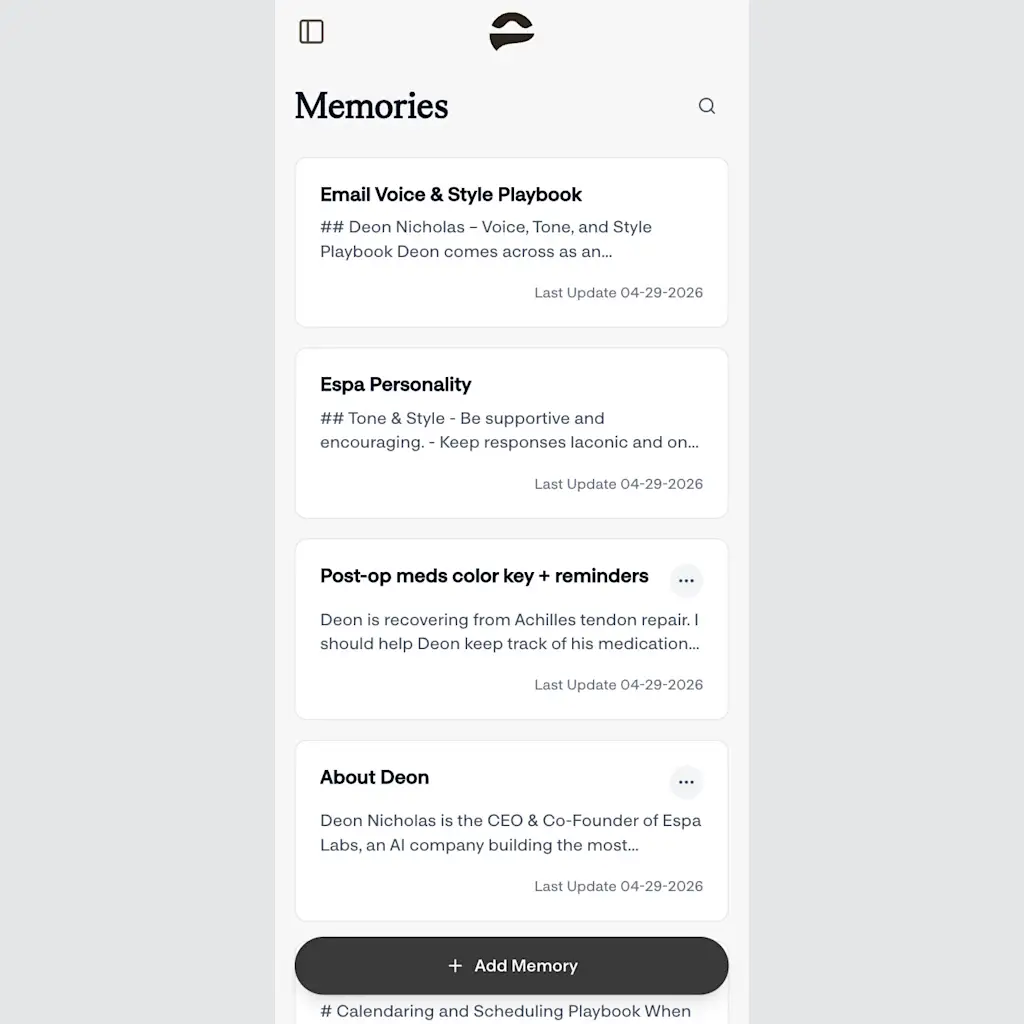
I’m too much of a wuss to run OpenClaw, and appreciated Espa’s more locked-down nature. But for a service that’s unlikely to careen out of control, it’s more open-ended than you might expect. For example, it gamely complied with my request that it monitor my inbox for airline receipts, turn them into calendar items, and cc: my wife so she knows about travel plans. It responds well to feedback, such as when I told it to check with me before turning random emailed event solicitations into calendar items. Up until then, its eagerness to please had led to it adding a few before I’d confirmed I had any interest in them.
Espa’s tendency to charge ahead is also reflected in its approach to email assistance. Along with assessing the gist of incoming messages and applying labels such as “Needs action” and “Needs reply,” it selectively drafts responses for my approval. If someone writes requesting a meeting, for instance, it might consult my calendar and dash off a brief message suggesting a few potential time slots, attempting to mimic my writing style.
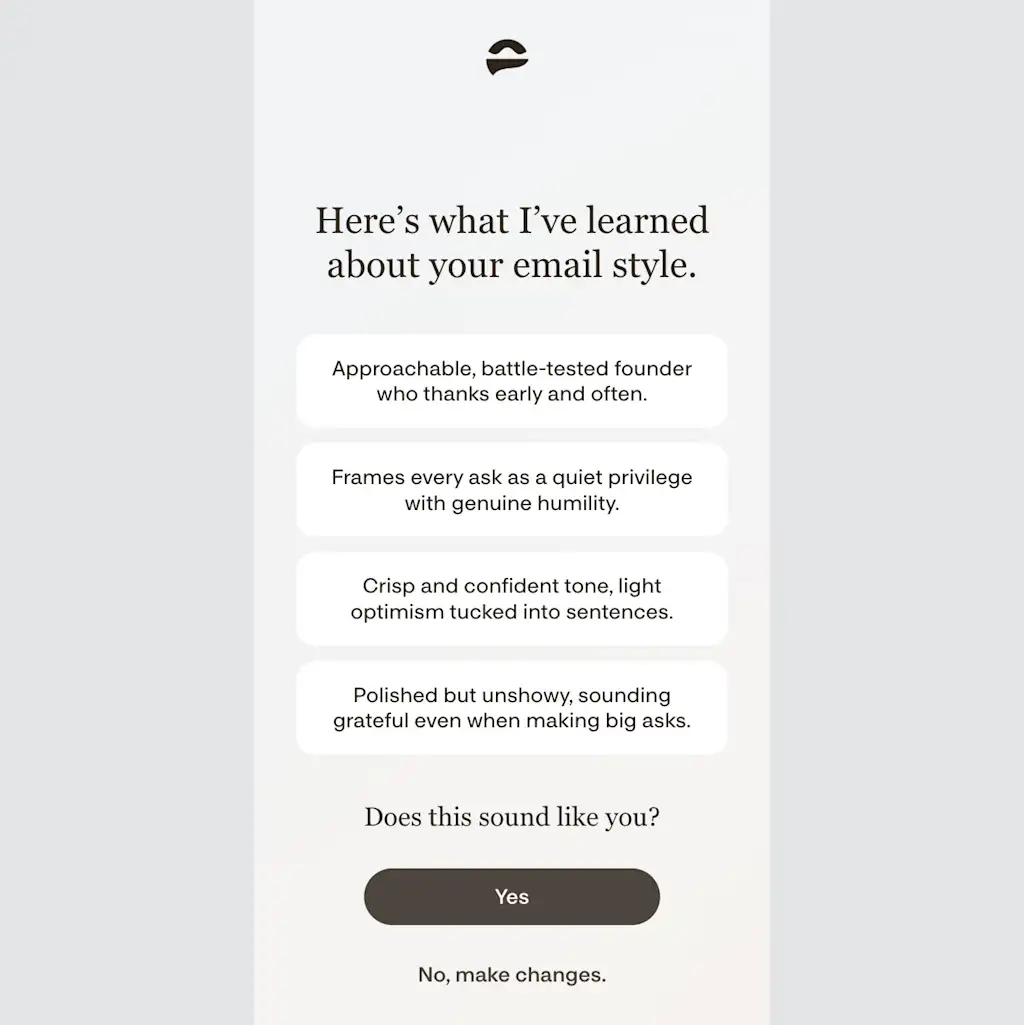
Ultimately, I didn’t send any of Espa’s proposed messages. No algorithm is well-equipped to contend with my particular inbox: The lot of a technology journalist is that pitches from PR people overwhelm everything else, and whether I’ll bite on one has little to do with how busy my schedule looks. Even if Espa were better able to channel my likely reaction, my gut tells me that emails meriting a response deserve one written by me. I did flirt with affixing a disclaimer to its messages, which it began adding at my request—“Note: This message was drafted by my AI assistant.”
My reservations about sending AI-generated email might explain why I find Espa impressive but a trifle pricey. Additional features are “coming soon,” including the ability to give it access to Google Drive, Google Docs, and Google Sheets; Docs and Sheets will be reserved for even pricier Pro-tier accounts. The more such integrations the service adds, the meatier its assistance will get. (People with paid Granola accounts can already have it tap into their notes.)
Even as a first draft, Espa is too rich with possibilities to fully assess during its seven-day free trial period. After a week, you’d still be developing a working relationship with any human assistant, and the same is true for this digital one.
I plan to spring for another month of service and figure out additional ways to throw my daily drudgery Espa’s way. If we truly mind-meld, its cost—which Nicholas points out is less than some people pay for Netflix—might start to feel downright reasonable.
You’ve been reading Plugged In, Fast Company’s weekly technology newsletter from me, global technology editor Harry McCracken. If a friend or colleague forwarded this edition to you—or if you’re reading it on fastcompany.com—you can check out previous issues and sign up to get it yourself every Friday morning. I love hearing from you: Ping me at hmccracken@fastcompany.com with your feedback and ideas for future newsletters. I’m also on Bluesky, Mastodon, and Threads, and you can follow Plugged In on Flipboard.
More top tech stories from Fast Company
If an obscure 1980s paradox is any guide, AI may be about to hit a huge tipping point
Is AI finally finding its economic groove? Read More →
Meta AI is coming to Threads, and some users aren’t thrilled
Threads is testing a feature that lets users summon Meta AI into posts and replies for real-time context, though many users say they never asked for it. Read More →
Can this Silicon Valley startup make autonomous fleets profitable?
Aseon Labs wants to help AV fleets scale with automated service pods that charge, clean, and inspect cars without sending them back to faraway depots. Read More →
Gantri just reinvented the wireless light. Now you can, too
The lighting company is launching a series of new wireless lamps, and giving everyone else the chance to design their own via a new platform. Read More →
The Demi Moore-AI debate is missing the point
The backlash to the actress’s Cannes comments reveals how conversations about artificial intelligence keep collapsing into shallow pro- and anti-AI tribalism. Read More →
The Internet Archive at 30: Can the web’s memory bank withstand the AI era?
Three decades after Brewster Kahle founded the Internet Archive to preserve humanity’s digital record, the nonprofit behind the Wayback Machine is confronting AI scraping fears, antagonistic publishers, and rising storage costs that threaten the future of the open web. Read More →