The United States has reached an ignominious milestone this week.
According to data from the International Vaccine Access Center at the Johns Hopkins Bloomberg School of Public Health, measles cases have now surpassed the 3,500 mark—a level not seen in 35 years.
Here’s what you need to know about the multiple outbreaks affecting the country, and which areas are currently being hit the hardest.
What’s happened?
According to the Johns Hopkins Bloomberg School of Public Health, as of September 18, 3,568 measles cases were reported in the United States this year so far.
More worryingly, nearly 10% of those cases—341 of them—occurred in the previous two weeks leading up to September 18.
The figure is nearly 1,300 more than the total U.S. measles cases reported in all of 2025, and a level not seen since 1991, when the U.S. Centers for Disease Control and Prevention (CDC) says measles cases reached 9,643.
Speaking of those CDC numbers, if you look at the agency’s official data up to September 18, you’ll see it differs slightly from the John Hopkins’s data. According to the CDC, measles cases for 2026 in the U.S. stand at 3,471 as of September 18. That’s a discrepancy of 97.
The difference seems to stem from the timeframes and the data the CDC uses to update its official measles dashboard, including, as the Guardian noted, how it registers measles deaths.
The CDC says its dashboard is updated with “only confirmed measles cases notified to CDC as of noon on Thursdays,” while John Hopkins updates its dashboard on Fridays “with intermittent updates as warranted.”
Why is measles surging in the United States?
Regardless of which current tally you go by, there’s no disputing that measles is running rampant in America compared to the historic number of cases going back the last three decades.
Measles was officially declared eradicated in America in 2000, with only dozens to a few hundred cases popping up in most years between 2000 and 2018. But then in 2019, measles cases spiked to more than 1,200, according to CDC data.
Cases dropped again during the pandemic as social distancing made the spread of the virus harder, but then in 2025 they surged to nearly 2,300, and in 2026, cases now top 3,500.
And it’s not just America. As reported by UNICEF USA last November, measles cases are rising globally.
But why? UNICEF says there are two main culprits: rising vaccine hesitancy and public health funding cuts. Both have accelerated in the U.S. since 2025, when measles cases began skyrocketing in the country.
Mapping measles in the U.S.
Both the CDC and John Hopkins have maps that track the number of measles cases across the country.
The CDC’s most recent map shows that in 2026, measles cases have been reported in all but five states.
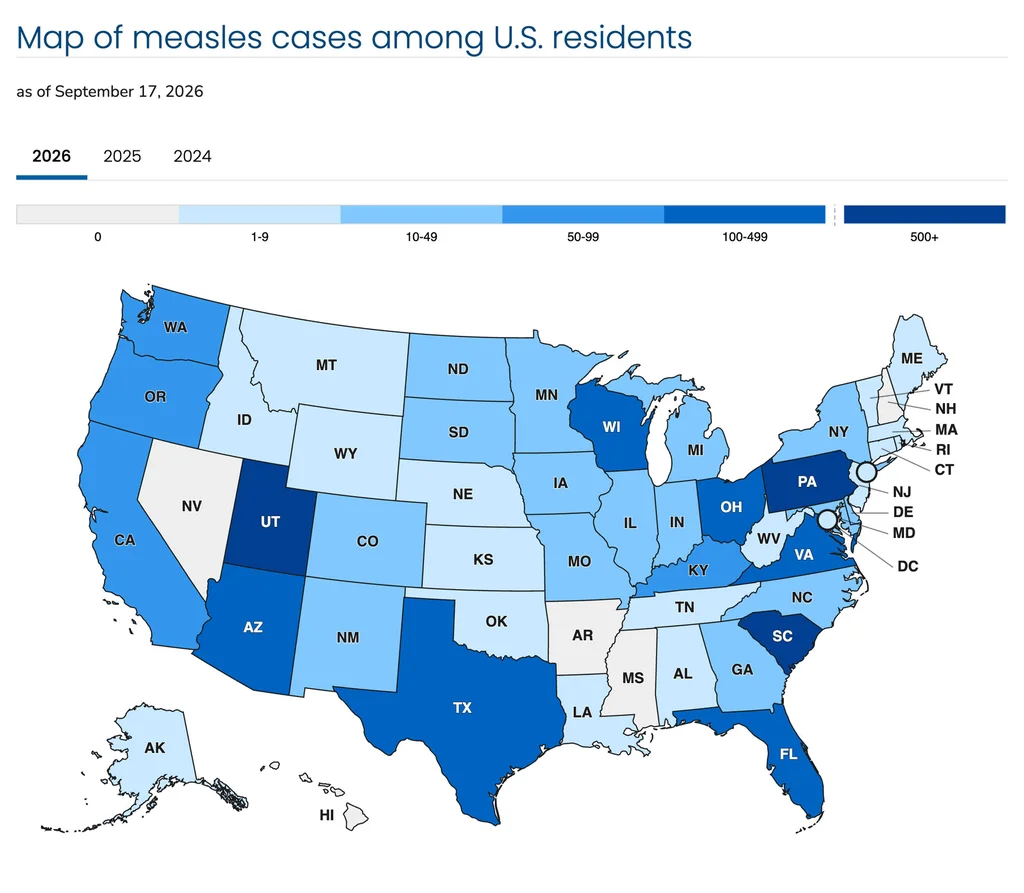
The five states with no reported cases are Arkansas, Hawaii, Mississippi, Nevada, and New Hampshire.
But those are the outliers. The map shows that nine states have reported more than 100 cases each, with the top three states reporting more than 500 cases each.
The worst state when it comes to the number of cases is Pennsylvania, where an outbreak is ongoing. That state so far has had 745 cases in 2026. South Carolina comes in second with 670 cases this year, and Utah third with 527 cases.
John Hopkins’s measles tracker map corroborates those state rankings on a year-to-date basis. However, the university also offers another map that covers just the last two-week period, which helps to visualize where outbreaks are currently occurring.
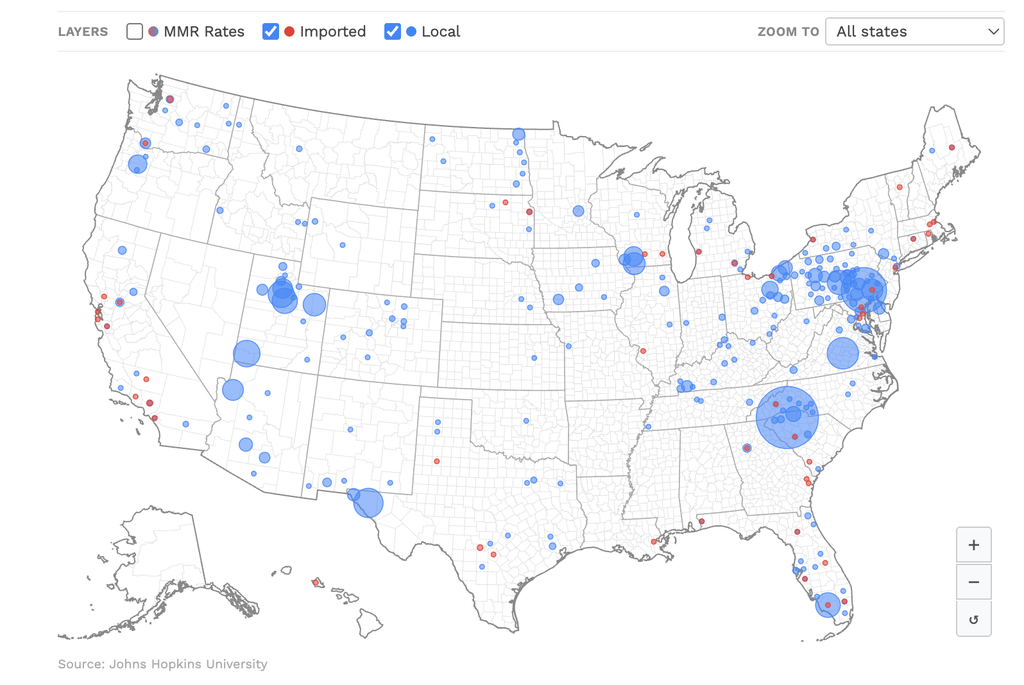
According to that map, for the September 4 to September 18 period, 314 cases have been confirmed, with the majority—193 of them—happening in Pennsylvania. Ohio is the next state with the highest number of cases, at 58. Wisconsin follows in third place with 20 cases.