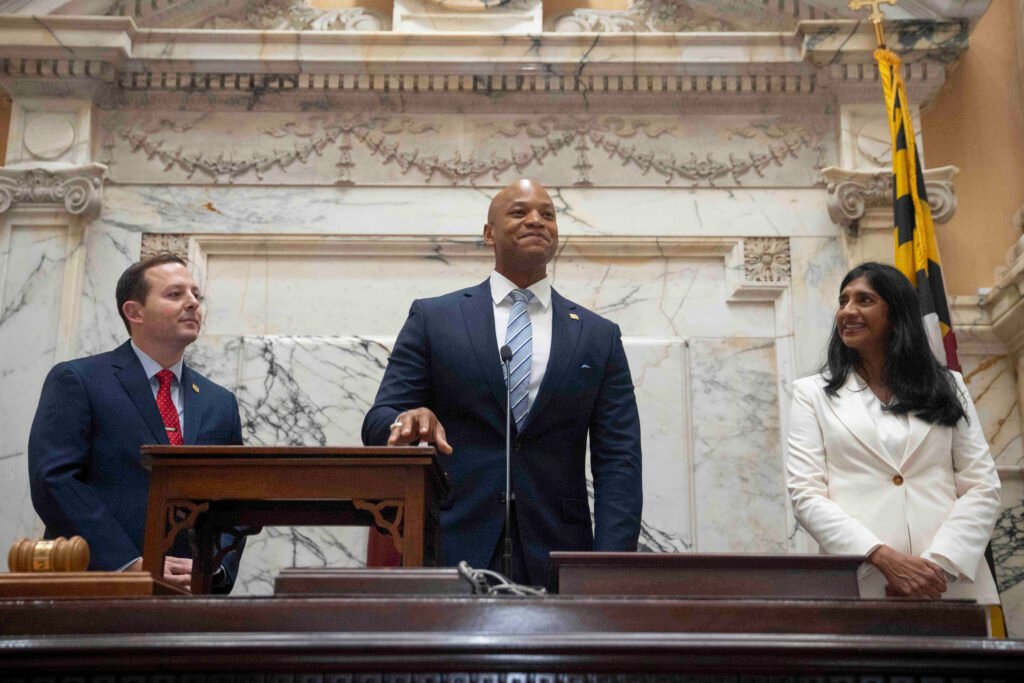
ANNAPOLIS, Md. — Maryland Democrats kicked off a special session on redistricting Monday, with the battle to redraw House districts around the country showing no signs of stopping at the November midterm elections.
Democrats are gearing up for a process to ultimately draw out the state’s only Republican member of Congress, Rep. Andy Harris. But any new map wouldn’t kick in until 2028.
Instead, the state Legislature is in town this week to vote on a constitutional amendment that some party leaders believe would insulate future redistricting efforts from legal scrutiny. This, after a Maryland state court blocked a proposed 8-0 Democratic district map in 2022, charging that it ran afoul of the state Constitution.
While Democrats around the state, including Gov. Wes Moore, had called for the Legislature to enact redistricting in time for this year’s midterms, Senate President Bill Ferguson — also a Democrat — has long argued that any map redraw coming before an amendment wouldn’t pass legal muster, and that the downside risks were “catastrophic.”
“We’ve known from the beginning what is at stake, and most importantly, we have known that in this moment of American history, it is insufficient to act with haste when the consequences of missteps are so impactful,” Ferguson said at a Monday press conference. “What those consequences could have looked like: a map rejected by Maryland’s Supreme Court. A map drawn by the court that sends us backwards when we could least afford it.”
The new language aims to make clear that certain requirements around compactness and respecting natural and political boundaries apply only to legislative districts and not congressional ones, which could clear a path for the state to gerrymander.
Should lawmakers pass it, Maryland voters would still need to approve the proposed amendment in November.
Republicans have taken a major lead in the interparty redistricting war for this year’s election, particularly after redrawing maps in a handful of Southern states after the Supreme Court gutted the Voting Rights Act in April.
“A legal earthquake changed the landscape this spring,” Ferguson said. “Even worse, we saw states like Tennessee, Louisiana, and South Carolina act with haste to attempt to eliminate majority-minority congressional districts. These acts changed the calculus, and that’s why we’re here.”
(Tennessee and Louisiana changed their lines for 2026, but South Carolina ultimately did not.)
The amendment, Ferguson said, “ensures that Maryland has the ability to respond if the Trump administration or any future federal administration seeks to further erode the basic standards of democracy.”