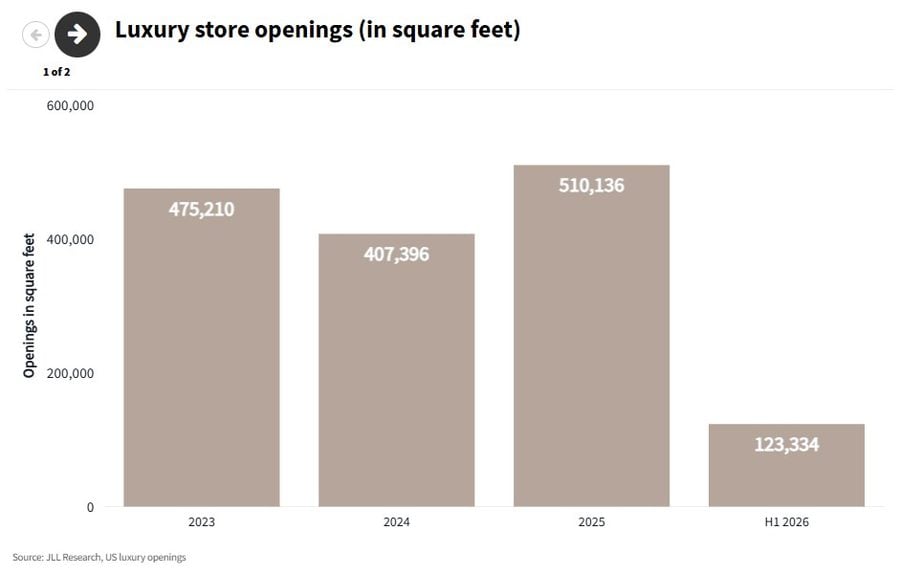
In 2025, leasing activity for luxury retail topped 500,000 square feet, with 277,000 square feet completed in the first half of the year. During the first half of 2026, luxury retail spacing was down, with 123,334 square feet leased, according to JLL.
There are a few reasons for the numbers:
- Deloitte’s Global Powers of Luxury report showed that 39.3% of luxury executives are focused on network optimization, meaning prioritizing a smaller number of higher-quality locations over door count.
- Luxury leasing in the U.S. has been uneven since 2023. JLL pointed out that quarterly numbers tell a more in-depth story as “activity consistently spikes in the back half of the year as brands time their biggest debuts to catch holiday traffic and close out capital plans before the fiscal year turns.”
- Three of five U.S. openings above 10,000 square feet landed on the street in New York and Los Angeles, with prime corridors capturing 30 of 45 street retail openings. “Street activity concentrates heavily in a handful of established addresses, rather than spreading across secondary retail streets,” JLL said.
- Half of every opening (48.4%) clocked in at under 2,500 square feet. Another 29.5% were between 2,500 and 5,000 square feet, while 16.8% fell between 5,000 and 10,000 square feet. “Only 5.3% cleared 10,000 square feet,” according to JLL.
- New flagship locations are also becoming destinations, adding cafés, dining rooms and gallery and exhibition space. Some offer room for traveling pop-ups and installations. A brand that adds extras needs additional square feet and different infrastructure.
“Corridors and centers that can accommodate that specification will keep winning flagship deals,” JLL said. “Those that cannot will compete for the compact formats instead.”
Photo: Creative Lab/Shutterstock
The post Luxury Retail Gets Pickier as Brands Rethink Store Footprints appeared first on Connect CRE.