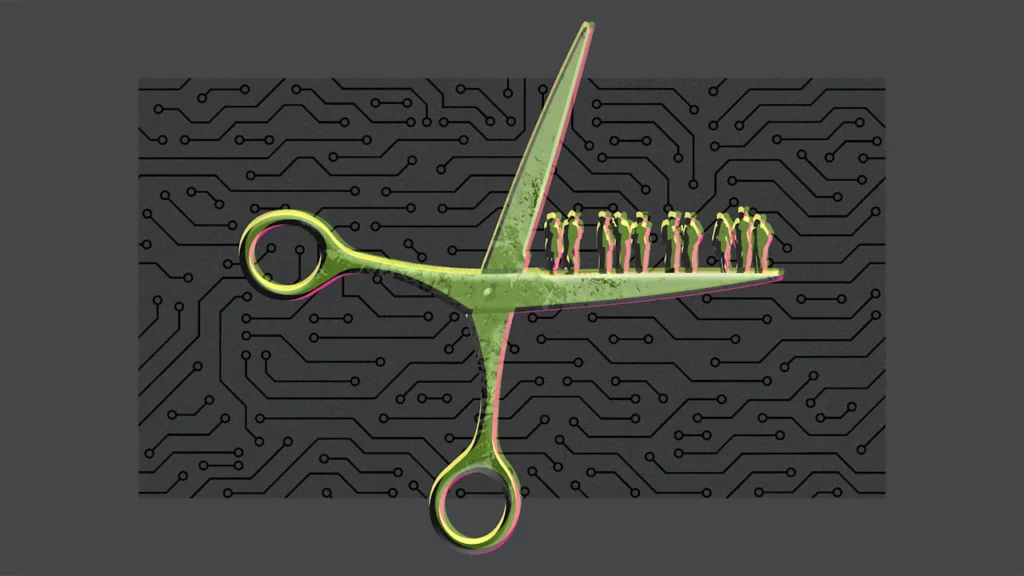
As tech companies continue slashing jobs with impunity, workers are right to be fearful—and fed up. But it appears overall layoffs may actually be slowing down, according to the latest report from outplacement firm Challenger, Gray & Christmas.
In April, employers across the country announced 83,387 job cuts, an uptick of 38% from the 60,620 cuts during the month prior. That figure is, however, lower than it was in April 2025, when layoffs had reached 105,441. Overall layoffs for 2026 have also significantly dropped relative to last year: As of April, employers have disclosed plans for over 300,000 layoffs—half the number of layoffs that had been announced by this time last year.
But in tech, there were 33,361 job cuts in April, bringing year-to-date layoffs to 85,411—an uptick of 33% from the 64,118 layoffs at this point in 2025. In fact, this is the highest year-to-date total since 2023, when the industry saw record-high layoffs.
The tech industry is often an exception to broader economic trends, given the boom and bust nature of the sector. Even when tech layoffs spike, those cuts don’t necessarily account for a sizable portion of total layoffs across the labor market—though they tend to get outsized attention from the media and industry observers.
In this era, tech is also uniquely susceptible to the sweeping investments in AI that are driving many layoffs in the industry. The report by Challenger, Gray & Christmas captures this effect: In April, AI was the top reason that companies cited for layoffs, accounting for 26% of job cuts. AI has been behind 49,135 job cuts so far this year, and it is the third most frequently cited rationale for layoffs.
“Technology companies continue to announce large-scale cuts and are leading all industries in layoff announcements,” Andy Challenger, the workplace expert and chief revenue officer for Challenger, Gray & Christmas, said in a statement. “They are also often citing AI spend and innovation. Regardless of whether individual jobs are being replaced by AI, the money for those roles is.”
There is, of course, plenty of debate over how many of these job cuts actually reflect AI-related productivity gains, especially as CEOs face immense pressure to prove that their AI investments are worthwhile. Economists have cautioned that AI has yet to usher in major shifts across the labor market, and that jobs are not yet being replaced outright.
Still, these ongoing layoffs are yet another sign that the tech industry no longer promises the job security that it once did—and tech workers have reason to be disillusioned as they brace themselves for endless rounds of layoffs.