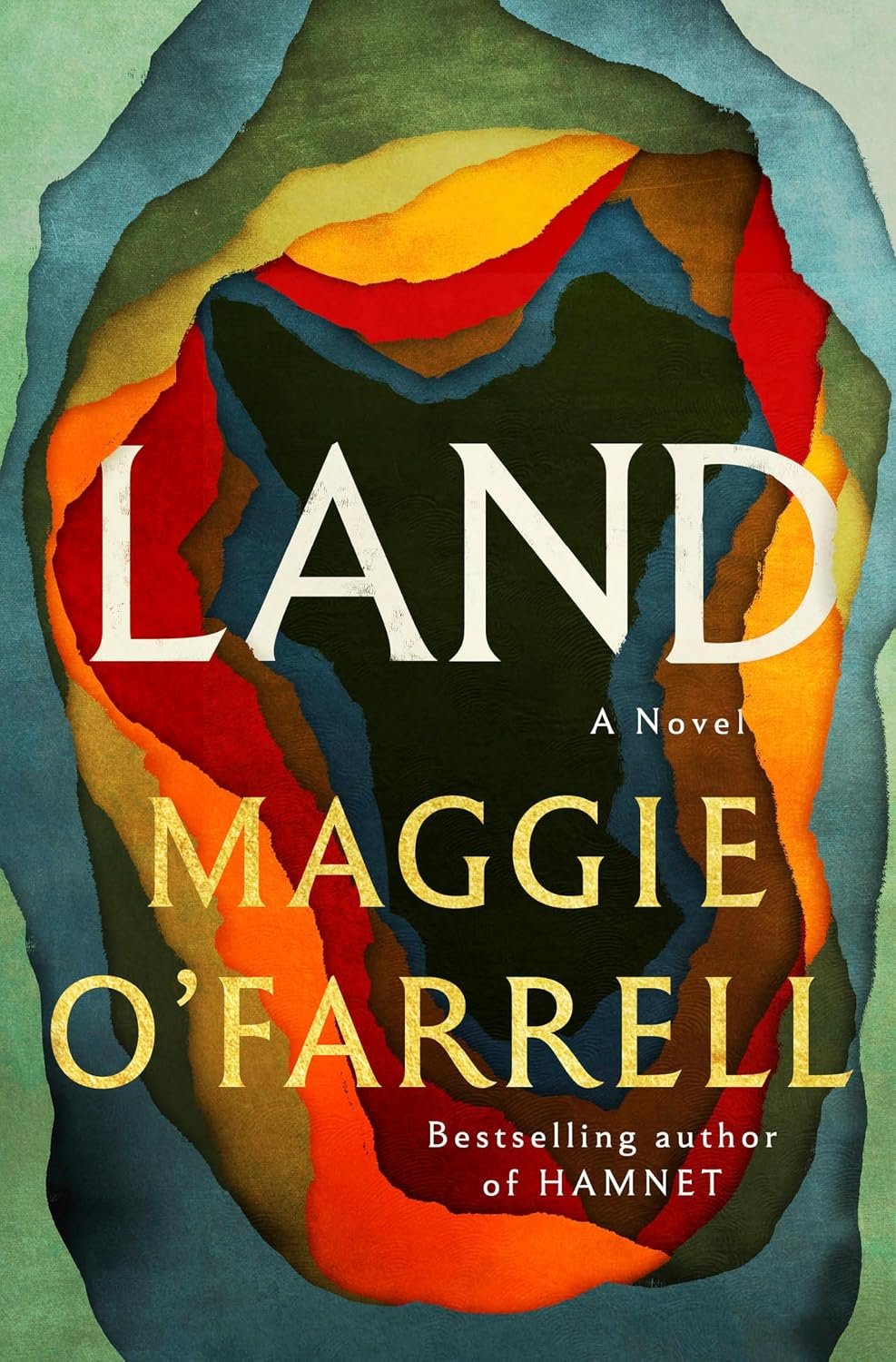
Land by Maggie O’Farrell is a book to be experienced and luxuriated in.
I felt such intensity for this family and all the challenges they faced. It’s sweeping historical fiction about survival, family trauma, Ireland, motherhood, colonialism and our connection to the places we call home. It’s also mystical, occasionally strange and deeply unsettling.
Which leads me to something you should know before I go any further.
Warning: This book contains several extremely violent and disturbing passages, including violence against women and dogs. It’s not the main theme of the book, but if these are triggers for you, steer clear.
Still with me? Good.
Because Land is one of those books that made me want to hug my daughters and my dog close, book a trip to Ireland and immediately read more Maggie O’Farrell.

The Setting: Ireland After the Great Hunger
Most of the novel is rooted in Ireland in the aftermath of the Great Hunger, or Irish Potato Famine, which devastated the country between 1845 and 1852. Roughly one million people died and another million emigrated. Potato blight triggered the crop failures, but British government policies and the continued export of food from Ireland intensified the catastrophe.
This history isn’t simply background noise. It shapes everything.
Tomás and Phina are each the lone surviving children of their respective families. They meet in a Dublin workhouse, carrying a kind of trauma that we would understand very differently today.
Tomás is quick with calculations and possesses neat penmanship—skills that eventually provide his passage out of the workhouse and into employment working on the British Ordnance Survey of Ireland.
Though poorly treated, Tomás saves enough money to help Phina leave the workhouse, and the couple sets up house in Dublin. They live with their growing family in crowded rented quarters. They have a home, but they don’t have much control over it.
For Tomás, the dream of land represents something different: permanence, independence and perhaps even peace.
Mapping a Country—and Its Trauma
Tomás continues his cartography work while Phina tends to their growing family.
His job is one of the most fascinating aspects of the novel.
Tomás is working on the British Ordnance Survey of Ireland, helping map and standardize a landscape whose ownership, population and place names have been profoundly shaped by British rule and the Great Hunger.
There’s a terrible irony here.
Tomás is an Irish famine survivor working for the British to map an Ireland that has been emptied of so many of its people. He wants his maps to record what happened—to show the abandoned homes, changed boundaries and scars left behind.
Add to this the survivor’s guilt of being the only member of his family to survive the famine, and Tomás is carrying an enormous psychological burden.
Then, during a surveying trip with his son Liam, something happens.
Today, we might interpret Tomás’s experience through the lens of trauma or a psychological break. In his own world, however, there is talk of demonic possession and supernatural forces.
Whatever happened to him, Tomás returns changed.
There’s no talk therapy waiting for him. Instead, the episode causes him to rethink his purpose and eventually uproot his family from Dublin.
His solace becomes Phina—and the land.
But Whose Land Is It?
This is where the title really begins to do some work.
Tomás uses the family’s savings to lease land from a local viscount, an aristocratic landowner, and moves his family to a remote peninsula. Their new home is a ruined cottage abandoned during the Great Hunger.
Importantly, Tomás hasn’t bought the property. He’s paying for the right to occupy and work land owned by someone else.
Before the Great Hunger, the estate had supported dozens of tenant households. Afterward, only a handful remained, with much of the land turned over to grazing.
People replaced by sheep.
We see capitalism—and colonialism—at their most inhumane.
And it raises one of the questions that runs throughout Land: Who gets to say that land belongs to them?
The aristocrat who holds the title?
The family who pays rent?
The people who work it?
The generations who lived and died on it before them?
Or the government that arrives to measure it, rename it and draw lines around it?
Tomás becomes fiercely connected to this patch of Ireland, but he never truly owns it. And despite all his efforts, he never quite finds peace there.
A Family Scattered
There is no guaranteed safety in the remote countryside.
Trouble follows the family even to the far reaches of the coast. Phina dies. Tomás is horribly injured during a surveying project. Those losses send ripples through the family, eventually scattering the children.
Liam, Enda, Rose and Eugene respond differently to the trauma they’ve inherited, but they remain connected to one another—and to their father’s troubled relationship with the land.
Can the children escape the cycle?
For me, this is where Land is at its best.
Like many families, there are fierce sibling bonds alongside deep rifts. There is loyalty and resentment. Children misunderstand their parents. Parents unwittingly hand their trauma to their children.
O’Farrell knows how families work.
 Credit: Momtrends Media
The Mystical and Magical
And then O’Farrell goes back. Way back.
Thousands of years.
The novel reaches into an ancient version of Ireland, where earlier inhabitants of the same landscape also battle hunger, invasion, violence and loss.
The story of a young girl and her dog becomes intertwined with the later family’s experiences on the land. It’s as if the landscape itself possesses a memory, capable of holding what happened there long after the people are gone.
At the center of this mystical thread is a hidden well tucked inside a copse—a word I had to look up after listening to the audiobook. A copse is simply a small group of trees or little wooded area.
But there’s nothing simple about this particular copse.
The well becomes a place of power, danger and mystery, linking people who occupy the same piece of earth thousands of years apart.
It’s magical realism, but it also reinforces one of O’Farrell’s central ideas: history doesn’t disappear just because the people who experienced it are gone.
The land remembers.
And Then There’s Eugene
One of my favorite threads involves Eugene, who gradually becomes an almost mythical presence in the rural community.
O’Farrell turns him into a sort of gruagach, a figure from Gaelic folklore—a mysterious rural spirit associated with the land and domestic life, appearing and disappearing, taking what he needs and leaving something in return.
It’s a lovely device.
In a book where British surveyors are measuring, categorizing, naming and mapping everything they encounter, Eugene remains something that can’t be easily categorized.
He belongs to the landscape in an entirely different way.
What Land Is Really About
On the surface, this is an intergenerational historical novel about one Irish family and the fierce battles its members face to stay alive.
But it’s about much more than that.
It’s about who owns land and who gets displaced from it.
It’s about the trauma parents pass to their children.
It’s about famine and survival.
It’s about mapping and naming.
It’s about the stories that disappear from official records but remain alive in families and places.
And it’s about the possibility that a landscape can remember what happened upon it.
What Mattered to Me
While Tomás might appear to be the central character, he’s by no means the only one who will resonate.
For me, it’s the women O’Farrell really gets right.
The women in Land are fierce, but they are also extraordinarily vulnerable. They endure motherhood, violence, poverty, displacement and loss while finding ways to keep moving forward.
These women—and the dogs they love—will stick with me.
Yes, the dogs.
This is also, unexpectedly, a book about the extraordinary loyalty of dogs.
In particular, Bran, a lurcher.
Naturally, I went down a dog rabbit hole.
A lurcher isn’t technically a single breed. It’s a type of dog traditionally created by crossing a sighthound—such as a Greyhound, Whippet or Deerhound—with another breed, often a working dog such as a Collie or terrier.
They’re lean, long-legged, fast and very British-countryside-looking.
Which led me to the obvious question:
WHAT KIND OF DOG IS BRAN AND HOW DO I GET ONE?
I am now accepting lurcher applications.
Final Thoughts
Land is heart-wrenching historical fiction about resilience, inherited trauma, family and our complicated relationship with the places we call home.
It’s not an easy read. There is tremendous brutality here, and O’Farrell doesn’t shy away from showing how vulnerable women, children and animals can be in a world where powerful people control nearly everything.
But there is also enormous beauty.
I finished Land wanting to hug my daughters and my dog close, travel to Ireland to see these landscapes for myself—and read more Maggie O’Farrell. Get it on Amazon here.
One-line takeaway: Land is a sweeping, haunting family saga about Ireland, survival and the idea that people may disappear, but the land remembers.
For fans of: Hamnet, sweeping historical fiction, multigenerational family sagas, Irish history, magical realism, complicated sibling relationships and novels where the landscape becomes almost as important as the characters.
Would I recommend it? Absolutely—with the warning that some passages are genuinely difficult to read.
A Note for Audiobook Listeners
Audiobook note: I listened to Land, narrated by Dane Whyte O’Hara, who is a master storyteller. His narration adds another layer to O’Farrell’s already atmospheric writing. It’s a wonderful “listen” as well as a read—and an especially good choice if you want to hear the Irish names, places and language brought to life.
You can find this—and everything else I’m reading this year—on my running 2026 book list.

The post Land by Maggie O’Farrell Book Review: Family, Ireland and the Stories the Land Holds appeared first on Mom Trends.