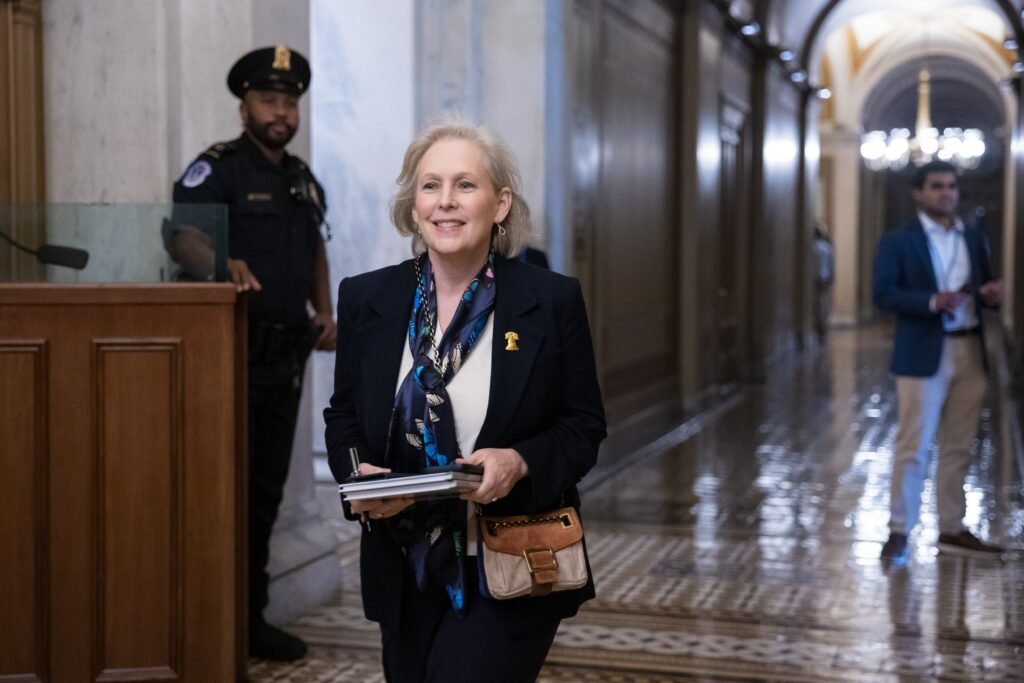
Democrats have improbably won at least 55 Senate seats in the upcoming Congress. Kirsten Gillibrand is already looking for a path to a filibuster-proof 60.
The Senate Democratic campaign chair, in an interview with POLITICO after last week’s sweeping wins, laid out the possibility of flipping seven more seats in 2028, when the party faces a more favorable map but could also face a referendum on their own leadership in Congress after two years in power.
Such a feat would give Democrats a Senate supermajority capable of defeating GOP attempts to block major bills. Coupled with a presidential win and a House majority, it would give them a level of unilateral power in Washington unseen since 2010, when President Barack Obama signed major health care and financial regulation overhauls.
Gillibrand pointed to several states President Donald Trump won three times that Democrats plan to heavily target, including Iowa, South Carolina and Kansas. Democrats flipped seats in those three states last week, and she also named Alaska — where they are optimistic they will unseat GOP Sen. Dan Sullivan once all the votes are counted.
Gillibrand also pointed to more traditional swing states including Wisconsin, where Democrats just swept state government, and North Carolina, where they took back retiring GOP Sen. Thom Tillis’ seat, as “the two bluest states that are in play” that Democrats would “absolutely” target.
“All of those states will now be states that we’re going to be hoping to find the best candidates, getting them early, organizing the grassroots early, trying to help state parties raise money so that they can actually organize,” Gillibrand said.
Democrats could also try to go back after some of the near-misses. Gillibrand mentioned Florida, where some in the party have publicly criticized leaders for not devoting considerable resources to what ended up being a closer-than-expected race.
Both Gillibrand and Senate Democratic Leader Chuck Schumer brushed off any second-guessing in the days after the election about Florida, an expensive state that would have required Democrats to pour in potentially hundreds of millions of dollars across several media markets.
“We had a big map, and we tried to maximize the number of states we could win,” Schumer said in an interview last week in his Capitol Hill office, while Gillibrand said in a separate interviewthat “you would have needed Texas-sized money to win in Florida.”
Democrats will also have to play defense in a number of states. Sen.-elect Sherrod Brown, who won his comeback special-election bid last week, must run again in 2028, and fellow Ohio Sen. Bernie Moreno, the incoming Senate GOP campaign chair, warned Brown about his Washington home search this week: “Make sure you rent, do not buy.”
Moreno and Senate Republican Leader John Thune met this week to start plotting out their own 2028 strategy. Though the map is viewed as more favorable to Democrats, Republicans are hoping the party overreaches with voters or gets mired in infighting, creating opportunities for GOP pickups.
In addition to Ohio, Democrats will need to defend seats in Georgia, Nevada, Colorado and Arizona — states that Republicans are all but guaranteed to make major investments. Pennsylvania Sen. John Fetterman is also up for reelection. He hasn’t said yet if he’s running, but he is likely to face a challenge if he enters the Democratic primary.
Gillibrand is preparing to volunteer for a second term as chair of the Senate Democratic campaign arm. So far, she faces no competition for the job but is making an emphatic case for another tour of duty.
She pointed to early recruitments of top-tier candidates such as former Gov. Roy Cooper in North Carolina and Brown in Ohio, investing early in key states and a partywide focus on rising costs as lessons from 2026 that she believes Democrats should carry over into 2028.
Many progressives have criticized the DSCC and Schumer’s primary strategy, accusing them of tilting the playing field against more left-leaning candidates. Most notably, Schumer backed Rep. Haley Stevens in a fierce Michigan primary, only for her to lose and then turn on the party’s hard-left nominee, Abdul El-Sayed, in the final days of the election.
Asked about changes to the DSCC’s primary strategy, Gillibrand did not answer directly but said that in states like Maine and Michigan, it largely focused early on attacking Republicans, not boosting particular Democrats.
“The DSCC doesn’t really have a primary strategy. If it’s a blue state, we really let all flowers bloom,” she said. “If the state’s going to be a winning state for Democrats, we don’t worry at all.”