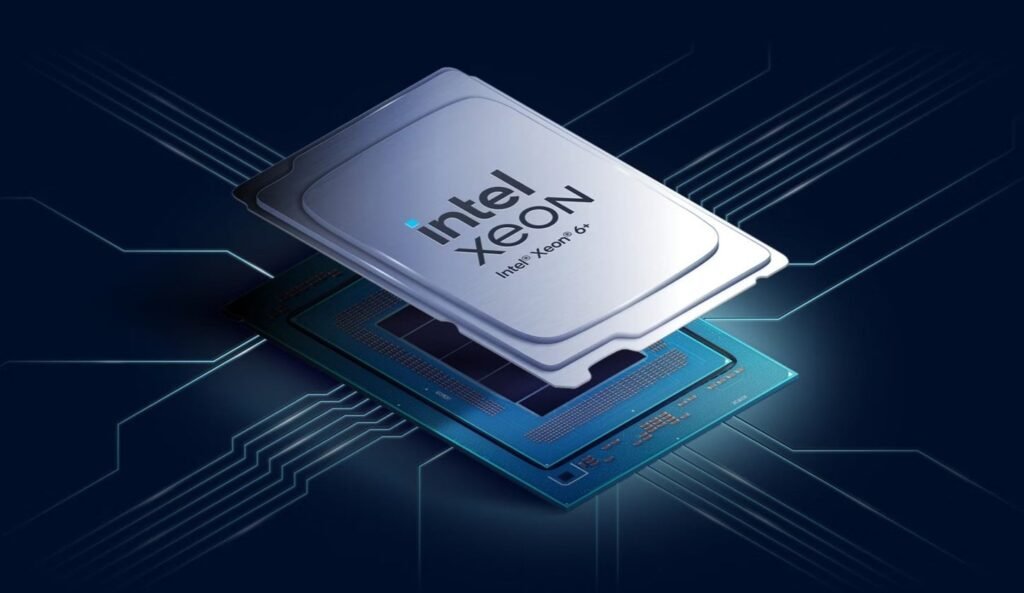

For a minute there, it looked like graphics cards and specialized accelerators completely stole the data center spotlight. However, as artificial intelligence evolves into complex autonomous agents, a major infrastructure shift is happening behind the scenes. Intel has officially launched its second-generation, Efficient-core-only processor family, codenamed Clearwater Forest. Arriving on the market as the Intel Xeon 6+ lineup, this massive 288-core chip makes a bold statement: the central processing unit is re-emerging at the center of modern AI infrastructure.
Intel 18A process node debuts with Xeon 6+ “Clearwater Forest” chips for AI
Clearwater Forest represents a major manufacturing milestone for Intel. It is the company’s first high-volume data center product built on the Intel 18A process node. To get this disaggregated architecture off the ground, Intel combined twelve compute tiles built on 18A, three base tiles using the Intel 3 process, and two I/O tiles fabricated on Intel 7.
The chip achieves its dense footprint through two proprietary breakthroughs. First, it uses PowerVia, an engineering approach that delivers electrical power from underneath the silicon—often called back-side power—to clear up routing congestion and maximize cell utilization above 90%. Second, it is the first high-volume chip to use Foveros Direct3D. This advanced design uses copper-to-copper bonding to bridge the components together with such low electrical resistance that it requires virtually zero power to transfer data across the dies.
Tackling real-world server workloads
The actual compute heavy lifting relies on Intel’s new Darkmont E-cores. These specialized cores feature a much wider instruction decode layout and significantly larger cache capacities compared to prior architectures. According to performance data shared by Intel, this translates into up to 90% higher performance than the previous-generation Sierra Forest chips, while enabling a massive 9:1 server consolidation ratio. This helps corporate data centers slash their overall footprint and operating costs (via Wccftech).
When compared directly to the competition, the flagship 450-watt Xeon 6990E+ holds its ground. Performance benchmarks published by Intel show that the 288-core Xeon 6+ delivers an average 30% uplift in both raw performance and power efficiency over AMD’s 192-core EPYC 9965 “Turin” processor across a broad variety of enterprise workloads.
Clearing data bottlenecks
Intel is well aware that raw processing power means very little if information gets trapped in a digital traffic jam. To support the heavy concurrency, data movement, and orchestration demands of emerging agentic systems, Intel simultaneously expanded its hardware ecosystem with the launch of the Intel Ethernet E835 portfolio.
These new controllers and network adapters scale all the way up to 200GbE throughput. The E835 adapter delivers up to 1.9 times higher performance-per-watt than comparable hardware from NVIDIA. To achieve this, it’s built with virtualization and high performance-per-watt efficiency in mind. Overall, it ensures that data smoothly flows to the CPU control plane without wasting precious grid power. Major industry hardware suppliers like ASUS, Dell, HPE, and Lenovo are already building ready-to-deploy enterprise systems around this coordinated silicon platform.
The post Intel Strikes Back: 288-Core ‘Clearwater Forest’ Ready to Power Agentic AI appeared first on Android Headlines.