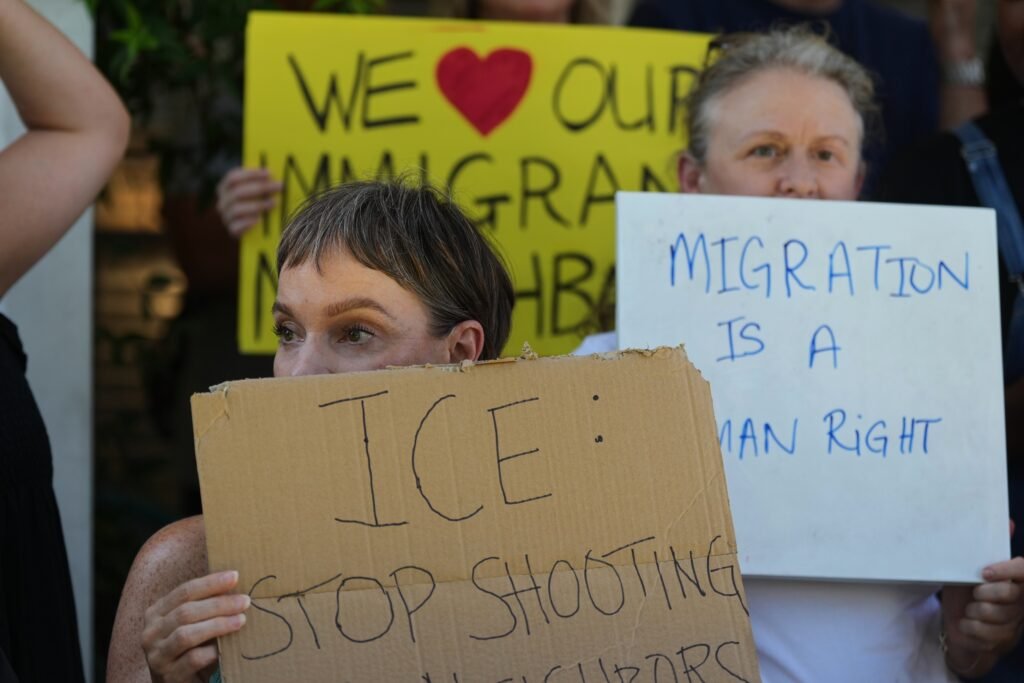
Battleground Republicans across the country are on defense as ICE operations keep finding their way into local headlines.
A flurry of ICE activity in four rural Kansas towns this week prompted businesses to shutter and public schools to urge families to identify who could pick up children from schools in case their parents were detained. Sen. Roger Marshall (R-Kansas) — a normally staunch MAGA defender who finds himself in a tougher-than-expected election — took to social media to say he was “closely following” the situation, signaled his displeasure that ICE wasn’t working more closely with local law enforcement, and said he had phoned Homeland Security Secretary Markwayne Mullin.
Later, he complained that ICE’s failure to communicate with local law enforcement caused “mass disruptions to local communities and businesses.”
“We must keep our communities safe, but it has to be done in a responsible and secure manner,” he said in a statement Thursday evening.
Mullin took over DHS in March with a mandate to keep immigration enforcement out of the news following a public outcry over the killing of two Americans by immigration agents during enforcement operations in Minneapolis. No subsequent incidents have generated the same type of national attention — but ICE’s recent record-high arrest rate is still landing hard in some communities.
“It does cause quite a disruption in the community,” said Scott Fischer, the GOP chair in Ford County, one of the counties where ICE activity was reported this week. “We don’t want our community disrupted.”
In Florida, local officials are warning about the impact of ICE raids on businesses, and a Republican incumbent is on air with a Spanish-language ad denouncing Trump’s crackdown. In Michigan, Democrats are calling for an investigation after a man crashed his car and died while fleeing ICE. In Maine, the fallout from a fatal ICE shooting of a 25-year-old from Colombia continues to loom over GOP Sen. Susan Collins’ reelection race. In Texas, last week’s nonfatal shooting of a Venezuelan in Austin is just the latest of several highly publicized ICE operations that have fueled wall-to-wall media coverage.
“There’s already been some blowback associated with what people feel is a little bit of a heavy hand when it comes to immigration enforcement,” said Sen. John Cornyn (R-Texas). “Obviously, border security is critical, but I think the administration maybe has miscalculated a little bit. … It is going to be one of the factors people are weighing in the election.”
The Department of Homeland Security said in a statement that the department “is focused on delivering the most HISTORIC mass deportation campaign in American history—exactly as President Trump promised.”“The men and women of ICE are enforcing the laws passed by Congress. We do not pick and choose which laws to enforce or where to enforce them,” the statement continued. “We will continue to enforce our nation’s laws and remove illegal aliens from American communities. Under President Trump and Secretary Mullin, if you break the law, you will face the consequences. Illegal aliens are not welcome in the U.S.”
The Trump administration’s deportation spree is not widely popular. A new POLITICO Poll finds that a plurality of U.S. adults, 49%, think the mass deportations campaign is “too aggressive,” while 26% find it “about right” and just 14% think it is “not aggressive enough.” And in an election cycle where cost of living is atop voters’ list of concerns, ICE enforcement has become an economic issue too: Immigration raids are affecting workers, from construction sites in Texas to meatpacking plants in Kansas, frustrating business leaders.
In Kansas, where Democrats aim to win a U.S. Senate seat for the first time in nearly a century, ICE’s activity this week has provided another political opening.
“This is not how Washington should be treating Kansans,” Adam Hamilton, the Democratic nominee for Senate, said on social media Wednesday.
“It impacts these operations economically,” said Matt Teagarden, CEO of the Kansas Livestock Association, whose organization released a joint statement Thursday noting the “massive chilling effect” of ICE enforcement on “the legal, documented, skilled workers that put beef on the table and keep the cattle supply chain moving.”
“We’re all for getting the bad actors out of our communities,” Teagarden said. “The method by which they do that has an impact. We’ve seen it.”
Mullin said in a statement Friday that “ICE is not conducting worksite operations in Kansas” but “operations targeting heinous criminals including murderers, rapists, and drug traffickers and illegal aliens with final orders of removal.”
Some of Marshall’s allies downplayed the possibility that the immigration activity could have political ramifications.
“Senator Marshall has nothing to do with when ICE decides to do a surge, and I think most people understand that,” said Danedri Herbert, chair of the Kansas Republican Party.
But others winced at the way ICE conducted itself, even those who say enforcement is necessary to remove criminals.
“I’d sure ask that we go back to some of the concepts of working with local law enforcement who actually know the area better, and I think that might have improved things tremendously,” said Kansas State Rep. Jim Minnix, a Republican who represents Scott County, where some of the ICE activity occurred.
Texas has become the epicenter of ICE activity: One in five ICE arrests nationwide this year has occurred in the Lone Star State. Sunday’s Austin shooting came on the heels of a fatal ICE shooting in July. In South Texas, local news is consumed with a story of two teenagers who were stopped by ICE agents en route to a military recruiter’s office, one of whom was beaten on the side of the road. After17-year-old Luis Ochoa spoke out to say he was pepper sprayed and detained, his mother was quickly deported.
Bobby Pulido, the Democrat running in Texas’ 15th District, said his campaign has received more than 80 requests from South Texans asking for immigration help. The campaign passes those requests to pro bono attorneys, he said.
“Every single day we’re having people reach out. And it’s very frustrating, because we can’t help everybody,” Pulido said. “I’m not a congressman.”
His opponent, GOP Rep. Monica De La Cruz, has attempted to separate herself from the administration’s immigration crackdown: She hit the airwaves with an ad this month featuring a woman touting De La Cruz’s work getting her husband, who had legal status, released from immigration custody.
“I have been very direct with the White House, with leadership, that enforcement policy should be focused on the criminals and on the cartels that are terrorizing our communities,” De La Cruz said during an appearance on a conservative radio show Thursday. “They should not be on hardworking immigrants that are navigating the immigration process.”
Maine Democrat Troy Jackson has made Duran Guerrero’s death a key focus of his Senate campaign, hosting a town hall in the city where he was killed earlier this month and frequently criticizing Collins for voting to fund the Homeland Security Department. In response, Collins has emphasized she supports guardrails for ICE officers like body cameras and deescalation training.
In South Florida, public pressure is growing this week against policing partnerships with ICE as businesses report a dropoff in sales. GOP Rep. Maria Elvira Salazar released an ad — in both English and Spanish — that criticized the Trump administration for going “too far” on immigration. In the ad, she claims that half of the people detained in July “had no criminal record” and says Hispanics who backed Trump in 2024 feel “betrayed.”
Liliam López, president of the South Florida Hispanic Chamber of Commerce and the U.S. Hispanic Women’s Chamber of Commerce, said that her communities “are really, really hurting” from the ICE crackdown.
“All elected officials of the Republican Party that think that their constituents are being affected in an adverse manner should speak up, like Congresswoman Salazar did,” she said. “You can’t do what this administration is doing because it doesn’t work. It just doesn’t work.”
The concerns from vulnerable Republicans come as Mullin seeks to balance pressure from immigration hardliners with public backlash. When he took over the department in the spring, the administration moved to make its arrests of unauthorized immigrants more discreet, but the dip in visible deportation operations — coupled with messaging missteps wherein Mullin seemed to indicate an openness to some legal pathways for would-be immigrants — prompted considerable pushback from some of the loudest anti-immigration voices in Trump’s coalition.
DHS then recalibrated its messaging to highlight increased deportations and project continued operational toughness, in an effort to shore up support from that section of the president’s base.
The reported lack of body camera footage in the Austin shooting in particular has frustrated even some of Mullin’s defenders, given consistent pledges from DHS that the technology would be deployed and operational by the end of September.
“If the public report is accurate, that’s unacceptable,” Sen. Thom Tillis (R-N.C.) said. “Markwayne needs to pull these folks in and say, every piece of equipment you have, whether it’s a camera, a handgun or a mace canister, you show up to work with it every day or you’re failing to do your job.”
Voters’ concern seems to be building again with the election looming.
“Obviously for Hispanics, but I think just all voters in general right now, their main issue is overreach. They feel that there’s been abuse of power from everywhere,” said Sofia Kinzinger, a former DHS deputy assistant secretary during the president’s first term, and the wife of Trump-critical former Rep. Adam Kinzinger (R-Ill.). “Either you speak firmly against it, or you try to justify, which right now is the opposite of what people need.”
Jessica Piper contributed reporting.