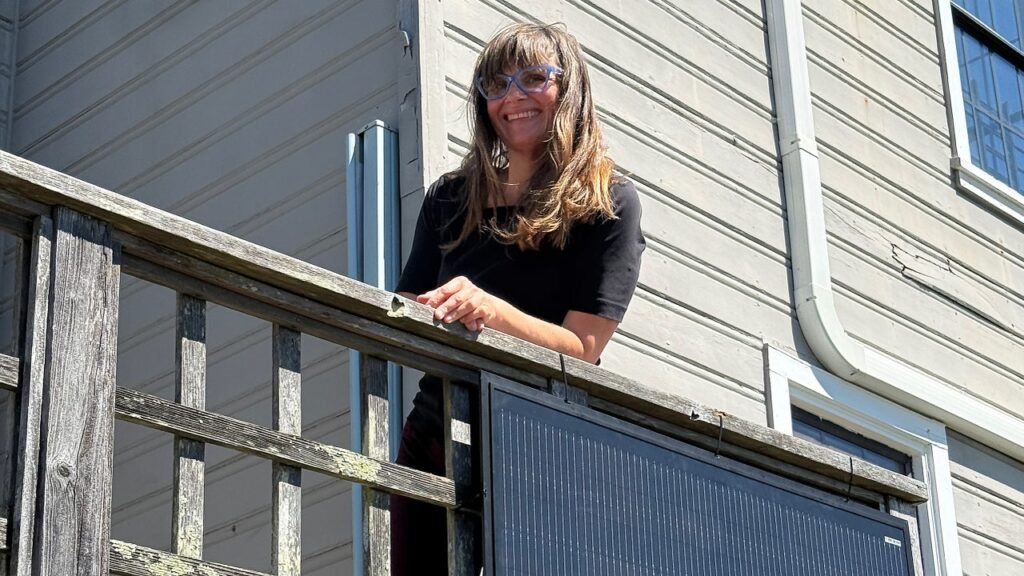
Getting solar installed on your roof typically involves weeks of planning and red tape and hiring an installation crew to do the work. I tried a very different option: a plug-in solar panel. Like the name implies, installing it essentially just means plugging it into an outdoor wall yourself. Then power starts flowing back into your house.
A single panel, of course, generates a tiny fraction of what you’d get from a full rooftop system. But it’s still a simple way to begin to offset your electric bill, and it’s something that renters can use, not just homeowners. This year, states have started rolling out a wave of new laws designed to clear the way for plug-in solar. I wanted to see how easy it was to use.
How plug-in solar works
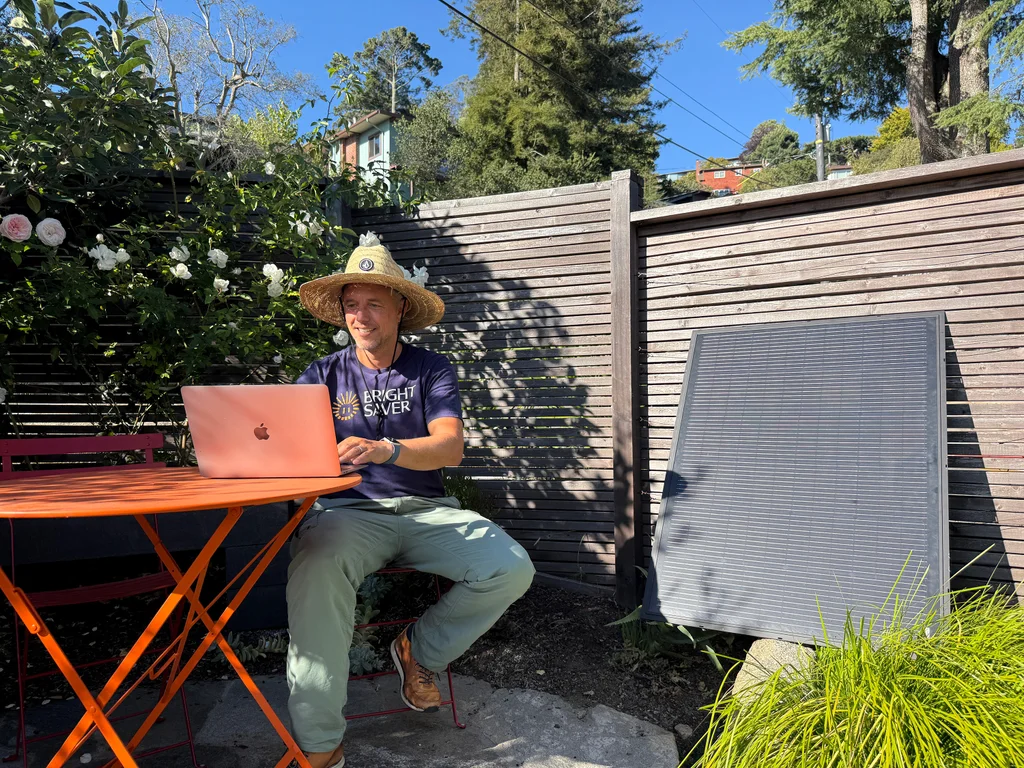
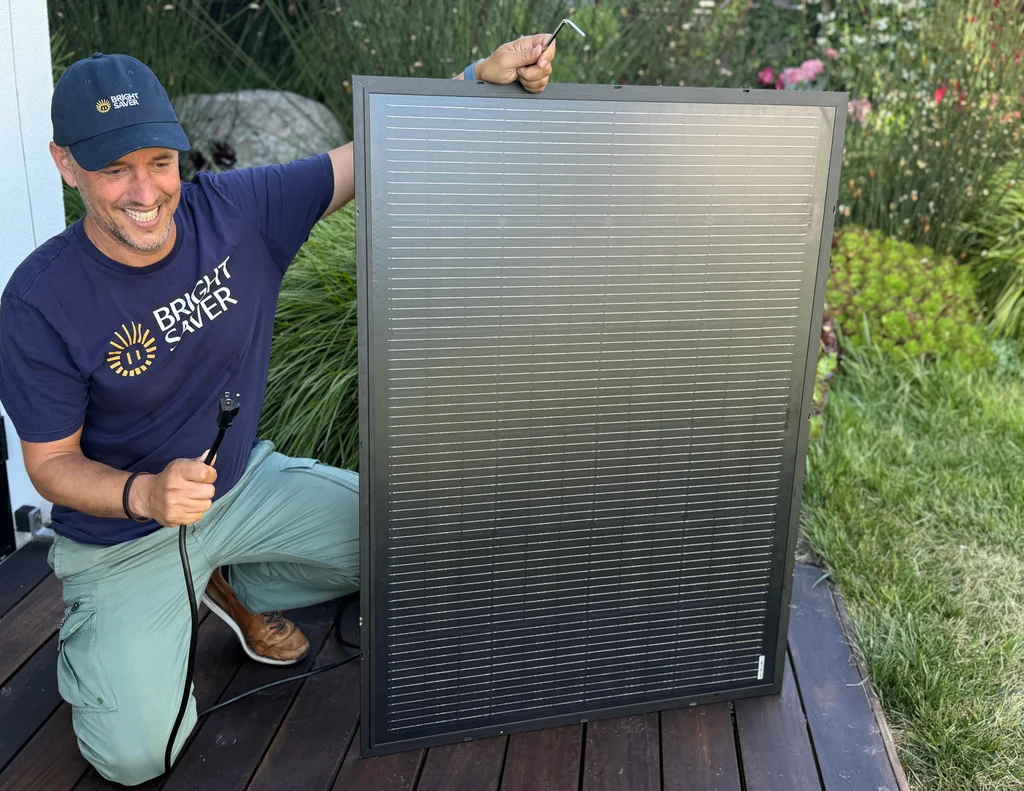
I tested a kit from Bright Saver, a nonprofit that advocates for plug-in solar. The 180-watt solar panel is somewhat large, at 4 by 3 feet, but lightweight and easy to move. You can attach it to a wall or fence, or buy a small separate stand so it can sit at an angle on the ground. In the back, the panel plugs into an inverter, a small box that converts the current from the solar panels into electricity that you can use in your house. The inverter plugs into the wall.
Unlike portable solar panels designed for camping, which typically work with a battery, this system is designed to sync with the grid, pushing current into your outlet at the exact frequency and voltage of the grid signal. If grid power goes out, the inverter shuts down in milliseconds, so there’s no risk of the solar panel sending electricity back into the grid when utility workers are fixing an outage on a line.
My first challenge was where to plug it in, since my 180-year-old house didn’t have outdoor outlets. When I started looking around for where wiring could be added—a process that involved opening a trap door and discovering a second, hidden basement—I realized that reaching the sunniest wall would be too difficult. The only easily accessible spot for my electrician to add an outlet was on an eastern wall; ideally, to generate the most energy, panels should face south or southwest. Still, it was a reasonably sunny place to test.
The kit was fast to set up. It took only a few minutes to plug everything together, and to begin testing it, I propped it up temporarily rather than trying to attach it to the wall. After a couple of minutes, the inverter started flashing green. Power was beginning to flow. The app for the kit was clunky, and repeatedly failed to connect to the system. But it finally recognized the inverter, then showed on the screen exactly how much power the solar panel was sending back into my house.
I live in upstate New York, and late October isn’t the sunniest time of year. When I first connected the system, early on a hazy morning with no direct light on the panel, it generated only 8 watts—roughly enough to power my WiFi router. Later in the morning, as it got sunnier, the output jumped up to 81 watts, more than enough to power my fridge or my MacBook Air.
The solar panel might only reach its peak of 180 watts under the right conditions in the summer. But even on a fall day, it was able to provide a meaningful chunk of the power I was using. Bright Saver offers the kit with either one 180-watt solar panel ($285 for members; $499 for nonmembers) or two, for a total of 360 watts. The panels are designed to last for 20 years, and depending on your electricity rates, can pay for themselves in savings within the first couple of years.
With a single small panel, you’re unlikely to produce extra power beyond what your house uses. If you use multiple panels and don’t have a battery, any extra power that you don’t use goes back into the grid. While your utility won’t pay you for it, it could eventually help you in an indirect way: If solar panels like these were used by large numbers of people, it could help shrink the load on the grid at times of peak demand. That reduces the need to turn on expensive “peaker” power plants that raise bills for everyone.
Where you can use plug-in solar now
There’s a catch, in my case: In New York, as in many states, there isn’t yet a law in place to clear a path to using plug-in solar. It’s not illegal to use. But it exists in a gray area with utilities. Some utilities have said that plug-in solar is allowed only if customers go through the process of “interconnection” to the grid; others don’t have any process in place, or have said that they won’t approve the systems and reserve the right to shut off service if they think a system is a safety hazard. My own utility, NYSEG, declined to answer questions about whether it allows plug-in solar now.
The new laws that are rolling out in several states now are designed to make the tech easy to use by eliminating the need for utility approval or permits. The first passed in Utah in 2025. This year, laws have taken effect in Colorado, Connecticut, Maine, Maryland, and Vermont; early in 2027, they’ll take effect in California, New Hampshire, New Jersey, and Virginia. New York’s legislature passed a plug-in solar law in May 2026, though the governor, Kathy Hochul, has yet to sign it; the governor’s office told me only that the governor would consider the bill. (Advocates told me that it’s not clear yet whether she will sign.) A long list of other states introduced bills this year, and will reintroduce them in 2027.
The laws are different in each state, though most say that it’s legal to plug the systems into a standard outlet, without an electrician. A few require a special new certification created by UL Solutions, the certification company. This is where things get complicated. The standard is still evolving, but currently requires plug-in solar panels to use a unique plug and outlet. In the states with this requirement, an electrician will have to verify that the outlet you want to use is on a dedicated circuit, and swap in a new specially-designed outlet. (Bright Saver is taking preorders for this version of the kit, which will soon be available.) The idea is to prevent someone from using a solar panel on a shared outlet; the concern is “breaker masking,” which can prevent a circuit breaker from tripping when wiring overheats. But Bright Saver told me that the risk isn’t a concern with small, 180-watt panels. And it adds enough friction to the process that it may dissuade some people from getting the panels in the first place.
That requirement doesn’t exist in Germany, where the idea of plug-in solar first took off. Germany has a similar climate to where I live—it’s not especially sunny. Still, the country gets nearly 20% of its electricity from solar power. And plug-in solar panels, while a tiny part of that supply, are helpful enough for power bills that around 1.5 million plug-in solar systems are in place there, often attached to apartment balconies. With luck, the same thing may soon be possible in more parts of the U.S.