Courtesy of the author
- I started teaching my daughter to pack when she was 3 years old.
- Packing together helps build her independence and decision-making.
- I hope the extra effort now will pay off as she grows older.
I started teaching my daughter to pack when she was 3 years old, which, I know, sounds inefficient at best and slightly unhinged at worst.
Packing with a preschooler is slow. It turns a 30-minute task into a 90-minute one. It involves delicate negotiations over which stuffed animals are “essential,” last-minute outfit swaps as she re-discovers her favorite sparkly boots, and frequent distractions. If saving time today were the goal, I would simply do it myself.
But my perspective changed after I heard versions of the same complaint from multiple mothers; they were still packing for their teenagers. Not just occasionally helping or reminding, but fully responsible for it. That dynamic doesn’t appear suddenly at 13; it builds over time.
So I decided to start while my toddler still craves independence with a fervor, hoping it will pay off over the next decade.
The first step was participation, not decision-making
The first time we “packed together,” I did almost all of the work in advance. I pulled everything she would need and laid it out on the floor of her room, alongside an open suitcase. My toddler wasn’t choosing items or deciding quantities. She happily folded clothes with me, shoved them into packing cubes, and put the packing cubes into the suitcase.
Courtesy of the author
This participation also helped her mentally prepare for the coming travel. As we packed bathing suits, we talked about going to the pool and the beach. Her blankie gets packed because we’ll be sleeping in a new place, so she’ll want to have something familiar. She’ll wear her sneakers to the airport because we’ll be walking more than usual.
Especially with toddlers, a smooth trip starts with helping them understand what the experience will be like before we get there. That mental preview reduces friction later.
The next step was constrained choice
Once that baseline was established, I shifted one variable: selection. Instead of laying everything out myself, I told her what we needed, and she got to pick: six T-shirts, five pairs of shorts, two bathing suits. Then she went to her drawers and chose them.
That changed the task meaningfully. She still wasn’t determining quantities or planning for contingencies, but she was making decisions within a defined framework. I separated “what do we need?” from “which specific items do we bring?” and introduced them in sequence.
Courtesy of the author
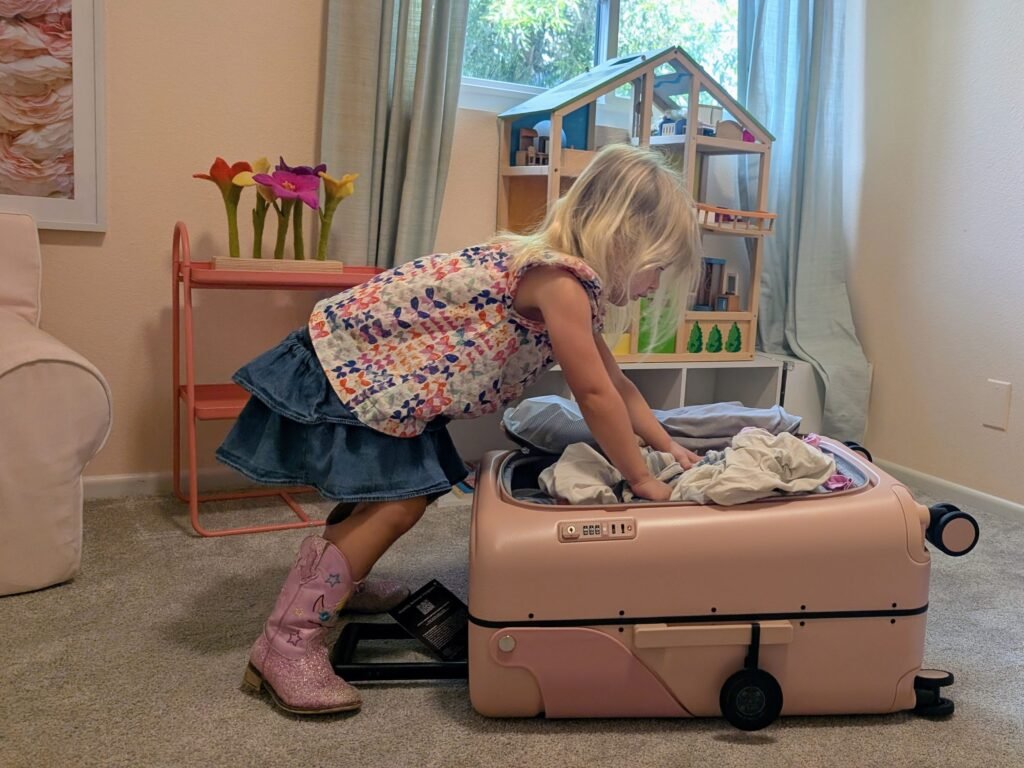
She’s also responsible for helping put everything into her suitcase, which makes it easier to say no to the constant requests to bring additional toys and books. For shorter trips, if it fits into her carry-on after her essentials, she can bring it. On longer trips with a checked bag, she gets one packing cube for toys and books so she can decide what she most wants to bring.
One major step is that now she has a suitcase that is clearly hers. For our coming trip to Asia, she’s packing into a light pink MiaMily suitcase that I gave her for her most recent birthday, now enthusiastically decorated with stickers. It’s a ride-on suitcase that she sits on proudly, like her travel throne.
That shift sounds small, but it changes how she approaches the task. It’s no longer a shared family suitcase or something I’m managing on her behalf—it’s her suitcase, and she treats it that way.
The goal is a gradual handoff
I’m not trying to create unrealistic independence at 3. Over time, I can shift more of that responsibility to her by asking her to suggest quantities, to think through activities, and to identify what might be missing.
It does take longer now. There’s no way around that. But if the alternative is still packing for her a decade from now, the tradeoff is worth it.