
Are you still troubled by issues such as “True Tone not supported” message after replacing your iPhone screen, iPhone battery pop-up, Face ID not working, or an Android phone stuck in an infinite reboot loop due to a failed system update?
These aren’t traditional hardware failures, and ordinary soldering irons or hot air guns can’t solve them. They are chip-level software and calibration issues, and what can truly repair them is a professional mobile phone programmer.
This article will delve into the core function of mobile phone programmers, common repair scenarios, and why mastering this technology can restore many “unrepairable” devices to normal operation.
What Is a Phone Chip Programmer?
A phone chip programmer is an electronic gadget that reads, writes, and alters information held on a particular chip inside a smartphone. These chips contain firmware, calibration data, serial numbers, and pairing information, which the operating system of the phone uses to verify and communicate with other components of the phone.
When such data becomes corrupted, gets deleted, or is mismatched, e.g., due to a failed update, replacement of a screen, replacement of a battery, or a waterproof case. A programmer can get direct access to the chip and restore, rewrite, or recalibrate that data at a level that cannot be reached by any standard diagnostic app.
Highly used types of programmable chips in modern smartphones store various types of vital information. Knowing the functions of each chip, you know who you need to turn to when you see a certain problem on your bench.
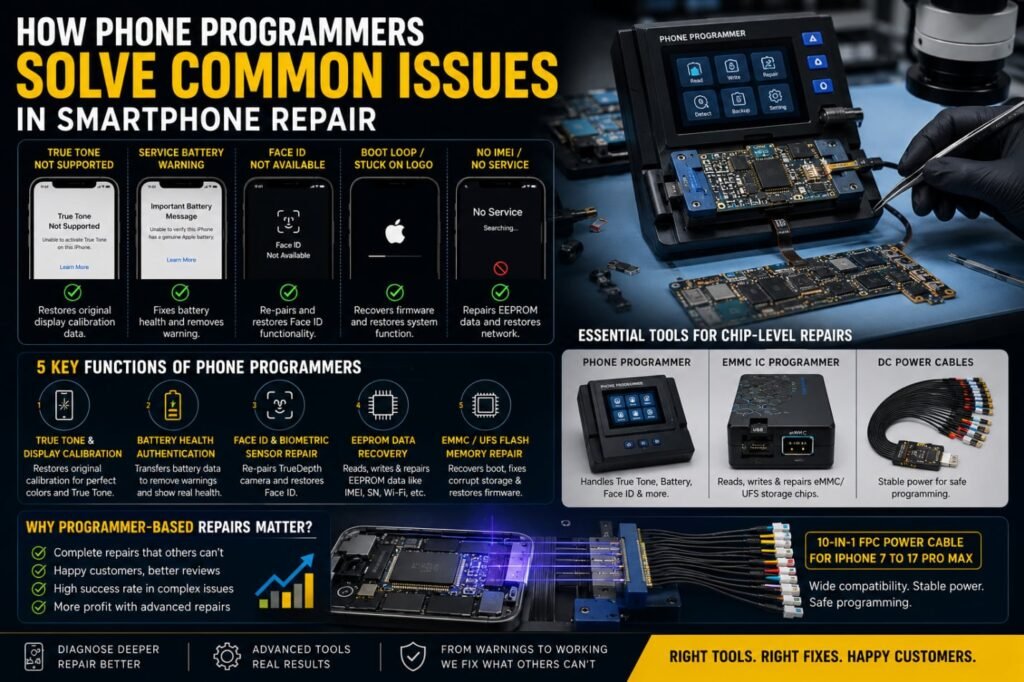
5 Key Functions of Phone Programmers in Smartphone Repair
1. True Tone and Display Calibration Repair
Once you change the screen of an iPhone without using the original calibration data of the display, the phone perceives the screen as unsynchronized and turns off True Tone. Colour inaccuracies or brightness variation can be seen in the display, even with a replacement panel that is authentic.
A Phone Programmer reads the original calibration information of the old screen on the chip and writes it to the replacement. The phone recognizes the new display as up-to-date. True Tone is turned on, and the repair is finished. There is no way this job can be completed to the proper degree, even with a real Apple display screen, without a programmer considering the job.
The fact that this is its sole justification in connection with the cost of investment to any store that frequently engages in changing the screens of iPhones.
2. Battery Health and Authentication Repair
New iPhones store battery information on the phone. In the event you install a replacement battery without passing on the original pairing data, iOS displays a “Service” warning and turns off battery health reporting. The customers take this to be an indicator that the repair has been done wrong, even when the battery itself is fine.
The authentication data on the original battery is read and written by the programmer to the replacement. The phone will no longer display the warning, battery health will be displayed correctly, and the customer will be content. It happens to be one of the most frequented use cases of phone programmers in iPhone repair shops today.
3. Face ID and Biometric Sensor Repair
The implementation of Face ID on iPhones is based on a cryptographic pairing of the TrueDepth camera module and the main logic board of the device. When you change a Face ID without a programmer to deal with the transfer of the information, the feature ceases to work altogether.
This pairing process is handled by a programmer, and this is enabled by the use of Face ID on an otherwise damaged or substituted sensor. The ability opens up a level of repair that most shops, at present, turn away from, which will provide you with a direct competitive advantage.
4. EEPROM Data Recovery and Rewriting
The EEPROM (Electrically Erasable Programmable Read Only Memory) chip stores device-specific configuration information, such as serial number, network unlock, and hardware identification. This data can be completely ruined by water damage, broken software upgrades, and flawed flashing processes.
An EEPROM Programmer reads the raw chip data directly, passes through the operating system, and lets you restore or rewrite the affected memory. This is what you do to phones failing to boot, displaying blank IMEI numbers, or worse yet, being unable to activate or repair, which looks like a complete loss until you connect up a programmer.
5. eMMC and UFS Flash Memory Repair
Storage chips, which store the operating system, apps, and user data of a phone, are referred to as eMMC and UFS chips. Once these chips have gone bad with bad files or become corrupt due to the file system, these chips may fail to boot or end up getting stuck on the next boot.
The Nand Programmer directly communicates with the storage chip and completely bypasses the processor itself, letting you read the chip contents, repair the file system, or flash an unpolluted firmware image. It is high-level data recovery and system restoration at the chip level, which can be done only by the specialized repair centers at premium prices.
Which Phones Benefit Most from Programmer-Based Repairs?
The snippet response is any state-of-the-art flagship. The iPhone 8 and later iPhones utilize pairing and authentication systems that can only be repaired by a programmer to do full-screen, battery, and Face ID repairs. Samsung, Huawei, and Xiaomi Android flagships have eMMC and UFS storage that is advantageous in terms of reacting to failure events during the process of firmware recovery.
Assuming your store deals with mid-range and high-end devices, a programmer is not a specialty tool. It is a typical piece of work equipment that applies in those jobs that the customers want to be done well.
The Role of DC Power Cables in Programmer-Based Repairs
Repairs at a chip level imply that a phone needs to be powered somehow in a controlled manner during the programming process. When connecting a phone with the standard USB when writing data on the chip, voltage variations are introduced and can even corrupt the data you are writing at that moment.
DC Power Cables. These cables are used to have a stable, controlled voltage during the program process, thereby connecting the phone to a regulated power supply on the bench using the battery connector. A 10-in-1 FPC power cable that fits between the iPhone 7 and through to the iPhone 17 Pro Max means you would have covered between the iPhone 7 and through to the iPhone 17 Pro Max with one single solution cable.
This combination, a programmer and a power cable, provides a controlled repair environment, allowing you to work without the risk of secondary damage.
Common Mistakes Technicians Make Without a Programmer
Many repair technicians, before actually using a programmer, are unaware of how many repair mishaps it can prevent. The most common problems include:
Replacing an iPhone screen without syncing calibration data means the technician can only tell the customer that “True Tone disappearing is normal”; however, customers often question the repair quality further. A device continuously displaying “Service” warnings after a battery replacement also makes customers feel the repair is incomplete. Some devices, clearly with a memory chip fault, are repeatedly attempted to be restored via iTunes, ultimately leading to a system that cannot be properly recovered.
These problems may seem different, but they are essentially related to data calibration and chip communication. A professional mobile phone programmer can solve all these critical issues simultaneously.
Building a Complete Programmer Setup
A professional programmer set up for a repair shop covering both iPhone and Android devices needs three things: a quality phone programmer that handles screen, battery, and Face ID pairing, an eMMC/UFS IC programmer for storage chip-level work, and regulated power delivery through proper FPC cables.
The Phone Programmer, the eMMC IC Programmer, and the DC Power Cables together form a setup that handles the full range of chip-level repair scenarios a modern shop encounters.
This is not about having more tools. It is about having the right tools so that fewer jobs leave your bench unfinished.
Conclusion
Mobile phone chip programmers can solve problems that traditional repair tools cannot handle, such as True Tone repair, battery calibration, Face ID recovery, EEPROM repair, and eMMC flashing. If a device continues to display warnings frequently after repair, requires repeated returns, or high-difficulty orders have to be transferred to other repair shops, the problem often lies in a lack of chip programming capabilities. Equipping yourself with a professional programmer not only improves your repair success rate but also allows you to take on more high-value repair work.
The post How Phone Programmers Solve Common Issues in Smartphone Repair appeared first on Android Headlines.