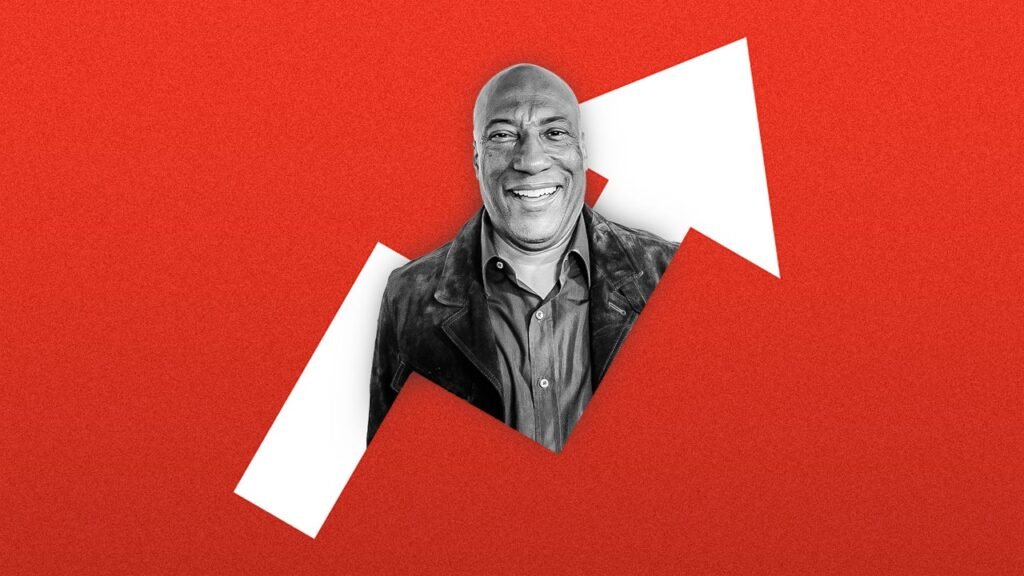
When the media mogul Byron Allen took a controlling stake in BuzzFeed in May—becoming its CEO and chairman—it was his latest bold bet in a volatile media landscape. The Allen Media Group founder explains his strategy for BuzzFeed, why YouTube and Netflix aren’t untouchable in the streaming wars, and why race matters in media ownership. (Editor’s note: This interview was recorded before BuzzFeed announced layoffs for 35% of its staff on July 27, 2026.)
This is an abridged transcript of an interview from Rapid Response, hosted by the former editor-in-chief of Fast Company Bob Safian. From the team behind the Masters of Scale podcast, Rapid Response features candid conversations with today’s top business leaders navigating real-time challenges. Subscribe to Rapid Response wherever you get your podcasts to ensure you never miss an episode.
You started out as a performer, and you personally host the TV show Comics Unleashed, which is in Colbert’s old spot, but you’re also very much a businessperson. How do we know when you’re joking and when you’re serious? You do make some audacious moves: trying to buy BET or ABC, suing McDonald’s, threatening GM.
I have made it very clear that, unfortunately, Black-owned media—not to be confused with Black-targeted media—virtually does not exist, and that’s unfortunate. You have to remember, I started the company from my dining room table, where I’m sitting now. I started the company from my dining room table in ’93. And Coretta Scott King was a friend of mine, Martin Luther King’s widow, and I think she’s the true queen of America. Bob, she taught me a lot. She said to me, “Byron, as Black people in America, we had four major challenges. Number one, end slavery. Number two, end Jim Crow. Number three, achieve civil rights.” Then she choked up and said, “Number four, the real reason they killed my Martin: achieve economic inclusion.”
She said, “You know, Byron, they didn’t kill my Martin”—that’s how she referred to him—”over the ‘I have a dream’ speech. They killed him over the speech he gave in February of ’68 at Stanford University called ‘The other America.’” In that speech, he said, “There are two Americas. One America has access to opportunity and economic inclusion and education, and the other America doesn’t. Two Americas will not survive. We must achieve one America or the whole system will implode.” And I said to her, “OK, you’ve done more than enough. It’s for our generation to deal with the fourth and final chapter.” All I said to corporate America is this simple thought, Bob: The greatest trade deficit in America is the trade deficit between white corporate America and Black America. Until we close that trade deficit, we can’t have one America. It starts with economic inclusion for all Americans, especially Black Americans, the furthest left behind. That’s the reason I filed the lawsuits, Bob.
You created a distinction between Black-owned media and Black-targeted media. And I know those lawsuits were about devoting more of their media budgets to Black-owned outlets.
That’s right.
But you bought the Black News Channel out of bankruptcy and merged it into TheGrio. Is there a business opportunity in talking to and engaging with Black audiences differently? Is that where there are undervalued properties and audiences, or are these things completely separate?
You should not have a world where we don’t have Black-owned media. We need to control our images. We need to control how we’re produced. We need to control how we’re depicted. Are you OK, Bob, if I control all of media and I control how your white children grow up and see themselves? Will you trust me with that? Can I tell your white children how to think about themselves, how to see themselves, who they are in this society? Are you OK with me having that power and that control over your children’s psychology and self-worth?
Let me ask you about BuzzFeed. You’ve built a lot of your media business by buying distressed, overlooked assets—the Weather Channel, regional sports networks—and taking advantage of these opportunities. You bought a majority stake in BuzzFeed for $120 million. It’s a business that has struggled for several years. Why? What do you see in BuzzFeed that others don’t value?
Look, really simple. BuzzFeed is phenomenal. BuzzFeed is one of the great original brands, right? And it’s not only BuzzFeed. It’s HuffPost. It’s Tasty. Tasty has 174 million social media followers, Bob. Unbelievable, OK? They announced that they were about to run out of money. I’m a firm believer in business as a contact sport, and speed wins championships. So I quickly called them and I said, “Hey, I understand you have some issues here. I’m here to help you get it done. Let’s work on it, and let’s get it done now.” So we cut a deal. No analysis paralysis. Let’s get to it. When I bought into the company, the stock was trading at about 60 to 70 cents a share. Once it got announced, it immediately moved to a buck 40, buck 50. And BuzzFeed is now going to chase YouTube.
When you think about BuzzFeed and the first 20 years of BuzzFeed, it was text. It was written. Advertisers are only paying about a buck 25 CPM [cost per thousand impressions] for written content, articles, a buck 25. Who cares? It’s a waste of time. We’ll do it. We will definitely do it. I love the written word, but I’m saying it’s a waste of time to invest huge resources when the advertisers are not supporting it.
Which is what Jonah [Jonah Peretti, cofounder and former CEO of BuzzFeed] figured out when he closed BuzzFeed News, right? It was just costing too much money.
And I love having those articles. I want that. I’m going to build on that. I’m going to make it even stronger. I love HuffPost. I love BuzzFeed. We’re going to do some amazing things with Tasty. But we have to get into the video business. A buck 25 for text, video is approximately $30. So I’m here, and I’m able to put BuzzFeed immediately into the video business and chase YouTube. YouTube is . . .
Because you’ve already got video from your other properties.
That’s exactly right. YouTube is the biggest streamer on the planet. Why? Two words: free and streaming. The world loves free and streaming. Bob, the two easiest things you will ever sell in your life: free and streaming. So it’s hard to fall off the floor. I like to buy businesses in the lobby and take them to the penthouse. I have no interest in buying a business in the penthouse and taking it to the lobby. BuzzFeed was on the floor. I picked it up. It’s on the elevator. We are going to be a serious competitor for free streaming video, and I’m taking it to the penthouse. And when I get to the penthouse, they’re going to have to add a lot more floors, because I’m going to go beyond the penthouse where it currently sits.
People must remember that the video sitting at YouTube, 99.9% of it, is noninclusive. Hey, YouTube creators, if your content is sitting at YouTube and you like getting one check, take your content, put it at BuzzFeed, and get two checks. Not a hard pitch, Bob. Not a hard pitch. Day one, I’m going to put over 30,000 movies, TV shows, and documentaries on BuzzFeed. Over 750 FAST [free ad-supported streaming TV] channels: People Magazine, Kevin Hart, Johnny Carson, Architectural Digest, and over 400 ABC, NBC, CBS, and Fox affiliates. Super-hyperlocal news, weather, sports, and traffic, geofenced to the user’s ZIP code. I already have that technology with Local Now. I’ve been building it and investing in Local Now since I bought the Weather Channel in 2018.
I have won best streamer [from various media outlets] three times with Local Now, and nobody knows about Local Now. So I have the best technology and the worst branding. Now I’m going to take some of the best branding, BuzzFeed and HuffPost, and marry it with the best technology.
The snootiest among my colleagues often complain that content quality is going down as access gets ubiquitous, and we’re going to the lowest common denominator as we change these financial models. Does that hold any weight? Are we losing anything culturally in this transition?
I don’t think so. I’ll say to your snooty friends, “Don’t smell it, sell it.” That’s what I’ll say to your snooty friends. Sell it. And Henry Ford said it best: “Opportunity is never lost. Your competitors will always find it.”