Why Is Saving Money So Difficult?
Why is there such a dilemma surrounding saving money despite most people having a basic level of economic literacy?
Perhaps because human nature is fickle?
People tend to give in to their whims and impulses, especially when it comes to financial commitments. They are quite often procrastinating or lazy and are not inclined to take the extra step to save money.
Behavioural economics asks us to think about this: Instead of trying to educate people on the merits of saving, what if we create financial environments for them that allow easy saving?
The concept of a “nudge” helps us do just that.
What Is a Nudge?
A nudge helps people make better financial decisions by influencing how the decision-making process for these choices takes place.
In a person’s life, a nudge could be as simple as a prompt or a system set up to make saving automatic.
The Power of Defaults in Saving Money
In their famous field experiment, Brigitte Madrian and Dennis Shea looked at the default option for 401(k) retirement plans at different firms.
They discovered that those who were automatically enrolled in the retirement plan were much more likely to save than those who had to manually enrol.
Moreover, many people who did not change their default savings option continued to save, and even increased their savings, as they got raises. This highlights the power of inertia in decision-making.
A nudge can take advantage of this inertia, reducing the burden of making the right decision.
For instance, it is much easier to save if saving is the default. That is, if we have the ability to opt out rather than having to opt in.
By changing the default while preserving the individual’s ability to opt out, a change in financial outcomes can be seen without their realisation. A nudge can be effective even when an individual’s economic status doesn’t change.
Save More Tomorrow: Using Behavioural Economics to Increase Savings
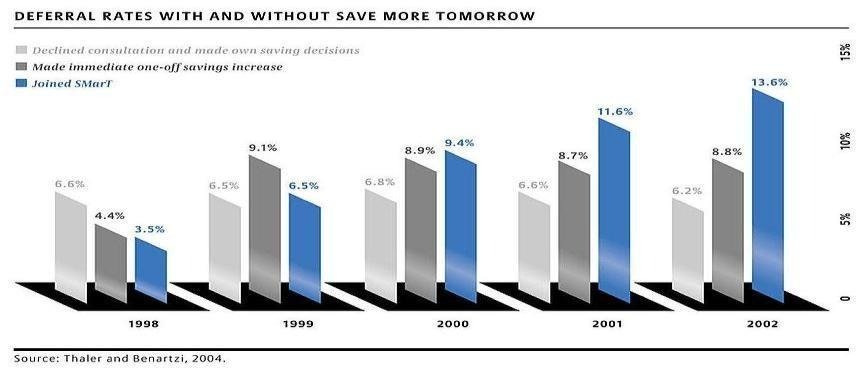
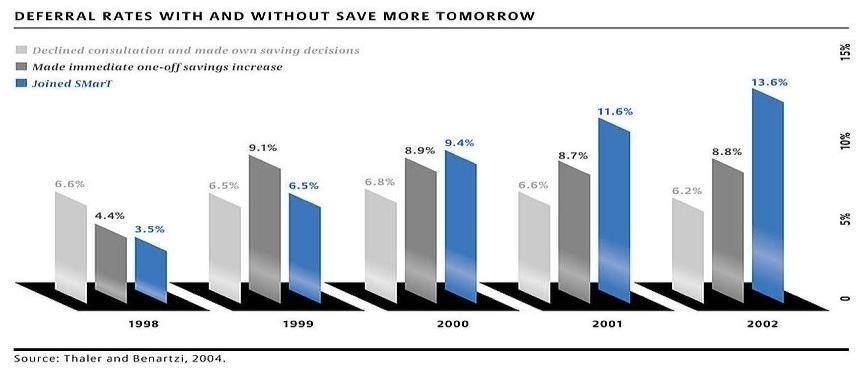
Richard Thaler and Shlomo Benartzi’s Save More Tomorrow campaign is an illustration of a nudge that utilises inertia to help people save more.
In their campaign, employees were asked to commit to increasing their retirement savings every time they received a pay increase.
The idea was to reduce the pain of sacrificing part of one’s salary by taking advantage of the fact that people typically don’t mind as much giving up a certain portion of an increased salary as they do when it comes directly out of a lower base salary.
Their campaign demonstrates the concept of hyperbolic discounting very well in that people were willing to commit to savings from future salaries, which are further away and, therefore, less salient.
The results were astounding.
The campaign had a staggering 78 percent opt-in rate during its first implementation and 80 percent of those who signed up were still actively participating by the fourth pay raise.
On average, the number of people saving increased from 3.5 percent to 13.6 percent over 40 months in the program.
The Power of Automation for Saving Money
Someone could be intending to save INR 2,000 every month but constantly fail to do so either because they forget or because the process is a hassle.
By setting up automatic transfers immediately after every salary, they could solve the problem of being constantly reminded and be one step closer to financial freedom.
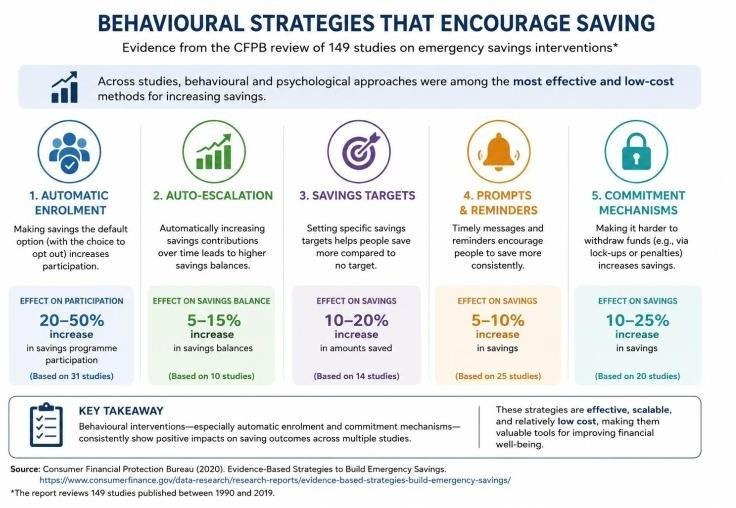
The CFPB highlights automatic enrolment and automatic escalation as some of the strategies used to increase saving by using the power of defaults.
The CFPB also highlights other nudges like alerts and targets.
With digital banks, saving is made easier by the numerous nudges that prompt automatic recurring transactions.
Instead of relying on one’s willpower, one can simply set up a system that makes it happen effortlessly by turning it into a habit.
The Limitations of Automatic Savings
Automation could fail if an individual is not prepared for it.
If someone intends to save INR 2,000 every month but only gets a salary of INR 10,000, automatic transfers might put them in a financially unstable position, especially if they have committed to a larger amount.
The CFPB highlights that commitment devices sometimes involve penalties and restrict individual freedom.
It is important to remember that nudging cannot undo an economically disadvantaged position or a difficult economic situation.
A nudge will only work if an individual has the means to make it work.
Can Financial Nudges Complement Financial Literacy?
Nudging could serve as an addition to financial literacy by helping turn intentions into actions.
Financial literacy informs people about how important it is to save some money, while financial nudges help them take those small additional steps to make saving happen.
We don’t need to rely on people having lots of self-discipline and willpower.
Instead, a nudge could take advantage of a default option or set something to automatically happen in order to facilitate positive change.
We are prone to making certain behaviours more salient by choosing when and how we engage with them.
For instance, we can decide that transferring money to savings only happens right when we receive money.
We could be prompted to save when it is easier for us to decide to do so.
Nudging allows us to make the better decision in an easier way.
Written by- Kajal Satyabhan Maurya
Edited by- Devangee Kedia
<p>The post How Behavioral Nudges Can Help You Save More Money? first appeared on The Economic Transcript.</p>