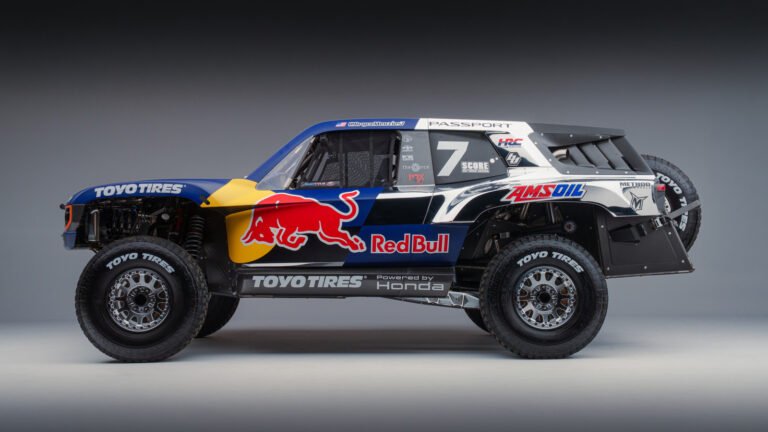
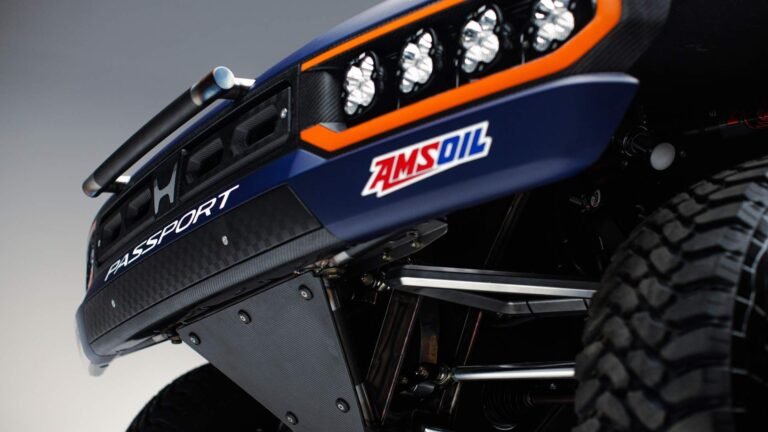
Honda apparently looked at the massive V8s powering today’s fastest desert trucks and decided to bring something smaller. Much smaller. Its answer is a 2.4-liter twin-turbocharged V6, an 800-volt hybrid system, and more than 1,300 horsepower. That’s an awful lot of unpleasantness to unleash on a patch of dirt, and I’m rather excited about it.
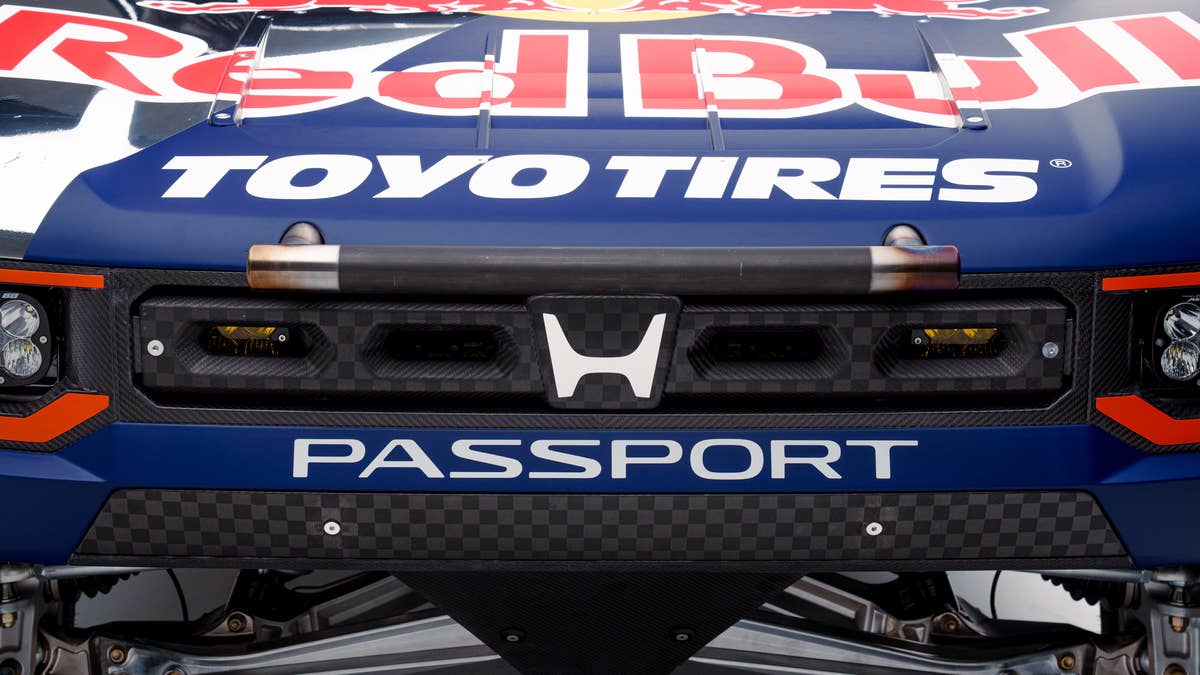
The Honda Passport Baja Spec is a purpose-built race truck developed by Honda Racing Corporation USA and Mason Motorsports. Honda says it will become the first hybrid-powered entry in the SCORE World Desert Championship’s top Trophy Truck class. Two-time Baja 1000 winner Bryce Menzies will drive through a partnership with Menzies Motorsports, with its competition debut scheduled for the 2027 Baja 500, June 2–6.
Before anybody starts calling dealerships, this isn’t a Passport TrailSport with an aggressive accessories package. Beneath the carbon-fiber body is a mid-engine, all-wheel-drive racing chassis. The Passport connection is primarily its identity and styling. Your neighborhood Honda service department can probably relax.
Powertrain and performance
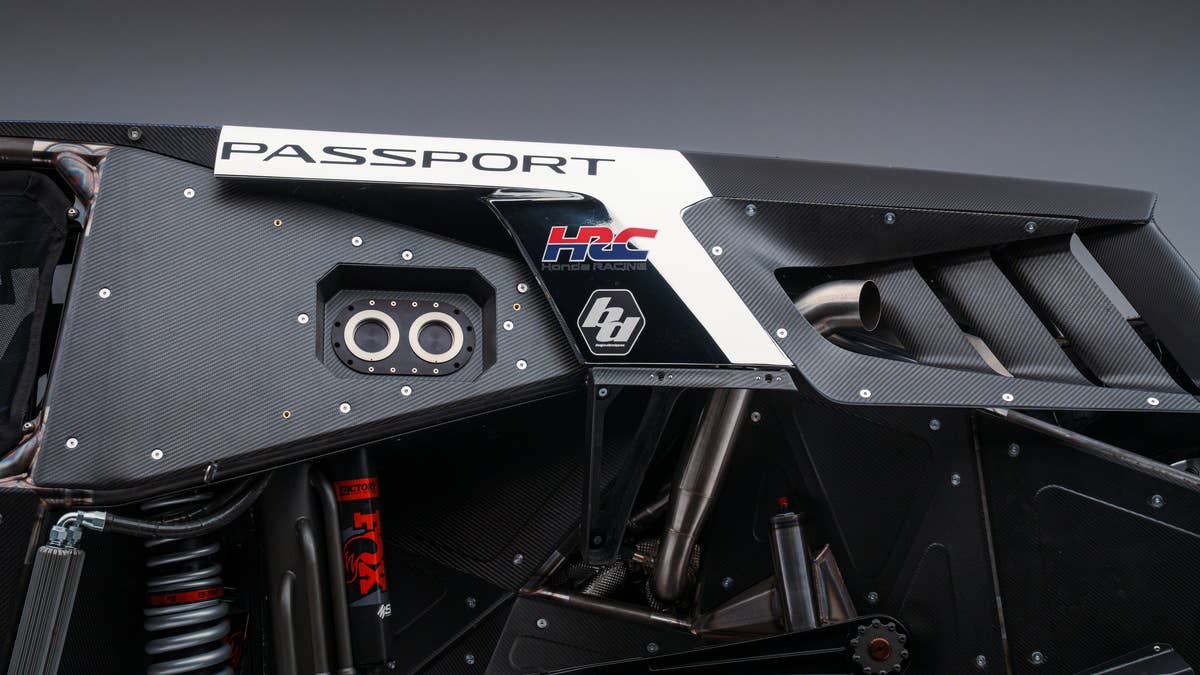
The all-aluminum V6 is based on the engine powering Acura’s ARX-06 GTP endurance racer, which has demonstrated its durability with victories at Daytona and Sebring. HRC US developed both the engine and its accompanying hybrid system in Southern California. Honda says their combined output surpasses the massive naturally aspirated 9-liter V8s used in leading Trophy Trucks.
Think about that: a 2.4-liter engine, working with electric assistance, taking on V8s approaching four times its displacement. That doesn’t automatically make it better, but it certainly makes the engineering conversation more interesting.
The battery uses previous-generation Formula 1-style pouch cells housed in a lightweight carbon-fiber enclosure. HRC engineers designed and manufactured the pack in-house, with assembly and validation taking place in a dedicated clean room at the company’s Santa Clarita headquarters. From a clean room to Baja: that battery is in for a fairly dramatic change of scenery.
Honda hasn’t disclosed battery capacity, electric-motor output, or combined torque. We also don’t have a curb weight. Until those numbers arrive, the headline remains 1,300-plus horsepower supported by an 800-volt hybrid architecture.

Getting that power into the dirt
Mason Motorsports supplies a Masomatic twin-angled-drive five-speed transmission mounted ahead of the engine. Its unusual AWD transaxle arrangement sends torque through two rear driveshafts to angled high-pinion spiral bevel gears at the rear wheels, replacing a conventional rear ring-and-pinion arrangement. The design increases clearance and permits camber and toe adjustments.
Up front, a Mason differential distributes torque through portal gearsets at the hubs, helping maximize ground clearance and optimize drivetrain geometry. This is considerably more involved than pressing the “Sand” button in a crossover and hoping somebody remembered a shovel.
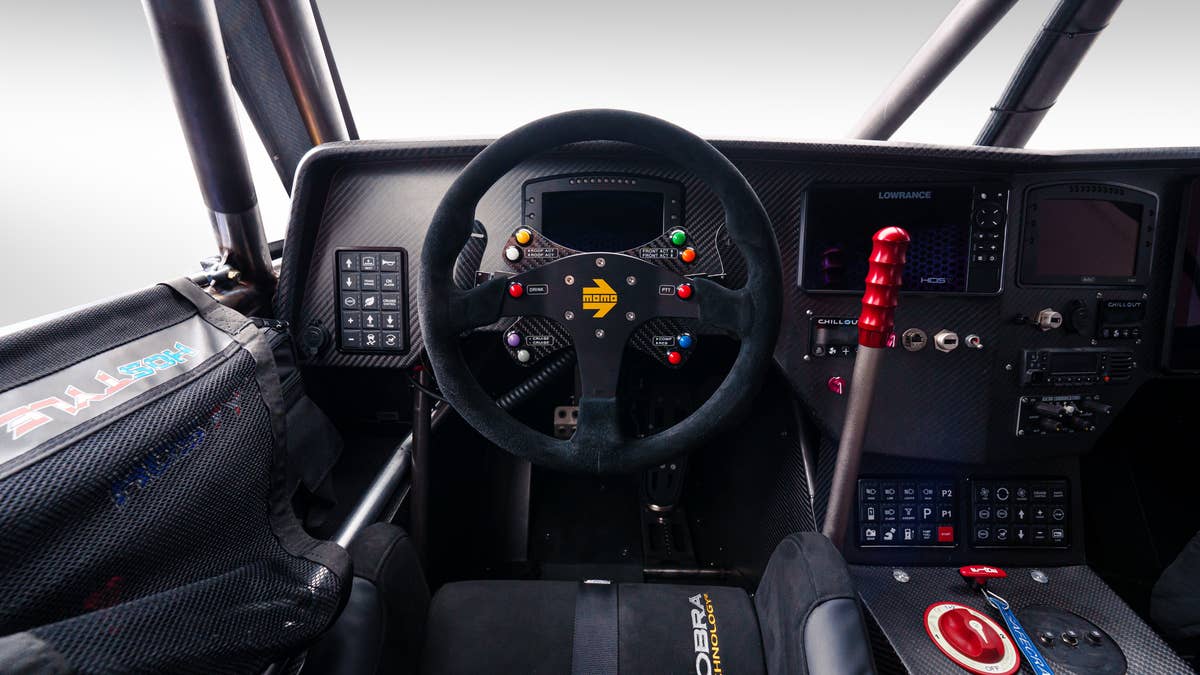
The electronics are equally ambitious. Honda specifies dual-axle brake-by-wire, adaptive traction control, and what it calls AI power deployment. Proprietary HRC software coordinates powertrain, chassis, and energy management, allowing the team to tailor responses to the driver, course, and changing conditions. The challenge will be making all that sophistication dependable when the truck is being repeatedly hammered.
Chassis, suspension, and aerodynamics
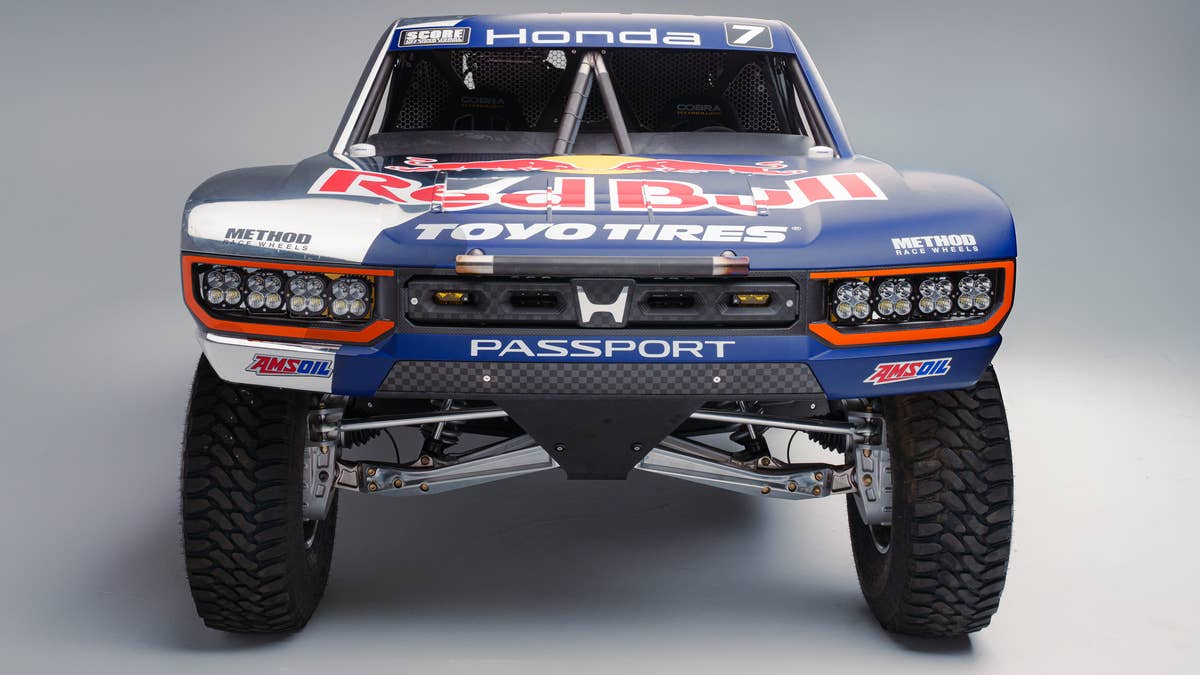
The foundation is Mason’s Gen 2 AWD chassis, with an HRC-specific rear frame section accommodating the hybrid powertrain. A 145-gallon carbon-Kevlar safety fuel cell sits centrally within the cab structure, helping minimize changes in weight distribution as fuel is consumed. Batteries, fluid tanks, and other fixed-mass components are positioned to support consistent balance.
Long-travel suspension uses two FOX Racing shocks at each corner, while Toyo tires handle contact with whatever Baja throws underneath. Suspension-travel figures haven’t been released.
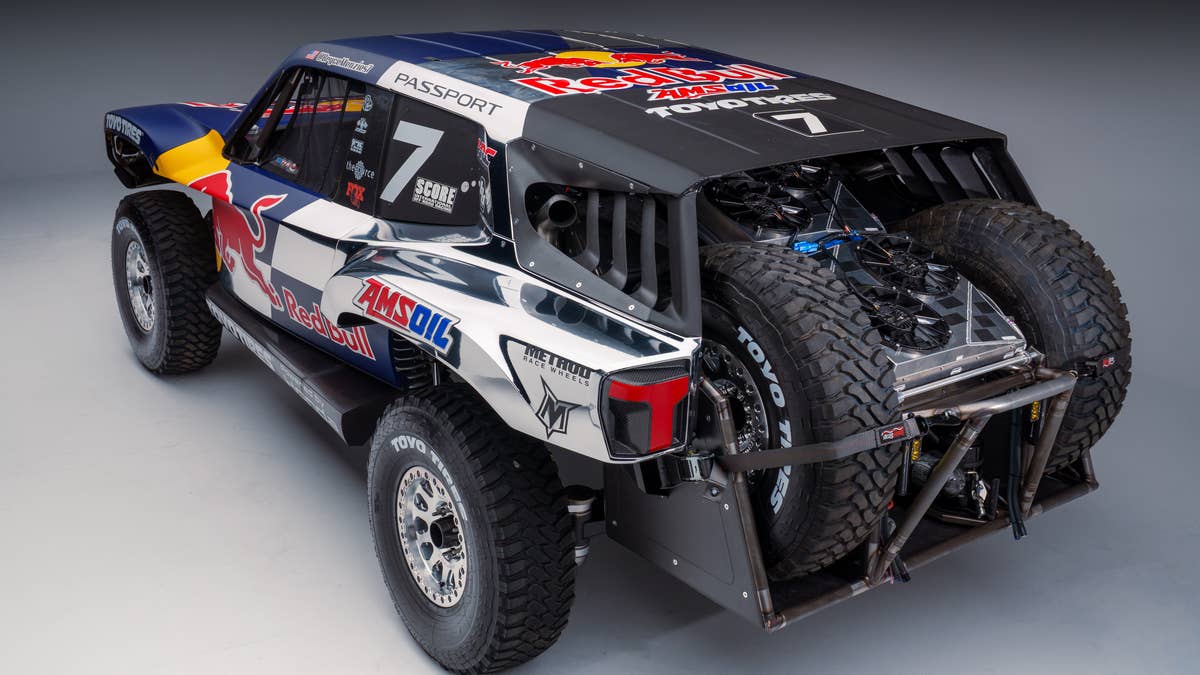
HRC also used computational fluid dynamics to develop the carbon-fiber body. Deep channels behind the front wheels manage airflow, while cab tunneling directs air toward a low-mounted rear cooler. High-mounted exhaust outlets behind the cockpit incorporate aerodynamic fins. The objective is improved stability, cooling, and efficiency. Apparently, simply looking intimidating wasn’t enough homework.
Final thoughts
Honda’s Baja history deserves context. Its 22 overall Baja 1000 victories came on motorcycles. Separately, its four-wheel racing program has accumulated 17 Baja class victories since 2015, including four Baja 1000 wins and five Baja 500 triumphs. This truck represents a bigger swing: targeting an overall Baja 1000 victory.
The Passport Baja Spec makes its first public appearance at SEMA, November 3–6, before heading toward competition in 2027. Impressive engineering makes a compelling introduction, but Baja has a habit of turning ambitious machinery into expensive scenery.
Still, an endurance-racing-derived hybrid powertrain, Mason chassis, and Bryce Menzies behind the wheel make a persuasive combination. I’m rooting for it. Preferably from somewhere with a clear view and a substantial distance between me and those tires.
Related: Genesis GV70 vs. Maserati Grecale: Sensible Luxury Meets Italian Temptation