
When I was about 10 years old, my parents organized a vacation to a tiny enclave called Orr Hot Springs just outside of Ukiah, California. Nestled in the mountains with a history dating to 1858 as a stagecoach stop with redwoods shading the trails, the property has a uniquely layered architectural history. We stayed in what my dad called “Art’s cabin,” which turned out to have really been built by a guy named Art in the mid-1970s. A giant tree intersected the middle of the structure.
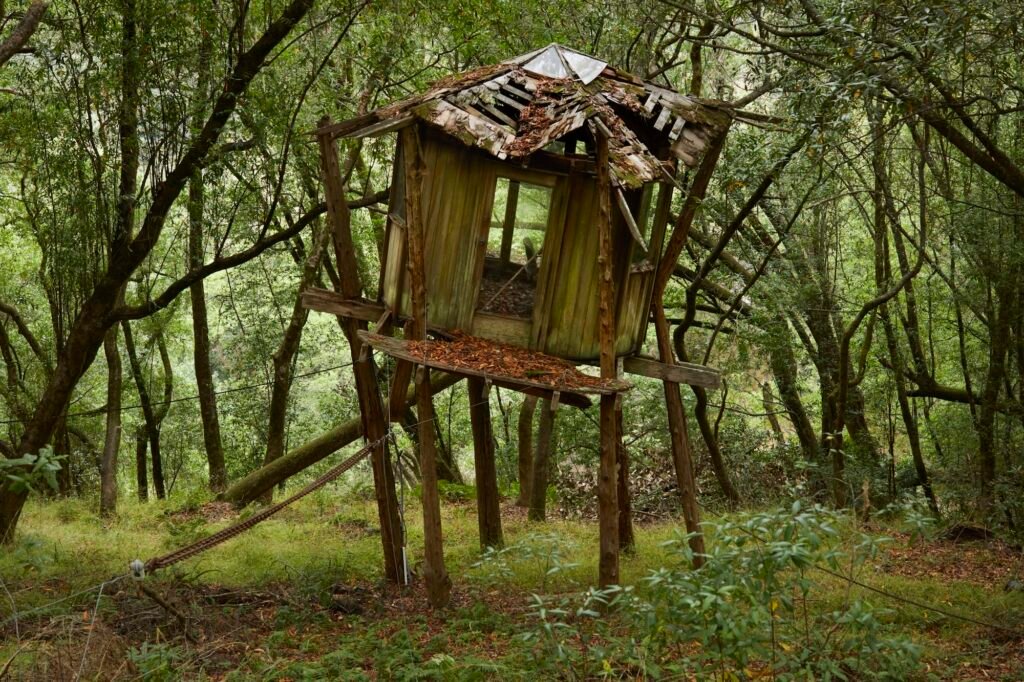
Art’s cabin is one of few remaining buildings from the property’s back-to-the-land era, before it became today’s modern resort. In 1974, my dad and a group of friends from Berkeley teamed up to buy the hot springs. Over time, a small community developed as people purchased “shares” in the property. Attracted by the cooperative nature of the place and the opportunity to escape the city, people came and went, sometimes staying for a couple of weeks and sometimes for a couple of years. To make income, my dad recalls leading week-long carpentry courses, during which visitors and community members alike constructed what he describes as tiny, “very not-code” cabins, some of which were finished and actually lived in for a time. There was a buzz around building.

As my dad and I both paged through my hot-off-the-press copy of Handmade Utopia: Back-to-the-Land Architecture in Northern California, I could tell that a lot jogged his memory. I grew up hearing stories about the ups and downs of running an intentional community in the hills during the 1970s, and his experience is but one among many thousands. Having also lived in Humboldt County for a time myself, I enjoy the striking sense of continuity throughout the past five decades that author David Jacob Kramer and photographer Michael Schmelling capture in this hefty tome. The work represents a counterculture that, though changed, is still alive and well.
The vernacular of Northern California architecture in the late 1960s and 1970s is a result of resourcefulness, timeliness, and a staunch desire to do things one’s own way. Scrounging for discarded redwood left over by the region’s logging industry and salvaging architectural details and appliances from historical homes, the houses cover a broad range of styles. Think triangular windows, diagonal paneling, cylindrical or octagonal footprints, and ad hoc additions.
Often, builders had no plan, constructing their dwellings to whatever standard they were able. They used plastic to cover windows and sometimes innovated with compositing toilet solutions or solar. The buildings were hardly ever up to code, and many lived with the constant anxiety that their homes could be condemned and they’d be evicted by local authorities. But the risk outweighed an alternative that felt too limiting or oppressive. “In pursuit of something better, back-to-the-landers radically reappraised what a home could and should be—and how it might inform the lives of its inhabitants,” Kramer says in the introductory essay.
Some homes of the era draw their inspiration from Buckminster Fuller’s geodesic dome design, while others take cues from neolithic forms or Indigenous structures around the world. Many examples of these were published contemporaneously in popular books like Lloyd Kahn’s Shelter, which itself was a spinoff of his editorial contributions to Stewart Brand’s counterculture magazine, Whole Earth Catalog. The legendary publication described itself as an “access device” that served as a kind of ultimate peer-to-peer DIY guide for living and building.

My first impression of Handmade Utopia was that it felt like a kind of reverent extension of Barry Shapiro and Art Boericke’s seminal 1973 photo book Handmade Houses: A Guide to the Woodbutcher’s Art. By comparison, this fresh look at the stylistic movement is a more personal expression of wonder and fondness for not only a particular style of architecture but the societal complexities that spawned it.
Kramer and Schmelling adventured through the NorCal countryside over the course of four years to touch base with people who still make their homes in the woods. Even those who no longer live in their decades-old dwellings can retrace their steps to see what remains. And the foundation of every one is composed of ingenuity and independent spirit. In addition to thoughtful introductory texts, the bulk of the book is chock full of photographs, archival material, and anecdotes by the folks whose structures the authors visit.
Rather than a comprehensive study of hand-built Northern California architecture, Handmade Utopia reads more like an homage to what Kramer calls the “audacious hope” of the back-to-the-land movement. And this hope isn’t relegated to its historical roots, as young people today are confronted by the prohibitive cost of both homes and land. “Schmelling and I felt an urgency in capturing these homes before they literally went back-to-the-land, disappearing along with the generation who built them,” Kramer says.
Handmade Utopia is officially slated for release on September 1. Find your copy in the Colossal Shop. You might also enjoy a tour of Ricky Boscarino’s whimiscal hand-built home in New Jersey or Matt Bua’s “repurposed city” in Upstate New York.


Do stories and artists like this matter to you? Become a Colossal Member today and support independent arts publishing for as little as $7 per month. The article ‘Handmade Utopia’ Relishes the Architecture of California’s Back-to-the-Land Movement appeared first on Colossal.