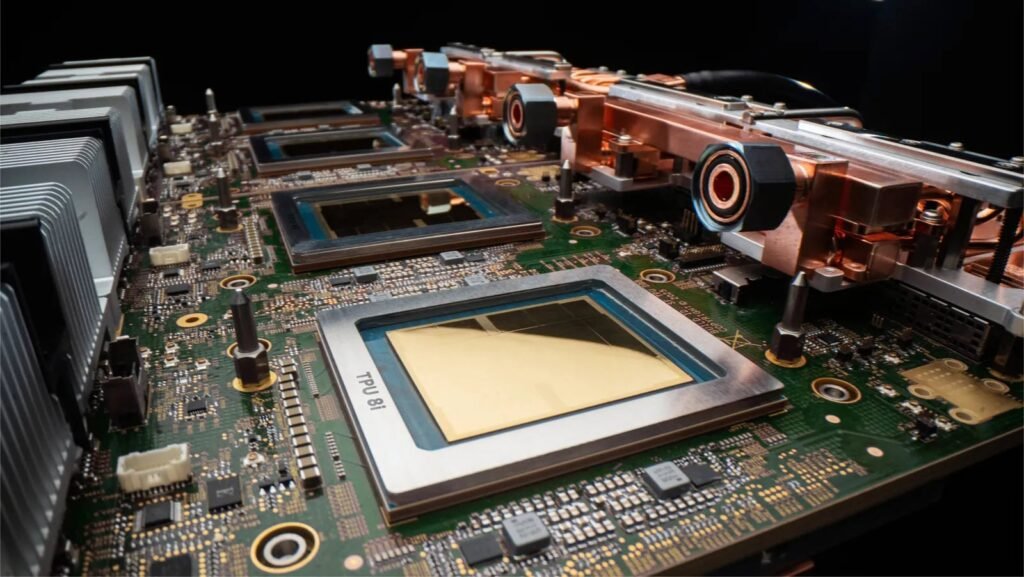

For years, Google had been using its own custom Tensor Processing Units (TPUs) as a “private” superpower. These internal chips quietly chugged away in the background, running heavy artificial intelligence workloads for everyday services like Search and speech recognition. However, things are changing as the AI industry evolves. Google is now aggressively pushing its proprietary AI chips out of its private labs and directly onto the commercial market, aiming straight at Nvidia’s iron grip on the AI hardware space.
As The Wall Street Journal reports, Google is using its massive corporate balance sheet to break into the ecosystem. The tech giant recently provided a staggering $3.2 billion financial guarantee for the Lake Mariner data center project located in western New York. Under this deal, the developers plan to lease computing power from thousands of Google’s custom TPUs straight to AI standout Anthropic.
Google is borrowing a proven playbook for AI chip success: the Nvidia approach
This aggressive move looks incredibly familiar to anyone watching the hardware industry. Industry analysts point out that Google is essentially borrowing a page from Nvidia’s own strategy book: use creative corporate financing to back massive data centers, lower capital costs for operators, and seamlessly guarantee a massive, predictable demand for your own hardware.
The Next Web also highlighted that this New York deal is just one piece of a much larger financial puzzle. Google is backing a $7 billion development called River Bend near Baton Rouge, Louisiana, throwing $1.4 billion toward a lease in Colorado City, Texas, and striking a $5 billion cloud-services partnership with Blackstone to buy and lease its silicon. Furthermore, Google confirmed it will start selling its TPUs directly to external buyers rather than keeping them locked strictly behind its own cloud walls.
Real savings and industry roadblocks
The strategy is already turning heads among major financial and tech institutions. Citadel Securities, a long-term Google Cloud client, recently migrated key research software to these custom processors. The firm reported that switching to TPUs ran their specific workloads up to four times faster while slashing overall operational costs by 30%.
Dethroning the current king will not be easy, though. Nvidia still controls roughly 90% of the AI chip market, largely because developers are comfortable with its established software ecosystem. Many specialized cloud startups even worry about shifting their budgets away from the market leader, fearing they might lose priority access to top-tier hardware—a dilemma venture capitalists half-jokingly refer to as “Jensen jail.”
Nvidia Chief Executive Jensen Huang remains skeptical of the competition. He publicly questioned the actual cost advantages of custom ASICs compared to his company’s widely adaptable graphics cards. Nevertheless, with the global demand for sheer raw computing power outstripping what any single supplier can comfortably deliver, Google’s aggressive multi-billion-dollar bet ensures its hardware is no longer just a backstage helper. It is becoming a highly viable alternative in an industry starving for options.
The post Google Unleashes Multi-Billion-Dollar War Chest to Break Nvidia’s AI Hardware Dominance appeared first on Android Headlines.