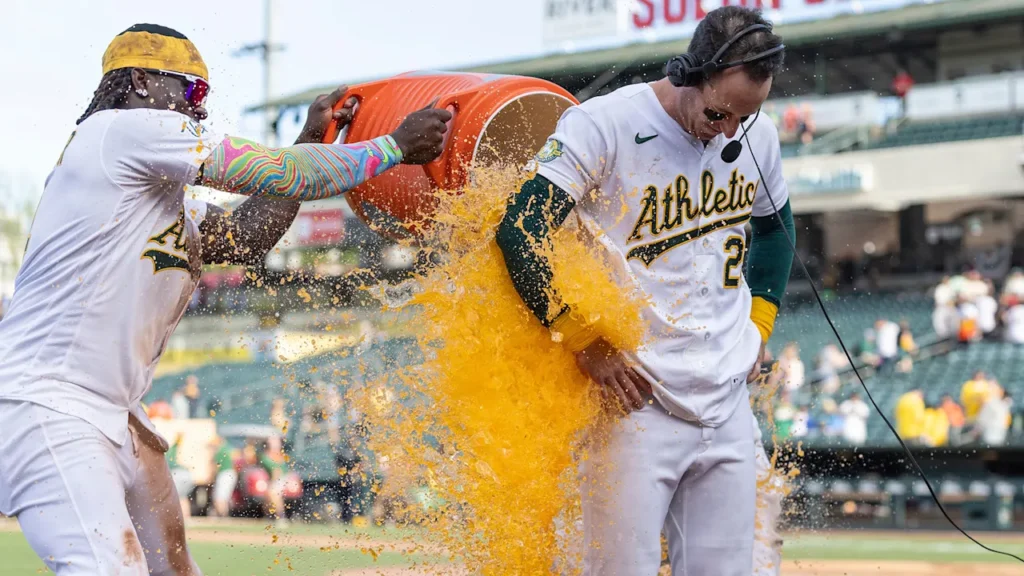
Sixty years after it invented sports drinks, Gatorade is making a surprising pivot: It’s no longer focusing primarily on athletes.
PepsiCo, Gatorade’s parent company, said Thursday that the brand wants to broaden its reach to non-athletes who are looking for ways to hydrate, whether they’re on a long flight, going for a walk or nursing a hangover. New packaging highlights the specific ways Gatorade’s various drinks and powders work and the research behind them.
The change reflects U.S. consumers’ booming interest in beverages with perceived health benefits. Jack Doggett, a food and drink analyst with the consulting firm Mintel, said his research indicates 60% of consumers who buy sports drinks aren’t athletes but want the functional ingredients those drinks provide, like electrolytes for hydration and carbohydrates for energy.
“People are using these drinks more for wellness and daily maintenance,” Doggett said. “It’s easy to say that the wellness consumer is the young consumer, but older generations are also drinking these drinks for hydration.”
Unit sales of sports drink mixes, like powders from Liquid I.V., Skratch Labs and Gatorade, rose nearly 20% in the year ending March 22, according to Circana, a market research company. Bottled water sales were flat in the same period.
Crowded shelves
Sensing that growth potential, new sports and hydration brands are crowding store shelves. Mike Del Pozzo, president of U.S. beverages at PepsiCo, said 150 new brands have entered the space in the last few years.
“That puts a lot of risk on the category and pressure from a credibility perspective,” Del Pozzo said. “Some that are coming in are building on the science that we created. And we’re like, ‘Well, geez, we should be doing that. We should be talking more overtly about the science and the business and why we believe we’re future-forward.”
Del Pozzo said Gatorade will now clearly label products that it says can hydrate better or faster than water. A new drink, Gatorade Longer Lasting, which will go on sale next year, blends glycerin and electrolytes to help the body stay hydrated for longer than water alone.
PepsiCo’s approach with Gatorade echoes moves made by some of its rivals. Powerade, a sports drink owned by Coca-Cola Co., received brighter, clearer packaging in 2023 that promoted an increase in electrolytes. Last fall, Powerade began selling Power Water, a zero-sugar, electrolyte-enhanced drink aimed at non-athletes.
Liquid I.V., which was founded as a sports drink mix in 2012, was acquired by Unilever in 2020 and has remade itself into a wellness and hydration brand. LMNT also had non-athletes in mind last fall when it introduced a smaller, 12-ounce version of its sparkling electrolyte drink.
Sean Harapko, a beverage sector leader with Ernst & Young Americas, said consumers have so many beverage choices that companies must clearly define their products and explain why people should choose one over another. Americans are trying to live healthier lives, he said, but they’re collecting information from many different sources and defining for themselves what that looks like.
Gatorade’s origins
Gatorade was born in 1965, when the football coach at the University of Florida asked Dr. Robert Cade, a physician and professor at the school, why his players were losing so much weight during games but not urinating. Cade realized the players were sweating out electrolytes – another word for minerals like sodium, potassium and magnesium – and upsetting the body’s chemical balance.
Cade came up with Gatorade, a drink containing salt to replace electrolytes, sugar to improve energy and lemon juice for flavor. Quaker Oats acquired Gatorade’s parent company in 1983 and established the Gatorade Sports Science Institute two years later. PepsiCo became Gatorade’s owner when it bought Quaker Oats in 2000.
Del Pozzo said Gatorade will continue to meet athletes’ needs. Gatorade Thirst Quencher, for example, has 48 grams of sugar and 18% of the recommended daily amount of carbohydrates, which athletes need to maintain energy. But Del Pozzo notes that Gatorade Lower Sugar, which went on sale last month and has 75% less sugar, is one of the company’s biggest sellers in recent history.
Del Pozzo said lower-sugar versions aimed at non-athletes, as well as the removal of artificial colors from Gatorade’s lineup, is bringing customers into the brand.
“I think there were people that said, ‘I didn’t exercise or I’m not out in the heat or I am not sweating.’ The reality is, everybody is sweating and dehydrated from the moment they wake up and many just don’t know it,” he said.
But Travis Masterson, an assistant professor at Pennsylvania State University’s College of Health and Human Development, said the average non-athlete gets the sodium they need from their diet. Athletes sometimes need a reminder to drink, he said, because their bodies are under stress. But for average people, the thirst signal is a good indicator.
“Gatorade 100% has a place, but is it going to be necessary for everybody? Do you need to hydrate faster or longer?” he said. “The average person doesn’t need all the extra stuff.”
—Dee-Ann Durbin, AP Business Writer