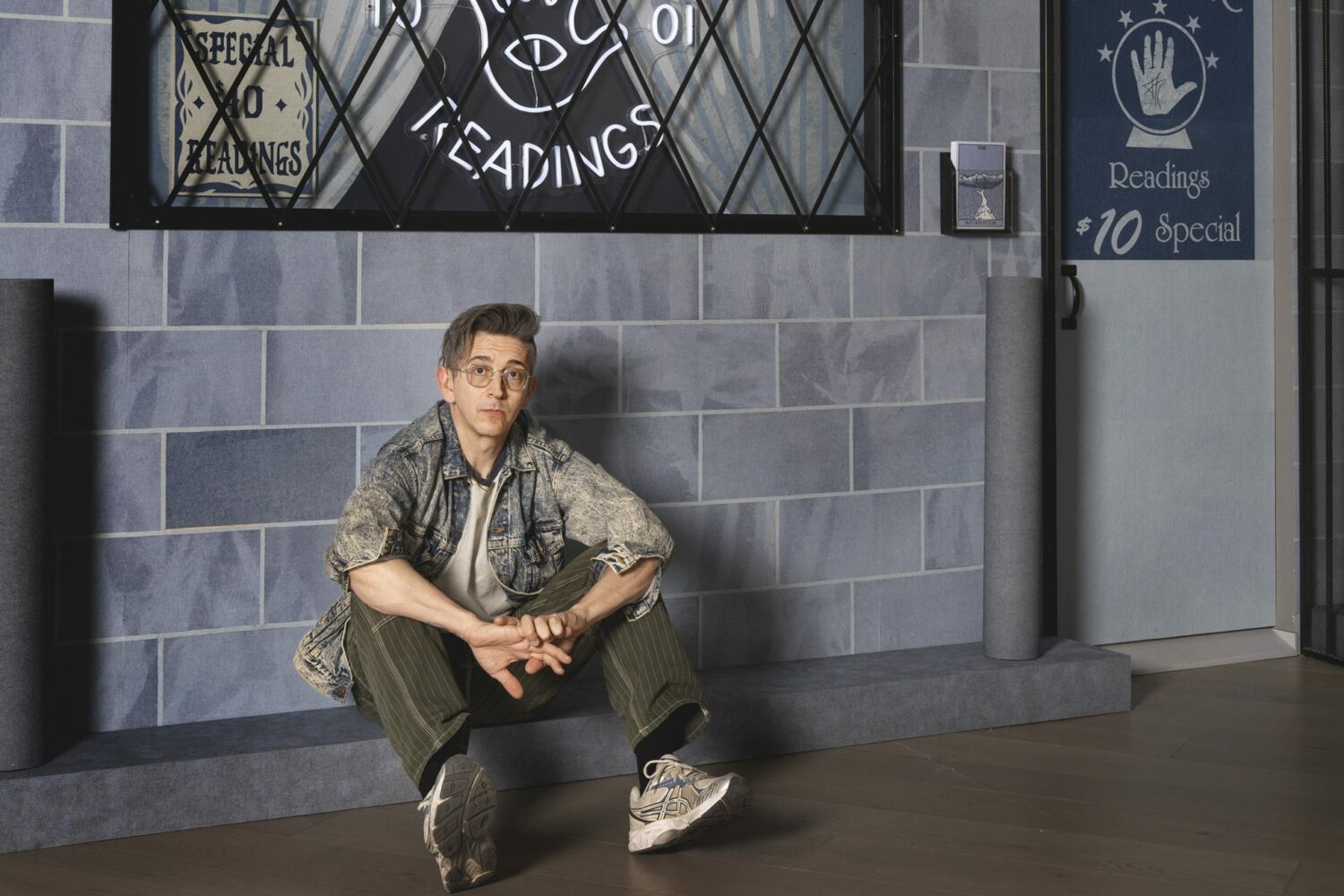
Creative minds can seemingly turn anything into art—from household items and food to packing supplies and bottle caps. For Los Angeles-born interdisciplinary artist Nick Doyle, the material of choice is denim. Even when working in other mediums, he often gravitates toward a denim-blue palette, as in his latest exhibition, “Lonely but Free I’ll Be Found.”
Presented at Pace Prints’ New York gallery this fall, the exhibition marks Doyle’s first venture into printmaking, using graphic interpretations of everyday objects to examine American preoccupations with risk and reward, escapism, and the myth of the self-made man. The gallery will present a selection of these works at Art Basel Miami Beach 2026.

‘Quick Fix’ (2026) by Nick Doyle. Photography courtesy of Pace Prints.
Now based in Brooklyn, Doyle earned a BFA in interdisciplinary arts from the San Francisco Art Institute and an MFA in sculpture from Hunter College, in addition to studying at Skowhegan School of Painting and Sculpture. He cites his discovery of denim as an artistic medium as a turning point in his career.
“I had been doing a ton of research on American history and making work exploring our relationship to nostalgia,” he recalls. “One day a fashion designer moved out of the neighboring studio and threw away a ton of stuff. I found a bolt of denim, and my brain flashed across a network of ideas I had already been considering. I intuitively knew I had stumbled across something significant.”

Photography courtesy of Pace Prints
Represented by Perrotin and Brussels-based Stems Gallery, Doyle typically uses denim collage to explore what he calls the “underlying structures in American culture.” His practice encompasses “painting-like wall works as well as interactive installations,” he says.
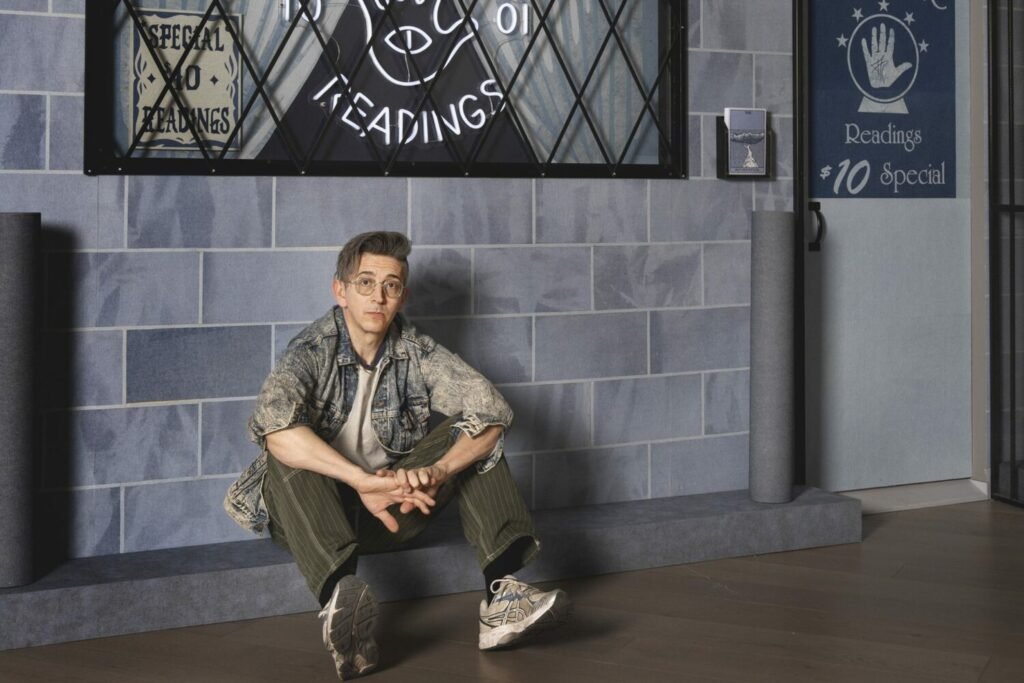
Doyle’s recent exhibition, Collective Hallucinations, presented at Perrotin New York this past spring, featured wall-mounted collages and an interactive installation called “Mirror Mirror.” The denim-clad structure featured a sign reading “Psychic Readings $10 Special,” while inside, a sassy AI avatar named Ava greeted visitors. The installation marked Doyle’s first foray into AI.
In another unexpected move, he presented his corporate-themed kink bar, Human Resources, at Basel Social Club in Switzerland this June. Built from repurposed cubicles and office furniture, the installation plays with the power dynamics inherent in both corporate and kink culture.

‘The Price of Ascension’ (2026) by Nick Doyle. Photography courtesy of Pace Prints.
Doyle calls his work “more of a reflection of American culture than an individualist perspective.” Reflecting on being raised Quaker, he says, “It’s a very consensus-driven community that is slow-paced and meditative. It’s culturally very counter to a fast-paced, consumer-driven way of life typical of growing up in a large American city.” The tension between these two ways of life surfaces throughout his work.
In this week’s Friday Five, we spent five minutes with Nick Doyle ahead of Art Basel Miami Beach, where Pace Prints will present selections from Lonely but Free I’ll Be Found, to discuss the inspirations behind his exploration of the contradictions of American life.

‘Empty’ (2026) by Nick Doyle. Photography courtesy of Pace Prints.
The Project: Lonely but Free I’ll Be Found
As with much of Doyle’s work, his latest exhibition examines the greed, excess, and toxic masculinity of American culture, this time through bold representations of the minutiae of everyday life: a folded shirt, a necktie, a lottery ticket, a gas gauge on empty, a Coca-Cola machine. Rendered in blue tones reminiscent of denim, the imagery evokes American labor and the archetype of the self-made man.
Together, the works question the country’s deep-rooted belief in self-reliance, drawing parallels between the ideal of the independent American and today’s “America First” mentality, in which individual freedom can come at the expense of collective responsibility. A selection of these works will be on view at Art Basel Miami Beach, Dec. 2–6, 2026.
Here, Doyle discusses his inspirations for the exhibition in his own words.

Photography courtesy of Pace Prints
What Inspired Lonely but Free I’ll Be Found?
The Ken Burns Documentary: Country Music
“This documentary has everything: It traces the origins of country music alongside American history and is a deeply emotional story about the search for salvation and community.
“One of the musical groups featured is The Sons of the Pioneers. The title of this exhibition Lonely but Free I’ll be Found is a lyric in their song ‘Tumbling Tumbleweeds.’ Originally a poem written by Bob Nolan in the 1930s, it describes lonely cowboys adrift on the range.”

The Neon Museum in Las Vegas, Nevada. Photography courtesy of Nick Doyle.
The Neon Museum in Las Vegas
“I take a lot of road trips in the Southwest. Vegas is a great access point, and one of my favorite places is the Neon Museum with a collection of old signage from the last century. There’s something about these retrofuturistic signs rotting away in the desert that I relate to. They exude a sad psychological aura of something that once served a purpose, sitting in functionless rows like a graveyard.
“I think of this body of work functioning similarly to these signs, although different in the sense that what I’m drawing attention to is an idea rather than something that can be purchased.”

‘The Itch’ (2026) by Nick Doyle. Photography courtesy of Pace Prints.
The Suicide Belt
“For this show, I was considering the perspective of a man who lived in the ‘suicide belt,’ a term coined by Matt Wray in the early 2000s to describe the high-suicide-rate region of the U.S. Mountain/Intermountain West. The belt includes Arizona, Colorado, Idaho, Montana, Nevada, New Mexico, Oregon, Utah, and Wyoming.
“Wray describes ‘the Intermountain West as a place that is disproportionately populated by middle-aged and aging white men, single, unattached, often unemployed, with access to guns.’ I often think about suicide as a larger social symptom and connect it to broader social issues in the U.S.”