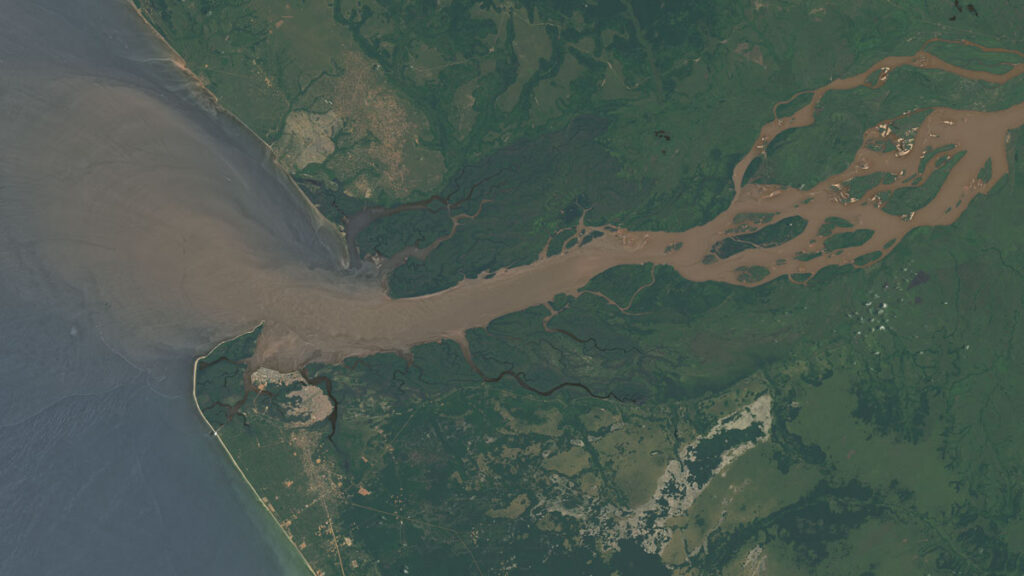
Source: Journal of Geophysical Research: Oceans
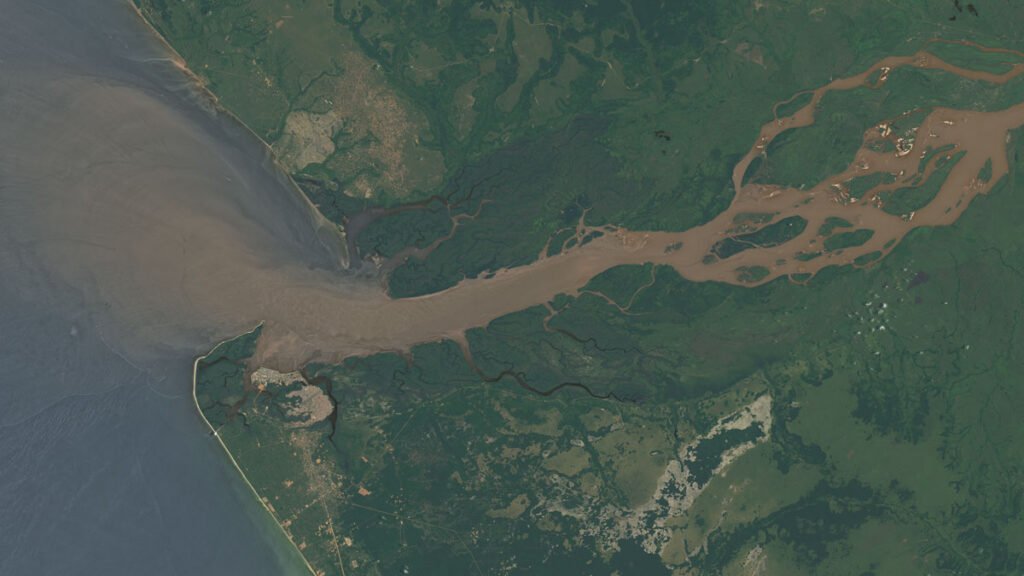
The Congo River is the second largest river in the world, releasing an average of 40,000 cubic meters of water per second into the Atlantic Ocean. This huge discharge rate creates a large plume of fresh water that fans out 800 kilometers offshore.
During the wet season, the plume shifts to the southwest, where it can be trapped by large, rotating currents called mesoscale eddies, with sizes on the order of 100 kilometers. These eddies transport fresh water hundreds of kilometers away from the coast. In work done at the Laboratory of Space Geophysical and Oceanographic Studies (LEGOS) and collaborating laboratories, Cardot et al. examined the swirling currents of mesoscale eddies through both modeling and recorded observations to better understand how fresh water moves from the Congo River into the Atlantic Ocean.
Researchers used a 3-kilometer ocean circulation model, NEMO (Nucleus for European Modelling of the Ocean), to simulate the Congo River discharge. The study focused on 2016 because of the year’s strong observational records from the Prediction and Research Moored Array in the Tropical Atlantic (PIRATA) and satellite records of salinity and currents in the region. They validated the model’s output using measurements of sea surface salinity, sea surface height, and surface current data gathered from the Automatic Identification System for ship tracking and processing done by eOdyn. Overall, the model was able to successfully reproduce the size, position, and seasonal changes of the Congo River plume.
Several mesoscale events occurred during 2016. One such eddy exported a large amount of fresh water into the ocean in March and April. This anticyclonic eddy (meaning that it rotated counterclockwise in the Southern Hemisphere) formed near the Congo River plume and lasted 49 days, growing to a radius of 150 kilometers. The eddy trapped low-salinity water from the plume in its core and transported it roughly 200 kilometers offshore before dissipating.
Particle-tracking experiments traced the origins of the water trapped inside the eddies and offered information about how river water was transported into the Atlantic. Researchers tracked more than 5,000 virtual particles back through time and discovered that the particles trapped inside the eddy’s core in April could be traced back to the southern portion of the Congo River plume earlier in March, highlighting how episodic events like this one in 2016 dominate freshwater transport offshore, rather than a continuous diffusion from the Congo River into the Atlantic. These findings have implications for regional ocean circulation as well as the marine ecosystems and fisheries that depend on this freshwater input. (Journal of Geophysical Research: Oceans, https://doi.org/10.1029/2025JC023642, 2026)
—Rebecca Owen (@beccapox.bsky.social), Science Writer

Citation: Owen, R. (2026), Forty thousand cubic meters of fresh water flow from the Congo into the Atlantic every second. A new study traces where it goes from there., Eos, 107, https://doi.org/10.1029/2026EO260214. Published on 2 July 2026.
Text © 2026. AGU. CC BY-NC-ND 3.0
Except where otherwise noted, images are subject to copyright. Any reuse without express permission from the copyright owner is prohibited.