Automakers not named Tesla aren’t accustomed to dramatic stock spikes, but Ford is on a run of its own right now.
Earlier this month, the all-American car company introduced its new venture to sell its batteries to data centers. In the weeks since, Ford’s stock is up by more than 30%, hitting highs the automaker hasn’t seen since 2022—growth powered by a business without four wheels.
Ford’s buzzy new side hustle, Ford Energy, offers the carmaker an unusual way to tap into the AI gold rush. The company first announced its plans to wade into the battery energy storage system business with a $2 billion investment late last year, but now those plans are taking shape.
The electric vehicle market has suffered since Biden-era tax credits that made EVs more affordable bit the dust under Trump, who backs oil and gas over green alternatives. Sales might be down, but auto companies like Ford still have the supply chains and manufacturing facilities set up to crank out a bunch of batteries that were destined for new cars, and which now can find lucrative new homes. The plan could also offset the huge investments that automakers made in the pivot to EVs—an environmental necessity, but one that’s gone off the rails in U.S. policy for now.
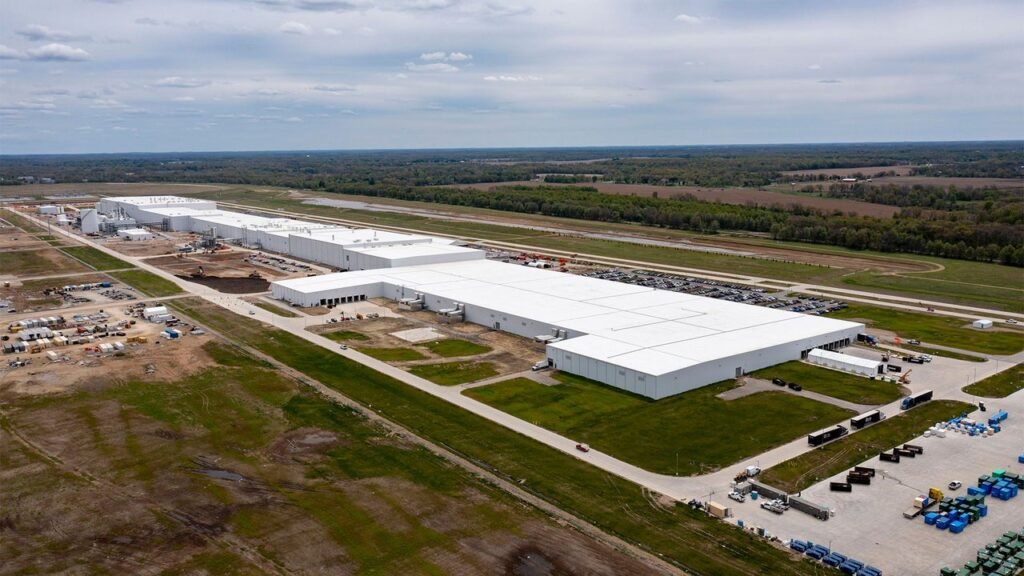
In the announcement, Ford explained that it would provide its batteries to “utilities, data centers, and large industrial and commercial customers” in the United States. Ford Energy’s first delivery is set for 2027, and the company is aiming to provide a minimum of 20 gigawatt hours each year through the side business. Ford will repurpose a battery facility in Glendale, Kentucky, to focus exclusively on the new application for the batteries it builds, which will compete with Tesla, among other battery makers. Ford Energy will function as a wholly owned subsidiary of Ford Motor Co.
In the new venture, Ford will lean on a partnership with the Chinese battery maker Contemporary Amperex Technology Ltd. (CATL). Ford previously announced a $3 billion plant in Michigan that will build battery cells with CATL’s technology, a project on track for ramping up this year. Ford’s reliance on Chinese tech led Rep. John Moolenaar, R-Mich., to question the company in light of its plans to expand beyond cars into powering critical infrastructure. Because they can provide essential power, battery energy storage systems, known as BESS, could be a juicy target for sophisticated cyberattacks.
“Ford’s revised business plan raises important questions about whether the original licensing terms have been updated, expanded, or otherwise altered to accommodate the company’s new focus on energy storage systems and data center markets,” Moolenaar wrote in a letter to Ford’s CEO, Jim Farley, earlier this year.
Ford is focused on cheaper EVs
With Trump’s war in Iran dragging gas prices up, it should be a good time to buy an electric vehicle, even if it doesn’t feel like it. Unfortunately, inflation still weighs heavily on American consumers, who are now paying more at the pump and are even less able to afford a costly new full-price EV. As a result, they might look to used EVs and hybrids as a compromise.
“Prices have gone up almost $10,000 in the U.S. for electric cars, and electric cars are now up to 7% of the U.S. industry,” Farley told Fast Company last month. “That’s not a small amount, with no government support.” Farley points out that many people may be priced out of a high-end EV, but “truly affordable” electric vehicles can still shine right now.
To fill that gap, Ford is redoubling its efforts around cheaper EVs in the $30,000 range and redesigning its EV platform from the ground up. The company will also deploy smaller, cheaper batteries that can combine with improved aerodynamics to bring the cost of a new car down. With the new platform, Ford will put its weight behind an new, experimental midsize electric pickup truck with a price tag around $30,000.
“We got out of our high-end EVs, but what we decided to do is double down on our affordable ones,” Farley said. “And that is what’s selling today around the world, not just in the U.S. You look at Australia, you look at China, you look at Europe. All those markets are moving to a pure EV being more of a commuter-type, low-cost vehicle. That’s really where the market has already gone.”