
Albert Einstein once said that “the most beautiful experience we can have is the mysterious. It is the fundamental emotion that stands at the cradle of true art and true science.” For Dr. Elliot McGucken, the sublime enigmas of nature form the basis of his explorations of landscape and light.
McGucken traverses North America’s most beautiful and striking terrain, including Death Valley where he captured a wildflower superbloom earlier this year. He revels in all kinds of natural phenomena, from the vicissitudes of the Rocky Mountains to brown bears fishing in Alaska’s Katmai National Park and Preserve to the ghostly, flood-carved walls of Antelope Canyon. He also happens to be a physicist whose research focuses on an artificial retina prosthesis that can help restore sight to those who are blind.

Although photography and physics may seem at first blush to be a world apart, they intersect in many ways, especially through the use of advanced lenses that manipulate light to create images. In this way, McGucken channels a limitless fascination with perception and seeing in which scientific inquiry drives his photography as much as the aesthetic and technical qualities of the medium. He’s also really into Albert Einstein’s Theory of Relativity and quantum mechanics, and that’s where an ongoing series called Spacetime Light Cone Sculptures dx4/dt=ic comes in.
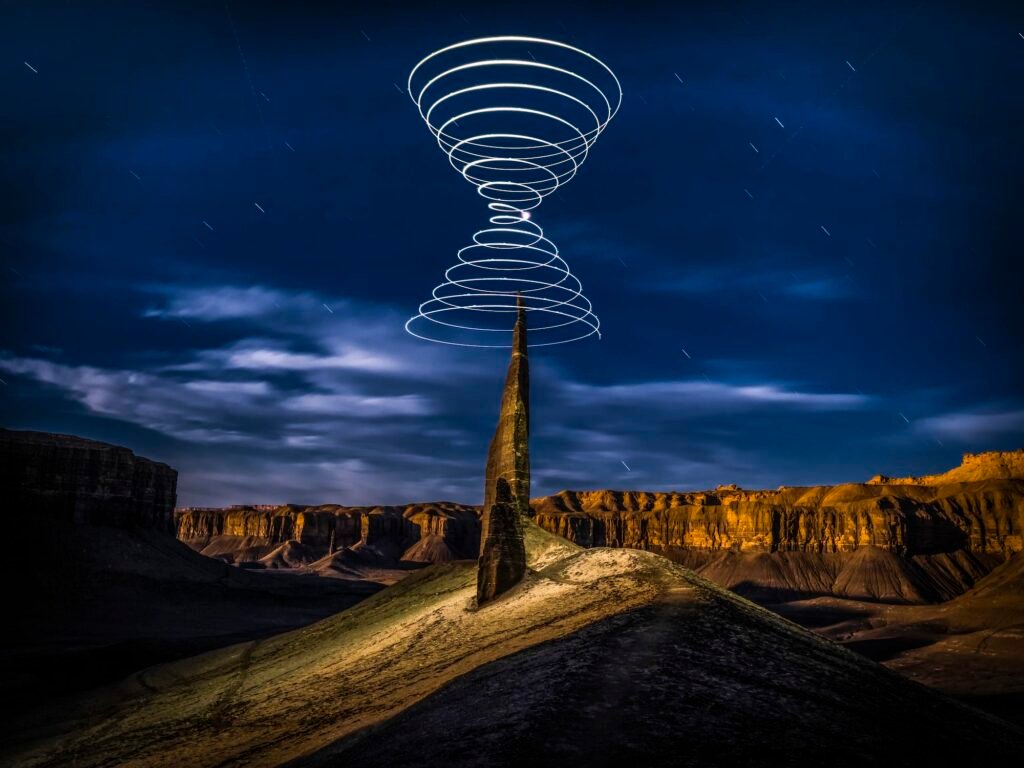
McGucken delves specifically into the study of the fourth dimension, drawing on Einstein’s 1922 book The Meaning of Relativity, in which the renowned scientist illustrated a “light cone” that represented “the deep, physical relationship between space, time, and the velocity of light,” McGucken says. This almost hourglass-like shape, with two cones that meet at their tips, forms the basis of Spacetime Light Cone Sculptures dx4/dt=ic.
McGucken describes the works as “sculptures upon nature’s exalted easel,” utilizing contemporary technology to illuminate theories of existence and the cosmos. He sends a drone into the air over dramatic and remote Southwest landscapes to capture long exposures of conical spirals of light. Over the years, he’s visited the Trona Pinnacles in the California Desert Conservation Area and the Mobius Arch rock formation in the Alabama Hills, among other places.
See more on the artist’s Instagram and purchase prints on his website. You might also enjoy Rueben Wu’s glowing light paintings.


Do stories and artists like this matter to you? Become a Colossal Member today and support independent arts publishing for as little as $7 per month. The article Elliot McGucken Suspends Einstein’s ‘Light Cones’ Over Desert Expanses appeared first on Colossal.