Every time I go to the dentist, I get a lecture about how important it is to floss my teeth. But after a few weeks of good behavior, this is the part of my daily routine I’m most guilty of skipping, because it’s such a laborious, unpleasant process.
I’m not alone—59% of Americans don’t floss daily, and 20% don’t floss at all.
But I have good news. Help is on the way for those of us who hate flossing. Dyson has created a seamless flossing system, which is incorporated into what might be the most technologically ambitious toothbrush ever made.
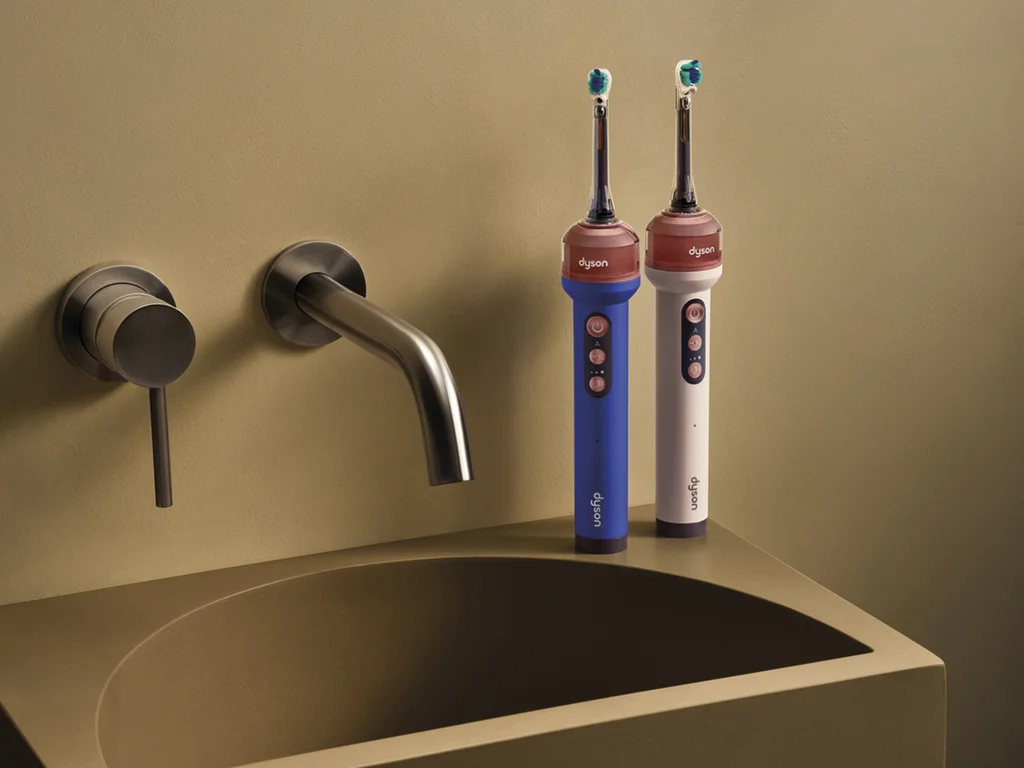
The British engineering company, best known for reinventing vacuums, is entering oral care. It has developed an electric toothbrush that automatically flosses with jets of mouthwash while you brush. The device, called the Dyson CameraJet, scans your mouth 28 times per second and fires tiny bursts of liquid into tight spaces where plaque can settle. And importantly, the process is so subtle and imperceptible that it feels like regular brushing.
It’s an impressive—and, at $499, an expensive—piece of engineering. But it’s also emblematic of Dyson’s increasingly expansive ambitions to apply its engineering-heavy approach to categories that haven’t seen much innovation.
Starting with a problem, not a toothbrush
The Dyson team began developing the device when they realized that the majority of people don’t floss, even though the American Dental Association recommends doing so every day. “The toothbrush started by trying to solve ill-compliance in flossing,” says Niamh Turney, a Dyson engineer who has spent the last several years developing the device. “We looked at whether you could floss without floss.”
Turney and her colleagues realized that this wasn’t just an engineering problem, but a behavioral problem. They believed they could get more people to floss if the process was incorporated into something they were already doing. “This was really about trying to integrate flossing into the toothbrushing routine, rather than trying to optimize a part of the routine that people aren’t engaging with,” Turney says. “We set about the problem of trying to create a toothbrush that flossed for you.”
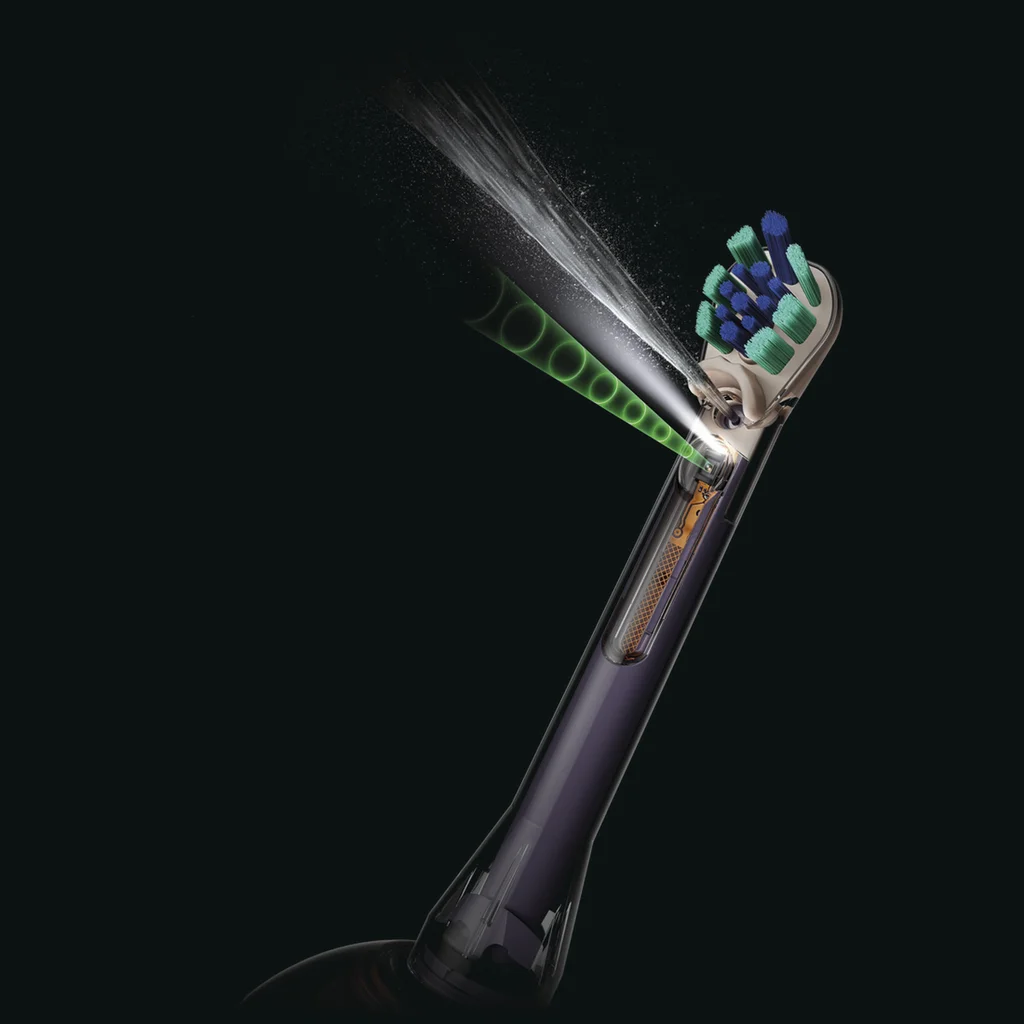
To do this, Dyson invented an entirely new system. One of the most recent innovations in flossing is the water flossers that spray liquid wherever the user points it. The problem with this was that it is very messy, with water dripping everywhere. The team wanted to see if they could incorporate a water flosser into the toothbrush, but they ran into the problem of how they could store the fluid. A countertop water flosser usually has a milliliter-sized tank, whereas a toothbrush is a much smaller device that could reasonably hold just a fraction of that.
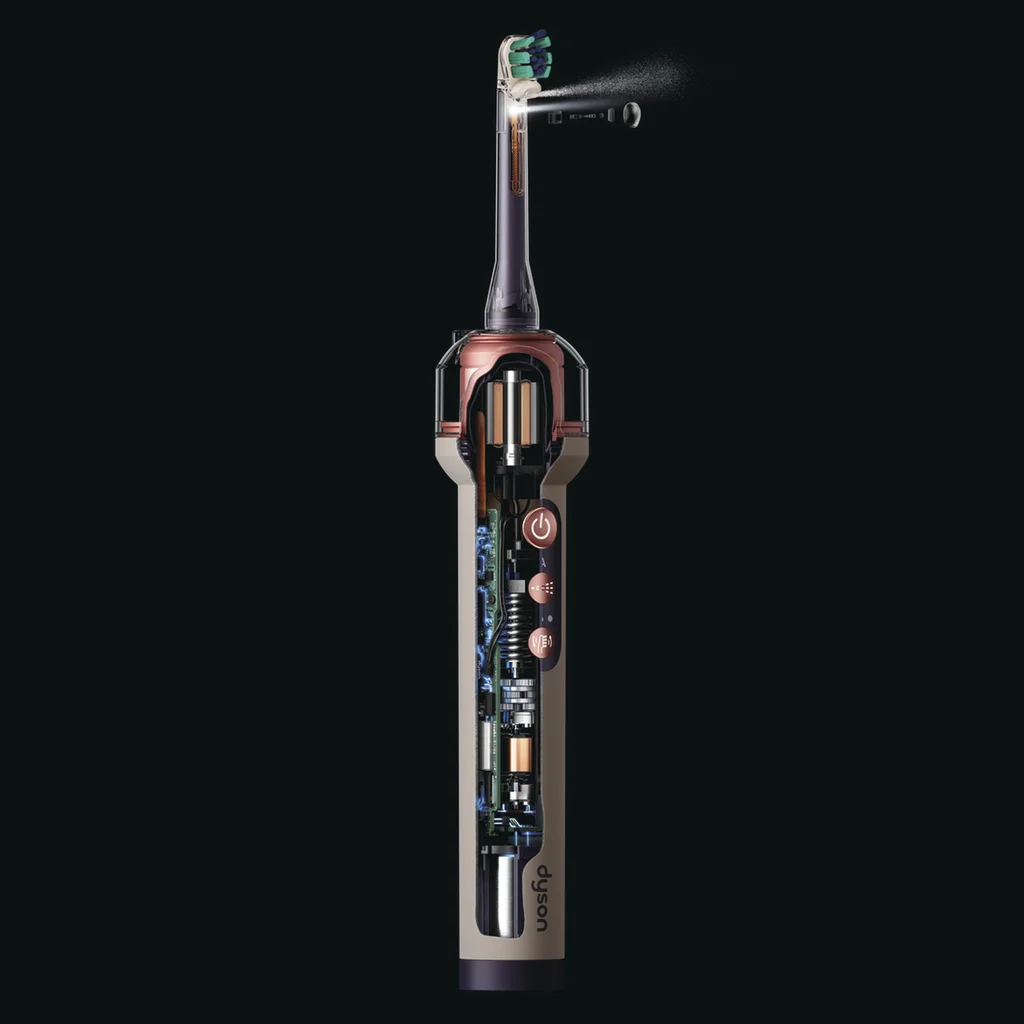
The solution was to build a miniature camera into the toothbrush that identifies the spaces between teeth in real time, and only sprays water into these gaps. This vision system is trained on nearly half a million dental images. When it recognizes a gap, the toothbrush triggers a spray of mouthwash designed to flush away plaque. As a result, it requires far less water. The tank only holds 12.5 milliliters of mouthwash. “It happens so quickly—it immediately triggers the jet while you’re brushing,” Turney explains.
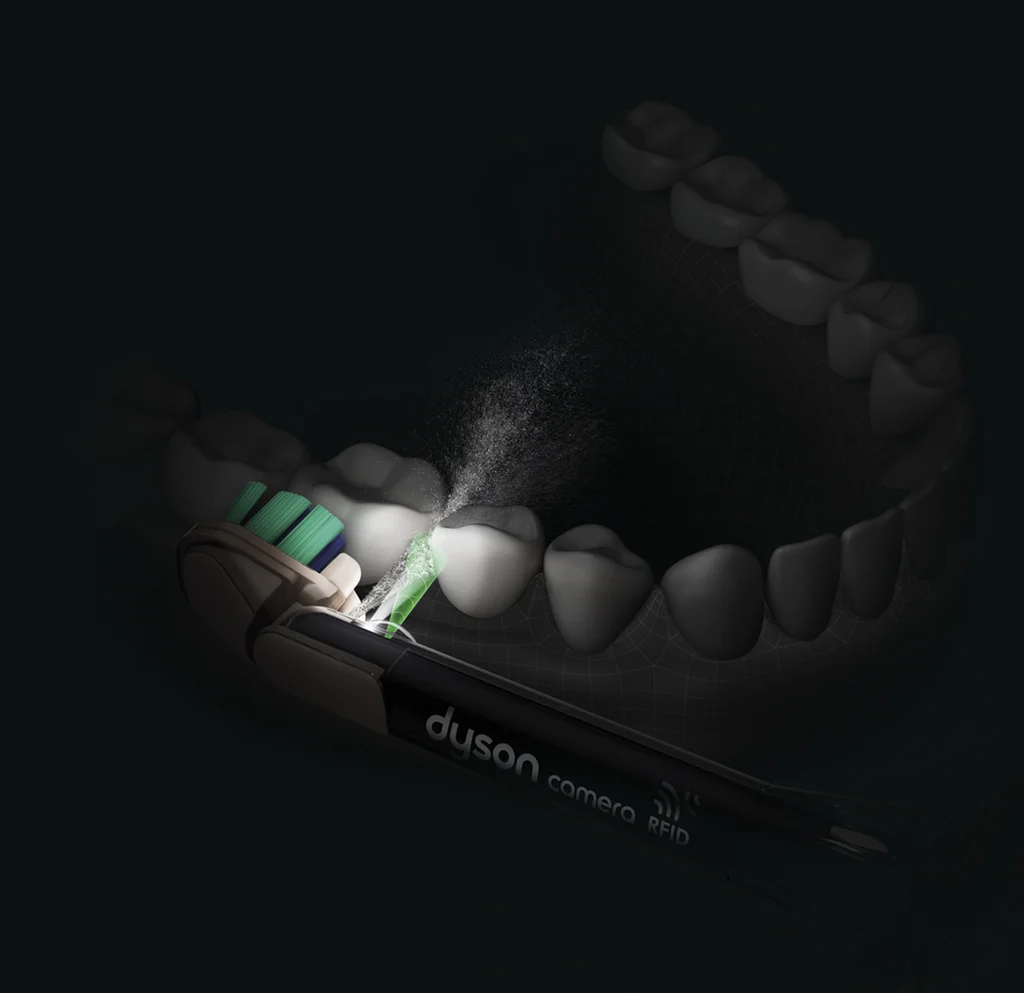
Dyson also redesigned the brush head. The company says conventional sonic toothbrushes stop vibrating effectively when pressed against teeth, since this reduces how much the bristles actually move. Dyson instead varies the oscillation angle of the brush, keeping the bristles in motion throughout brushing.
To develop this brushing system, Dyson partnered with researchers at the National University of Singapore to grow synthetic plaque that mimics the properties of real plaque. It developed prototypes that tested hundreds of brush and jet designs to effectively eliminate this synthetic plaque. “We tested hundreds of iterations of a brush head, a jet profile, and the combination of those,” says Turney.
Another surprising category for Dyson
The toothbrush is a surprising move for a company still best known for vacuums. But over the years, Dyson has expanded its expertise. It launched the Supersonic hair dryer a decade ago. While some questioned whether consumers would spend hundreds of dollars on a super high-tech hair dryer, the product became one of Dyson’s biggest successes. It helped spawn an entire beauty business that now includes the Airwrap styling system, straighteners, and even hair-care formulations.
These new categories have helped Dyson grow. The privately held company generated $8.3 billion in revenue in 2025. It also invested more than $540 million in research and development and introduced a record number of new products.
Turney argues that consumers don’t necessarily think of Dyson as a vacuum company anymore. “It’s focusing on solving problems and bringing innovative products to market that increase utility, efficacy, or simply are more enjoyable to use,” says Turney.
Will people pay for it?
The bigger question isn’t whether Dyson can build an extraordinarily sophisticated toothbrush. It’s whether enough consumers will pay $499 for one.
Along with replaceable brush heads, users will also be encouraged to refill the device with Dyson’s own specially formulated low-foaming mouthwash, which improves the camera’s ability to detect gaps between teeth. (They can use other mouthwash brands as well, but they won’t work as well.)
Still, consumers may be more willing to splurge than skeptics expect. Its hair dryers and styling tools have become popular despite costing several times more than conventional alternatives. Indeed, it appears to have raised the standard for the entire industry, with other brands like L’Oreal releasing similarly expensive high-tech hair dryers.
If the CameraJet finds similar success, it could have ripple effects well beyond Dyson’s own business. By embedding computer vision and automated flossing into a toothbrush, Dyson increases consumers’ expectations for oral-care devices.
We’ll have to see whether buyers ultimately embrace the idea of a toothbrush with its own camera. But Dyson has created a robust business by reinventing everyday household products from the ground up. With the CameraJet, it’s betting that even one of our most mundane routines is overdue for an engineering overhaul.