
While commercial real estate’s use of artificial intelligence has been around for over 40 years, it’s only been since the early 2020s that it’s made its way into the mainstream. Along with AI’s increased awareness are predictions ranging from promoting efficiency gains through automation to reducing loan processing time to quickly identifying trends.
But according to Cushman & Wakefield, AI’s future will be less about technical capabilities and more about productivity gains involving hiring, revenue growth and capital allocation.
Additionally, “AI will not affect all real estate equally. Instead, it will widen the distribution of outcomes across markets, property types, asset quality and investment strategies, magnifying both upside and downside outcomes,” according to the company’s just-released white paper, “AI Impact on CRE: The Next 10 Years.”
Cushman & Wakefield researchers didn’t focus on AI’s evolution, but rather on how sectors and the macroeconomy could respond to the technology and what it might mean for CRE fundamentals.
The chart below shows AI’s potential implications by commercial real estate asset type.
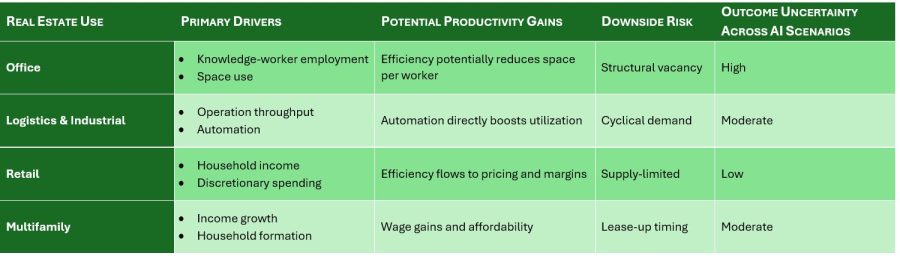
The report also noted that:
- Productivity gains often materialize before revenue growth and hiring decisions. This could lead to a delay in CRE demand, especially in office markets.
- The United States will likely lead in AI-driven impacts, while Europe and Asia-Pacific will experience slower impacts due to labor markets, policies and underlying growth conditions.
Because AI will change how work is organized, rather than how much space is needed, occupiers should:
- Prioritize flexibility, optionality and high-quality environments
- Anticipate uneven demand recovery by sector and location
- Focus on assets that support technology integration, talent attraction and coordination
On the investment side, AI will increase asset selection and timing importance; additionally:
- Office outcomes will be scenario-dependent
- Logistics & industrial could show the strongest cross-scenario resistance
- Retail and multifamily will be income-driven, while supply discipline will be critical
“AI will not deliver a single, predictable real estate outcome,” the report concluded. “Instead, it will introduce greater uncertainty, dispersion and strategic complexity across global markets. In this environment, success will depend less on predicting the future and more on preparing for multiple plausible scenarios.”
The post Digging Beneath the Confusion: The Future of Artificial Intelligence and Commercial Real Estate appeared first on Connect CRE.