This story was copublished with Next City, a nonprofit news organization reporting on solutions for more sustainable, accessible, inclusive, and equitable cities.
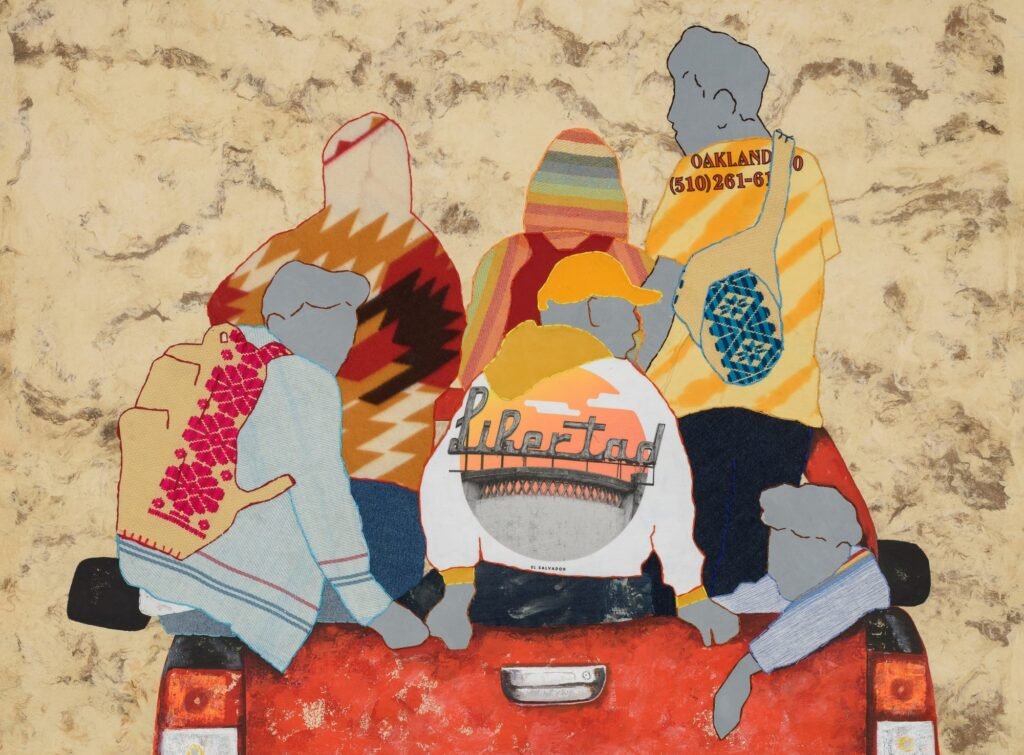
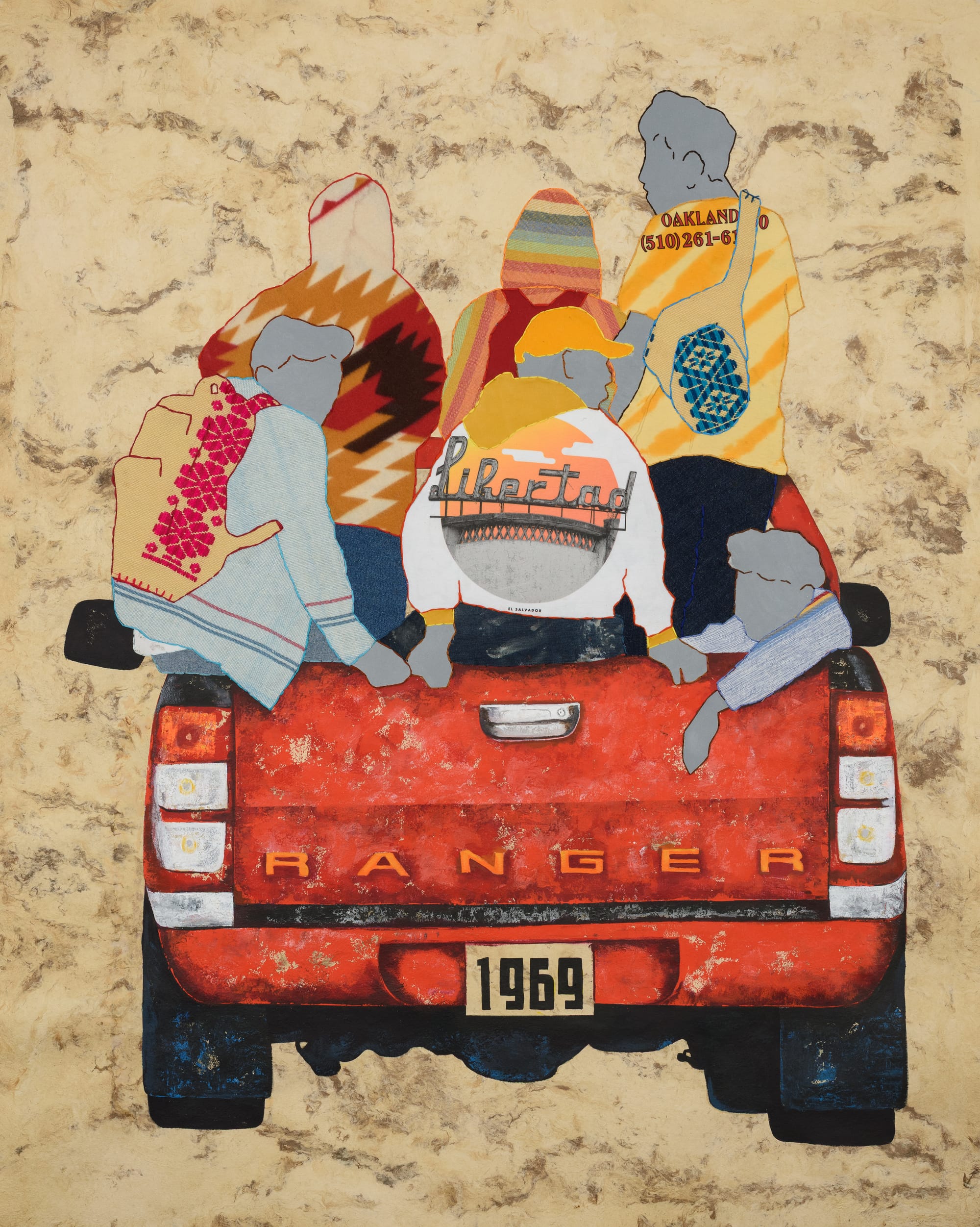
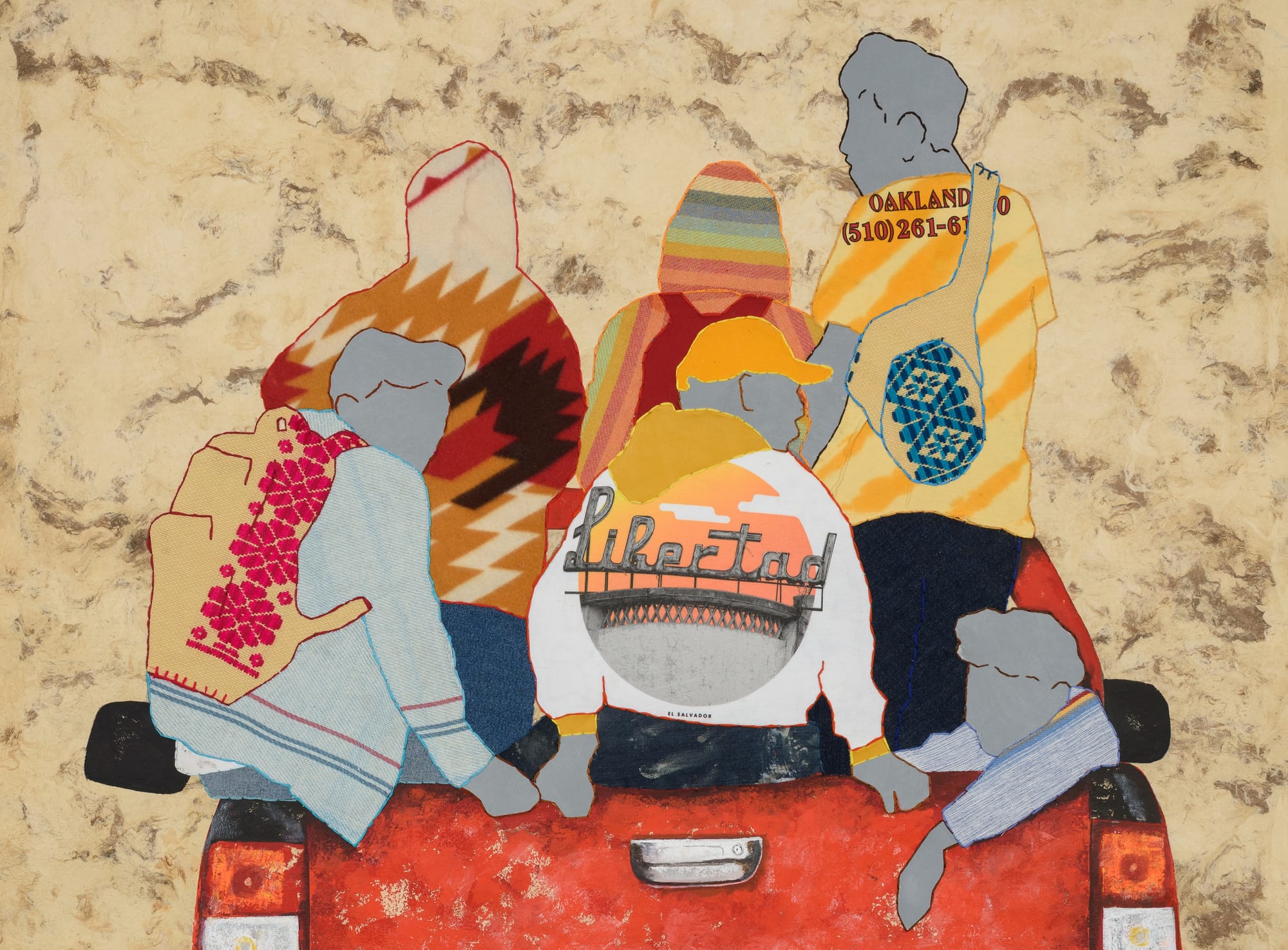
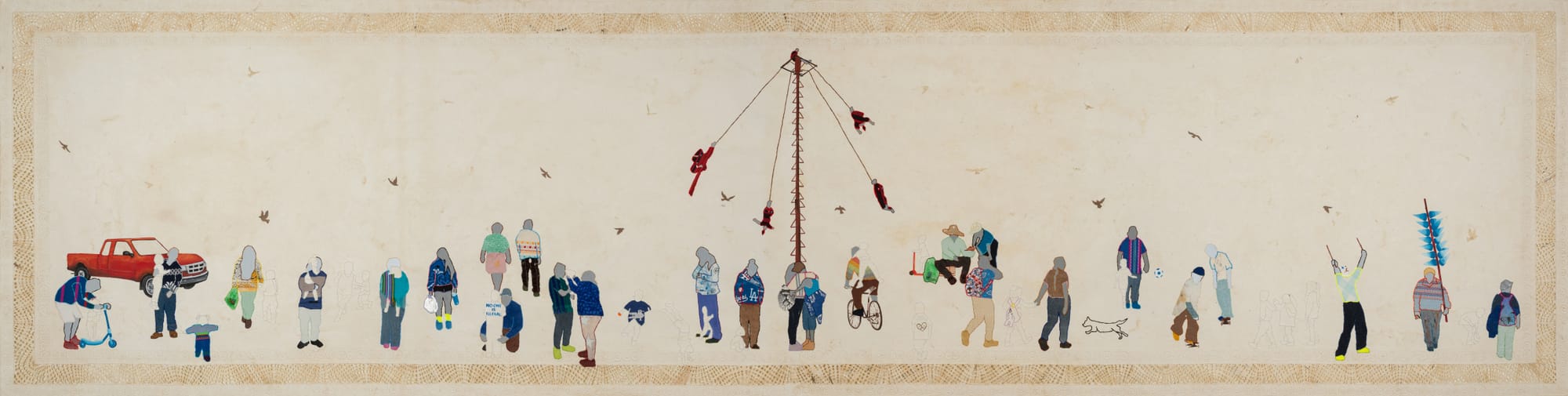
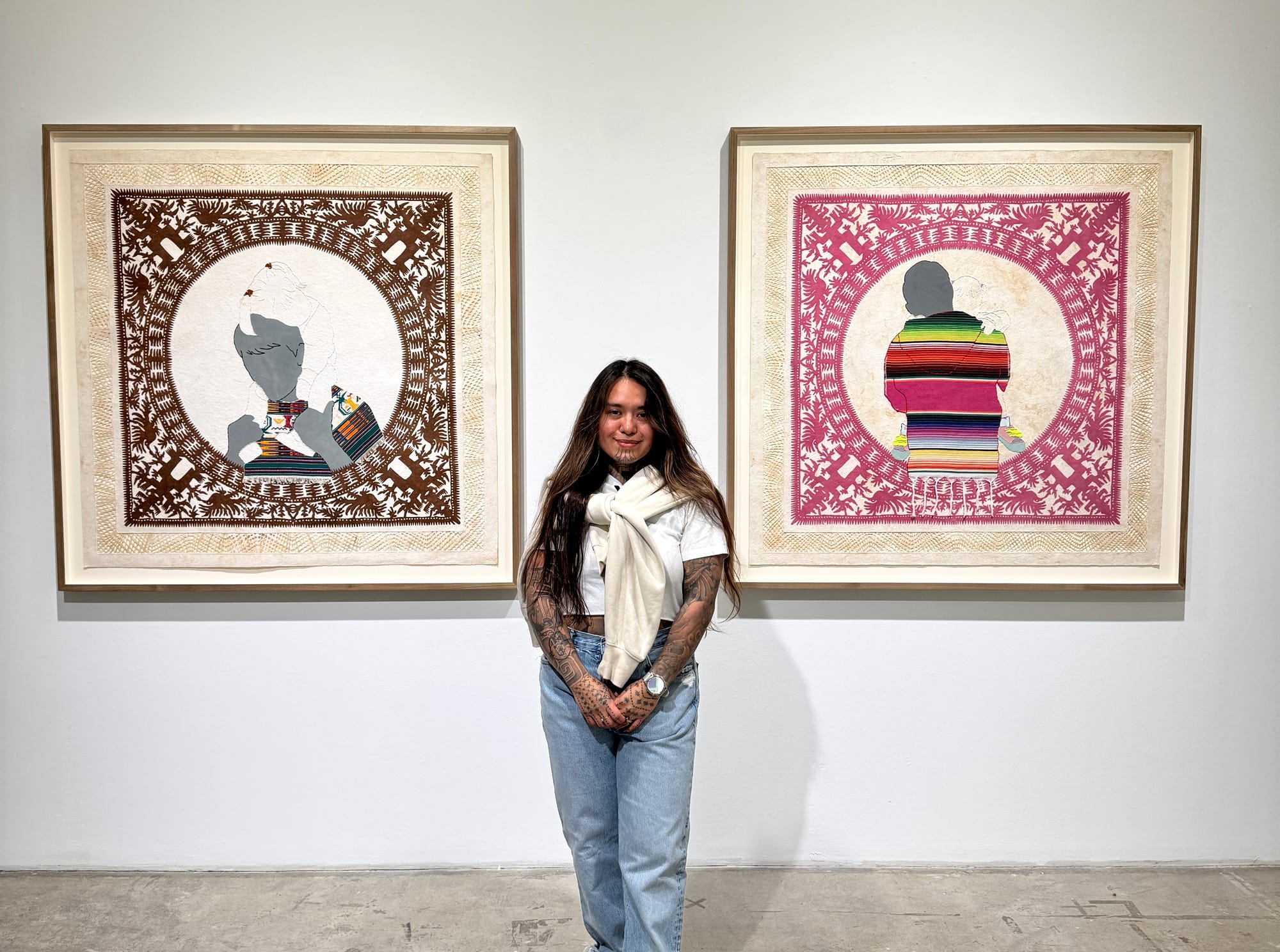
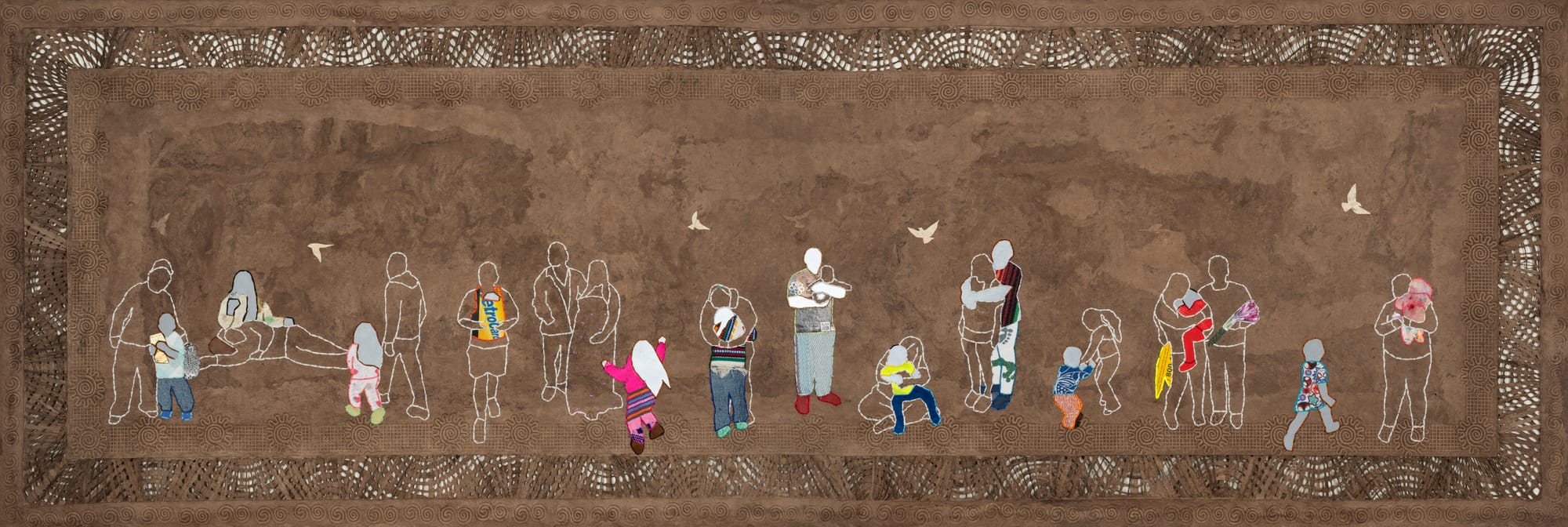
Visitors walking into Manhattan’s Fridman Gallery are instantly met with Arleene Correa Valencia’s four-by-five-foot acrylic and textile composition depicting six figures outlined in thread and fabric. They’re riding in the back of a red pickup truck, and their faces are blank. Toward the back of the space, her 16-foot-long “En El Cielo No Hay Fronteras / There Are No Borders In The Sky” (2025) portrays people being people — embracing, riding bikes and scooters, skateboarding, doing cartwheels. Taking in the massive piece is like tracing a plane or a star in the sky. In the center, outlined in thread and then painted, is a red swing set that represents the border between the United States and Mexico.
The Bay Area artist’s debut solo exhibition, CÓDICE •• SOBREVIVIENDO A LA PERSECUCIÓN, up through May 2, is an unflinching response to the violence against immigrants perpetrated by the Trump administration. Valencia, a DACA recipient, was born nearly 30 years ago in western Mexico, some 2,000 miles away from where she would eventually call home. In the 1990s, her parents chose — as much as choice can be made between death and living — to migrate her and her family from a small town in the mountains of Michoacán, Mexico, to Napa Valley, known as a community rich with jobs for undocumented people.
In place of canvas, Valencia uses amate, a soft-toned, sand-like bark paper whose origins date back to Mesoamerican times. Her pieces are created in collaboration with Jose Daniel Santos de la Puerta, who handcrafts the amate paper in Puebla, Mexico; her father, who does the primary painting; and her mother-in-law, who helps Valencia with embroidery.
While the artist’s larger, more intricate pieces capture the viewer’s attention, it is the smaller framed letters from her own childhood that are the most emotionally affecting. In these correspondences, from a time when she and her father were separated, Valencia attempts to write in Spanish, asking her father not to forget her, to come back to where she is.
“We search for love, and we want to know that we are loved. And I knew that from the day that I was three years old. My parents crossed the world for me … Not everybody has that,” Valencia said in an interview.
Valencia worked hard from a young age. She went to school, cleaned houses with her mother, and became a nanny at 14. Eventually, the racist cruelty she experienced in high school led her to finish her studies at home. She wanted to attend community college to study art, a dream she’d been harboring since she was a small child. “At a very young age, I knew that I wanted to become an artist. But everything around me told me that I could not,” Valencia said.
Valencia applied for the California Nonresident Tuition Exemption, or AB 540, a California law that allowed her to apply for community college and pay in-state tuition. Her boyfriend, who is now her husband, was eligible for scholarships, FAFSA aid, grants, and more; he could consider schools in California, in other states, and even abroad. These opportunities were not because of higher academic achievement, but because he had a Social Security number and she did not. This truth haunted her. Growing up, Valencia’s parents had alluded to her immigration status. While she didn’t fully understand what her lack of citizenship meant, it hung over her like a dark cloud.
Valencia spent four years at a two-year community college, taking every art class they offered. When one of her professors, Fain Hancock, asked Valencia about her prolonged coursework, she broke down. For the first time in her life, she told someone the truth about her immigration status — that she could not transfer to another school, leave Napa, or receive scholarships. She would never be able to afford any more training than what she had already received.
Hancock responded by calling California College of the Arts (CCA) and convincing a representative to visit Napa Valley and see Valencia’s work. If she applied for and was granted DACA (Deferred Action for Childhood Arrivals), the representative explained, Valencia could receive the scholarship and attend the CCA’s four-year program.
DACA is an immigration policy established in June 2012 that provides children of migrants born outside the US with lawful presence status, which can be renewed every two years. It offers protection from deportation and a work permit. The Trump administration is implementing new barriers for DACA recipients, making it easier to deport immigrants who were once protected by the program.
“If it wasn’t for Fain or for my work ethic that my parents instilled in me, of just showing up and not knowing how the door was going to open, but knocking on that door every single day, then I wouldn’t have ever stepped foot into San Francisco and moved there for school,” Valencia said.
Like many students of color in predominantly white institutions (PWI), she faced some of her greatest challenges yet. While she had received DACA and was well on her way to becoming an artist, the pressure of existing in a PWI was palpable. In 2017, Valencia traveled to New York City to attend the Whitney Biennial. She saw the controversial painting by Dana Schutz, a White artist who depicted Emmitt Till in a casket. Valencia was horrified.
“I remember the White professors saying, ‘It’s okay for anyone to tell any story.’ And I thought to myself, ‘No, it’s not.’ That’s how you take people’s agency away,” Valencia remembered. “As an undocumented person, I told myself nobody would be able to talk about the hardships of being undocumented and the joy and the love that exists.” She chose oil painting as a medium through which to tell her people’s story.
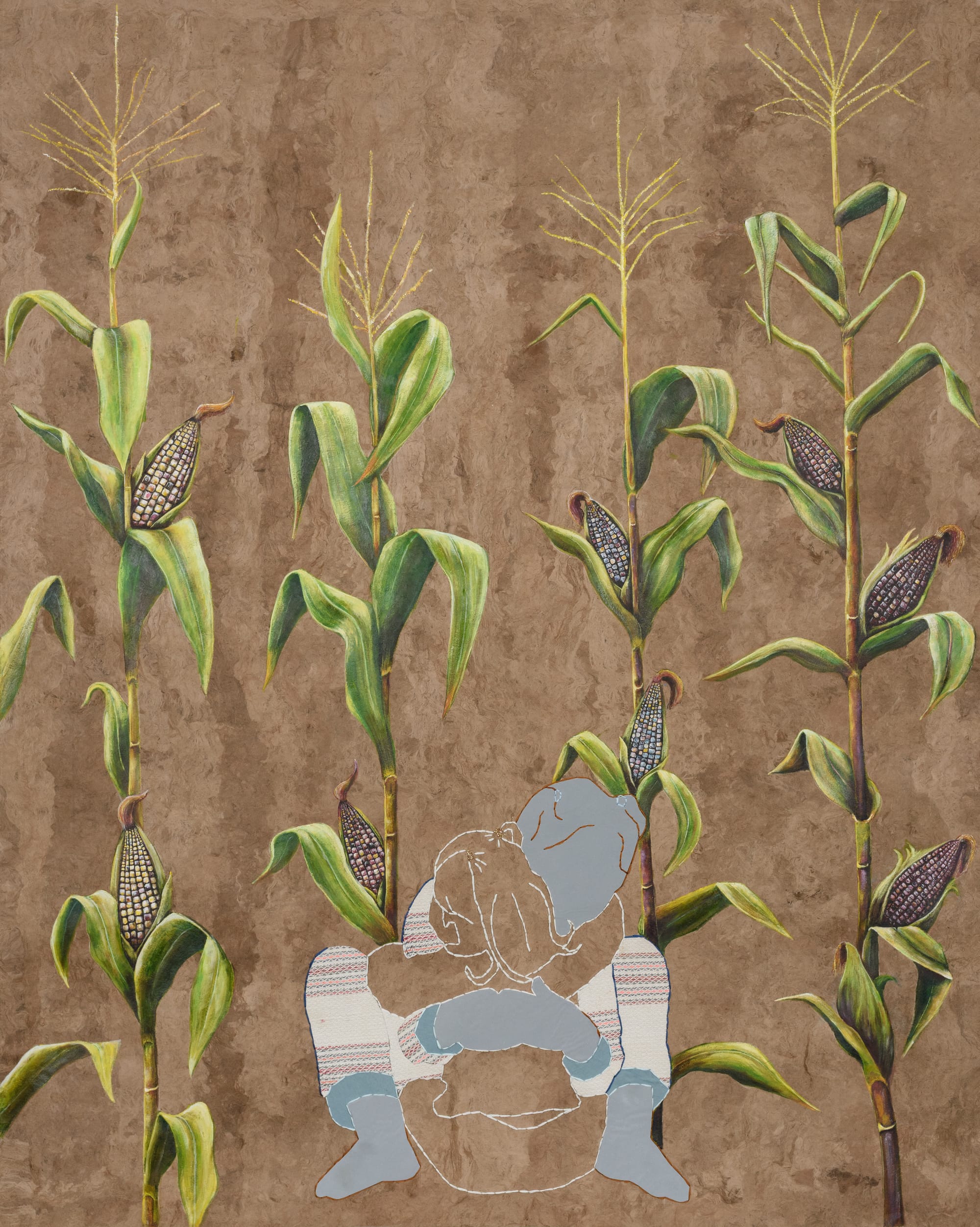
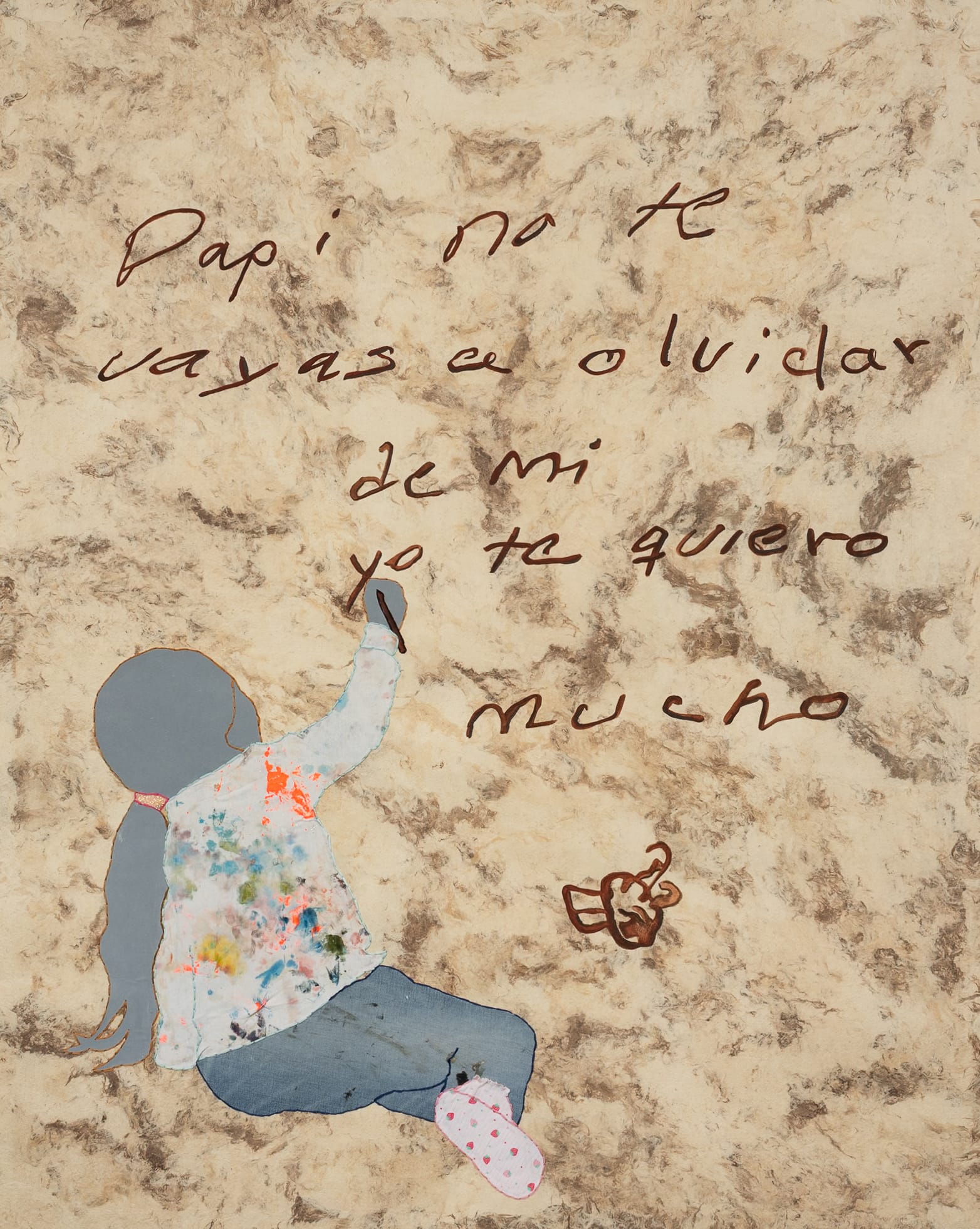
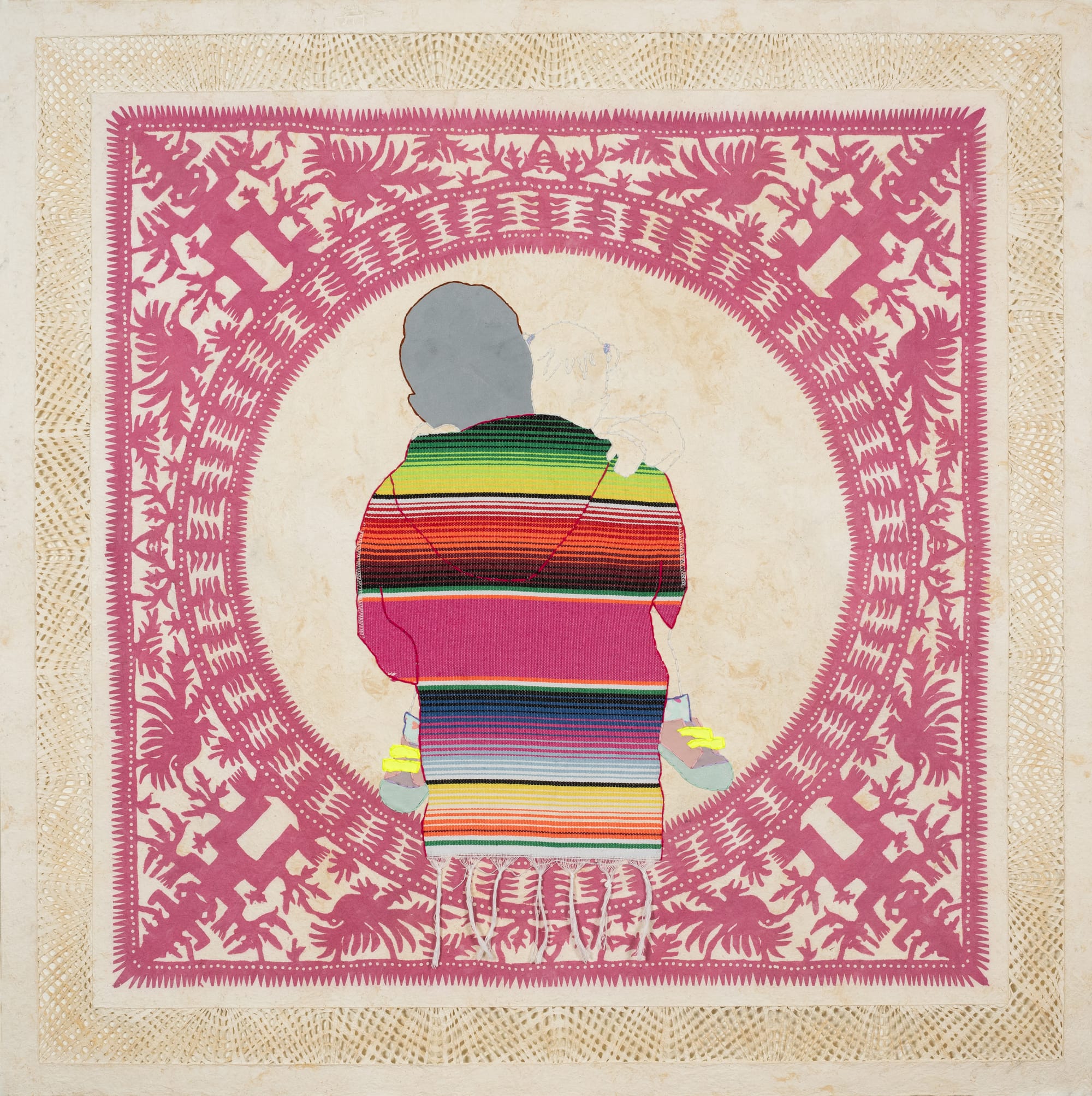
Arleene Correa Valencia, “I Lost My Childhood Learning How To Protect You, And I’d Do It All Again In Every Life / Perdí Mi Infancia Aprendiendo A Protegerte Y Lo Haría Todo De Nuevo En Cada Vida (2025) and “Don’t Forget About Me / No Te Vayas A Olvidar De Mi” (2025) (images courtesy Fridman Gallery)
In 2020, the pandemic lockdowns took Valencia from painting in her studio nearly every day to suddenly being told she could no longer enter the space. Her mother-in-law suggested she consider making art with her sewing machine. Valencia was offended. She was a formally trained oil painter, not a seamstress.
Around the same time, Valencia learned that she was BRCA1 positive, and her doctors found tumors in her breasts. She decided to undergo a double mastectomy, a 14-hour surgery that deconstructed her body. A football-sized portion of her stomach skin was used to reconstruct her breasts.
Forced to be still by her recovery and lack of studio access, Valencia reconsidered her mother-in-law’s suggestion. She asked her to teach her how to use a sewing machine.
Slowly, Valencia began to question why she’d pushed away this practice and considered it less than. She wondered if it was the result of internalizing a hierarchy of artmaking that was steeped in white supremacy, which excludes practices that are inherently more domestic, like sewing and embroidery.
“I was so mesmerized by the way that you can create a line and make a drawing on the sewing machine,” she says. “And that really shifted the way I was thinking about drawing and painting.”
Valencia was also inspired by her mother-in-law’s life. She survived the civil war in El Salvador and lived in an all-girls convent, where they made their own clothes and napkins, which they sold to feed themselves.
“Embroidery was her lifeline, and she’s teaching me this practice that to her is so traumatic,” Valencia said. “I was like, ‘Wow, this is art school.’” The ethos of her work, she discovered, was not in the medium of oil on canvas, but within the ancestral history of all the ways her people had been creating art long before she was told that painting was the way.
Valencia no longer dreams of being an artist; she is one. Her solo debut exhibition does not include oil paintings as she had once imagined, but rather large textile pieces depicting stories inspired by and made in collaboration with her community.
The artist incorporates glow-in-the-dark thread and reflective material, and when the lights are off, the negative of the image is visible instead — an approach that evokes ideas of visibility and its role in her life as a DACA recipient. In her portraits, parents hold their children, much as her own parents carried her to a better life. Outlined in glow-in-the-dark thread, the children only become visible in the darkness, physically separating them from their parents.
The exhibition journeys through the reality immigrants are facing today, as well as the kindness that binds them, and us, together. Valencia recalls that just this month, while shopping for groceries at the Latin supermarket, she realized she could make herself vulnerable to being “picked up” by immigration authorities. She said that while most of her family group chats consist of sharing jokes, they check in on each other every night to make sure they’ve made it home.
“We’re checking in to make sure that we’re alive and here. That is not fair,” Valencia said. “The show had to be a reflection of that. It had to be this extreme, violent state that is also showing the love and the joy.”