As the 61st edition of the Venice Biennale opens for previews this week, cultural workers are planning a 24-hour strike this Friday, May 8, opposing Israel’s inclusion in the event amid the ongoing genocide in Gaza.
In a statement shared with Hyperallergic, the Art Not Genocide Alliance (ANGA) described the action as “the first ever organized strike to occur within the Biennale.” Among the groups that will observe the strike are Biennaleocene, a coalition of local cultural workers formed in 2023 to mobilize against exploitation in Venice’s arts sector; the independent art space Sale Docks; cultural heritage association Mi Riconosci; and the grassroots movement Vogliamo Tutt’altro. The Italian trade unions Associazione Difesa Lavoratori, Unione Sindacale di Base, and Confederazione Unitaria di Base will also participate, ANGA said.
A rally is planned on the city’s Viale Garibaldi, a throughfare near the Biennale’s Arsenale, at 4:30 pm on Friday.
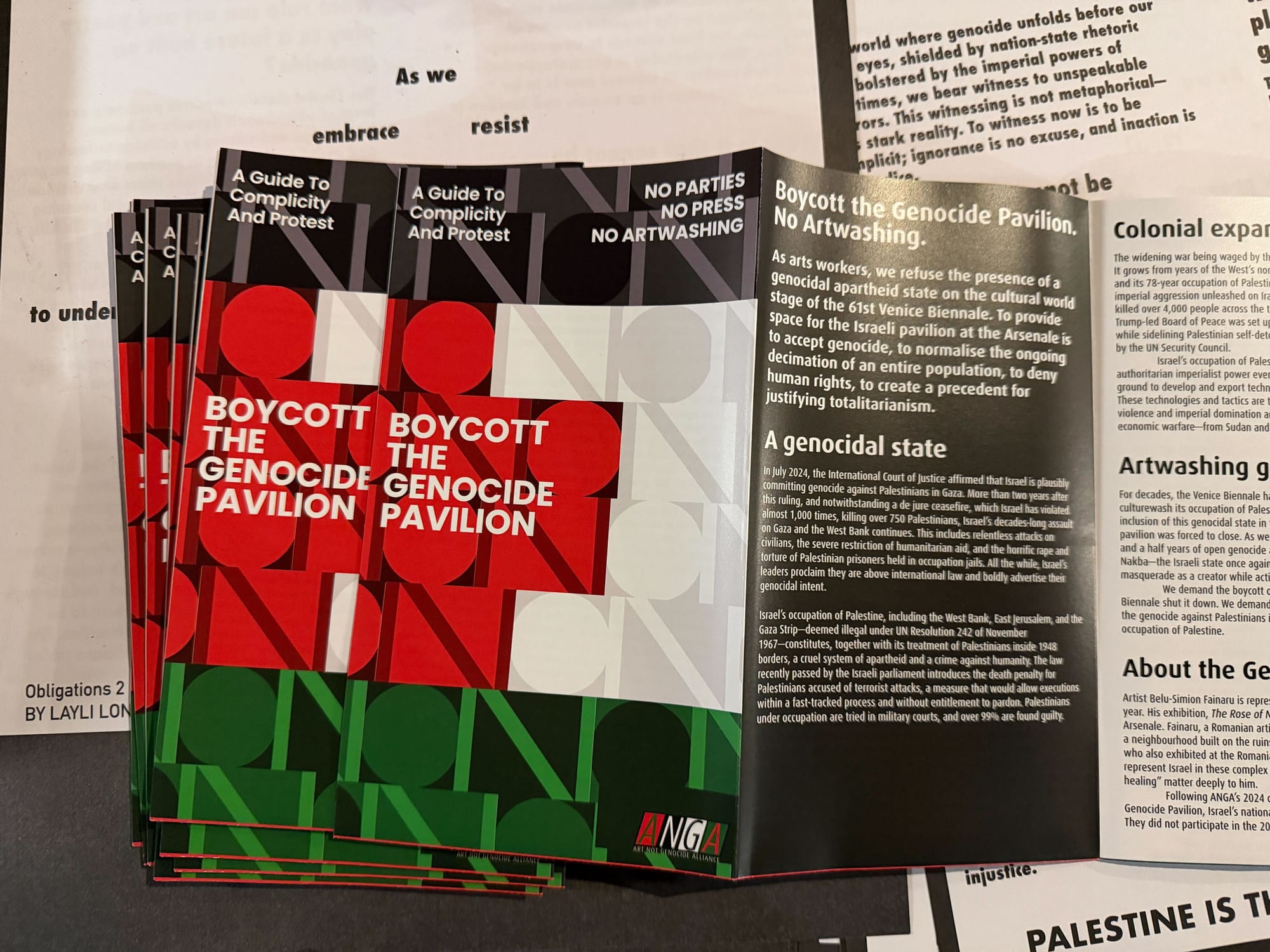
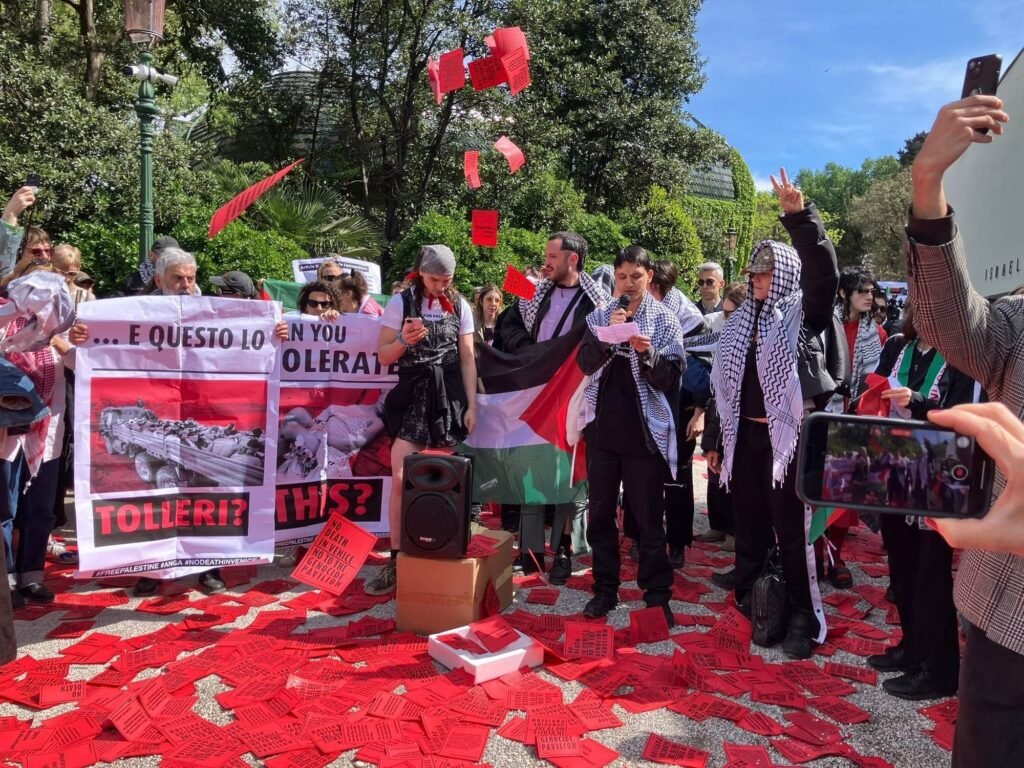
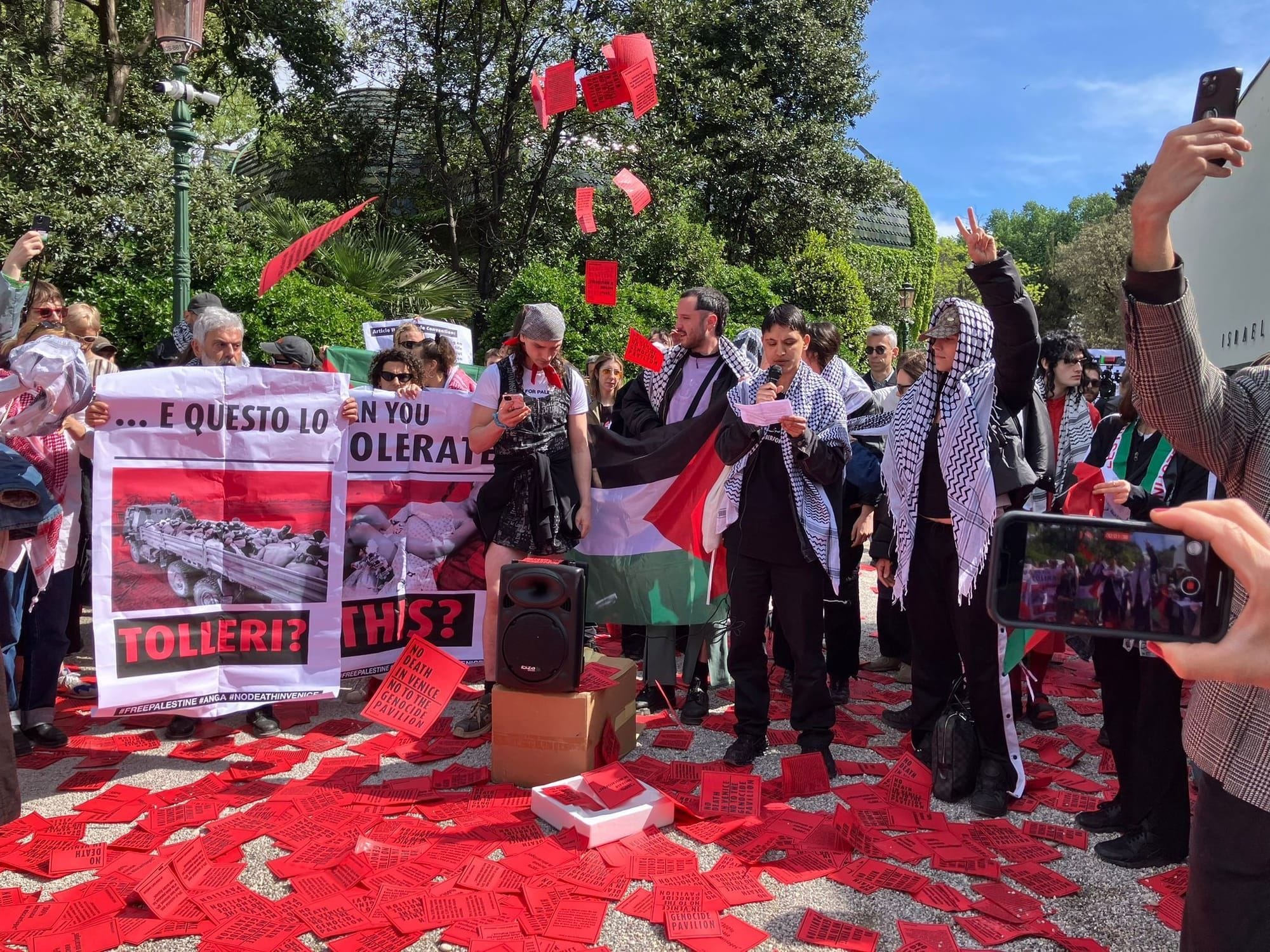
ANGA pamphlets circulating during this week’s Biennale previews call for a boycott of Israel’s “genocide pavilion” and encourage “no parties, no press, no artwashing.” The group is also sharing a “guide to complicity and protest,” which identifies supporters of violence against Palestinians embedded elsewhere in the event — like the United States, Israel’s principal military backer and largest arms supplier.
“Israel has killed over 73,000 people in Gaza, with a further 10,000 missing. It has systematically destroyed hospitals, schools, refugee camps, cultural institutions, and civilian infrastructure. Its leadership faces ICC arrest warrants for war crimes and crimes against humanity. The Biennale knows this and it chooses to accommodate Israel anyway,” ANGA said in a press release.
The coalition also expressed dismay at the Biennale’s decision to host Israel in a temporary pavilion in the Arsenale. Israel’s official pavilion has remained closed since 2024, when artist Ruth Patir shuttered public access to her exhibition until a “ceasefire and hostage release agreement” could be reached, a move some decried as insufficient.
Unlike Israel, Russia will participate in a reduced capacity, with its pavilion remaining closed to the public after previews due to international sanctions.
The planned protest follows months of activism opposing the Biennale’s decision to host an Israeli national pavilion, including a searing missive signed by over 200 event participants, including artists Brian Eno, Nina Katchadourian, and In Minor Keys curators Rasha Salti and Gabe Beckhurst Feijoo.
“This is an attempted annihilation of not just the Palestinian people but Palestinian culture,” reads the letter, organized by ANGA and signed by 18 national pavilion teams, 113 artists, 38 curators, 85 art workers, according to the group.
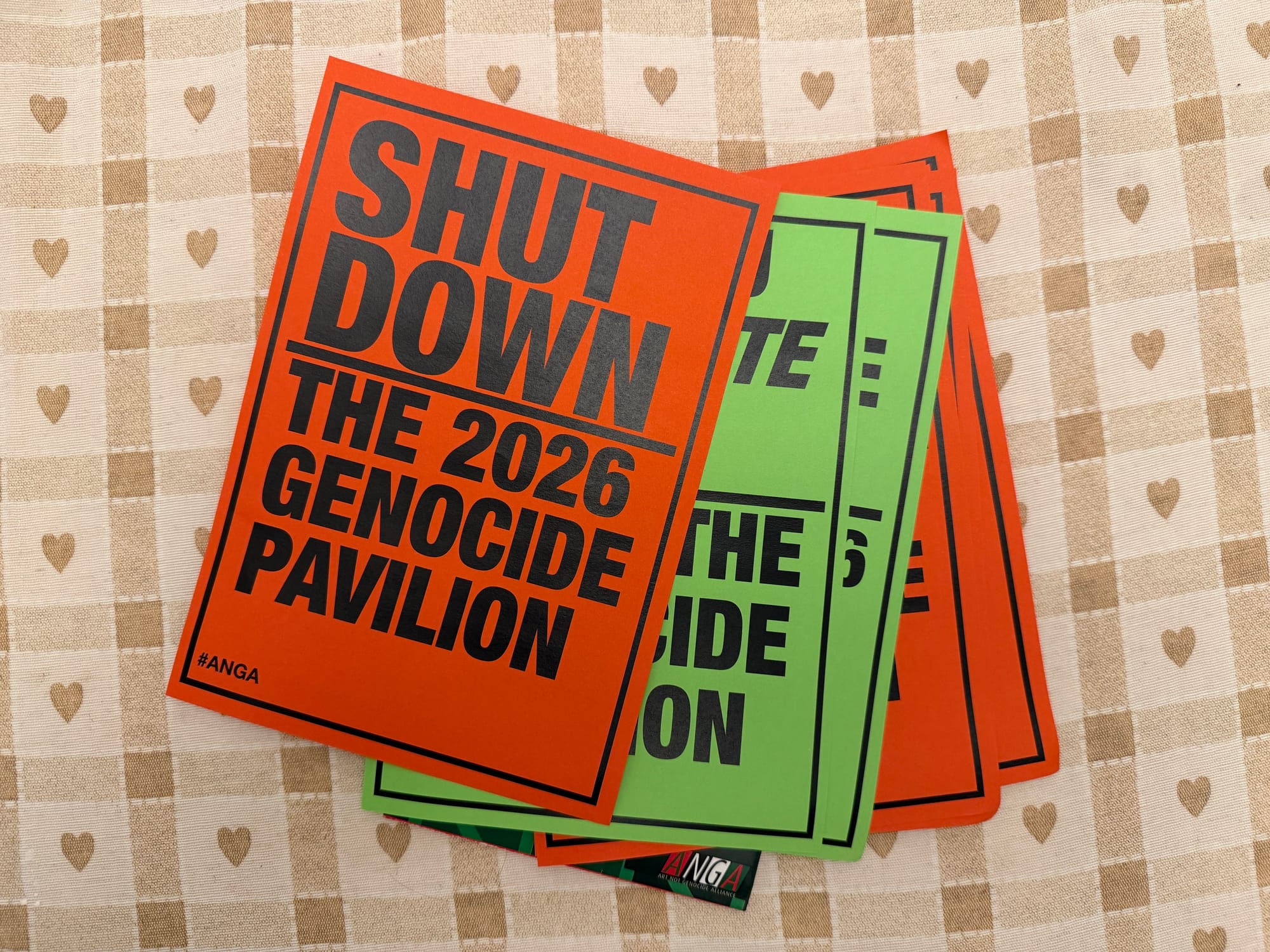
In recent weeks, tensions surrounding the Israeli and Russian pavilions have roiled the art world Olympics. Last week, the Biennale jury abruptly resigned days after announcing that it would not consider countries whose leaders “are currently charged with crimes against humanity by the International Criminal Court,” effectively excluding Israel and Russia from awards.
But following the jury’s resignation, the Biennale eliminated its signature Golden Lions and instituted a new “Visitor’s Lion” distinction to be voted on by the public; Russia and Israel are back in the running for these awards.
Also in the lead-up to the event, European leaders have met the Russian pavilion with fierce criticism, including vows to axe an ongoing grant to the Biennale Foundation.
In 2024, ANGA mounted major demonstrations outside the venue and launched an open letter opposing Israel’s inclusion that garnered over 22,000 signatures.
An organizer for Biennalocene did not provide an estimate for the number of people expected to participate in Friday’s protest, but ANGA’s October letter suggests that hundreds of individuals affiliated with the Biennale, including curators, artists, and workers, have committed to “stand in collective refusal” to Israel’s participation.
“Last year, during the general strike for the Global Sumud Flotilla, about 20 [Architecture Biennale] pavilions closed,” the Biennalocene organizer told Hyperallergic in an email. “We hope we will reach that result.”