BMW gave journalists a first technical briefing on the next-generation 3 Series at its Miramas proving ground in France, detailing chassis hardware for the base 320 and the range-topping M350 xDrive along with a new driving dynamics software architecture.
BMW 320 Chassis Specifications

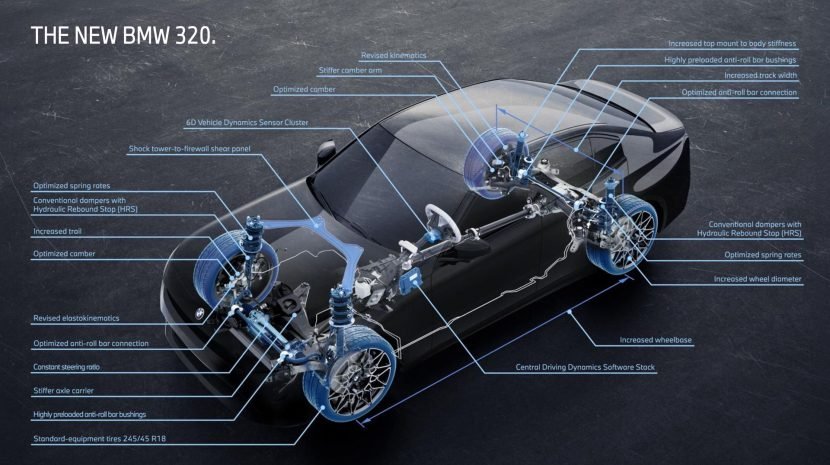
The base 320 rides on an all-new body with revised global stiffness targets, according to BMW. Front track width increases by 40mm and rear track width by 32mm over the outgoing model. Wheelbase grows by 90mm. Wheel diameter increases to 680mm. The front axle retains a double-joint MacPherson strut layout with revised kinematics for increased trail, slightly reduced camber, and softer spring rates. Dampers are conventional units fitted with a Hydraulic Rebound Stop, a technology BMW says it carried over from the Neue Klasse iX3. Other front-axle changes include a stiffer axle carrier, a new shear panel connecting the shock tower to the firewall, and revised anti-roll bar bushings. Steering ratio on the base car is fixed. Standard tires are 245/45R18.
The rear uses a five-link axle with the same Hydraulic Rebound Stop dampers, a stiffer camber arm, revised elastokinematics, and increased stiffness at the top mount-to-body connection. BMW says the stiffer connection is intended to reduce the delay between steering input and damper engagement during body roll. An Adaptive Suspension is available as an option on all variants, using electronically controlled dampers. It is always paired with Sport Steering and offers two drive modes, Personal and Sport.
BMW M350 xDrive Powertrain and Chassis

The M350 xDrive is powered by a 3.0-liter BMW TwinPower Turbo inline-six with 48V mild hybrid technology. BMW’s provisional figures list a maximum output of 326 kW (443 PS in the EU / 437 hp in the US), 580 Nm (428 lb-ft) of torque, a 0-100 km/h time of 4.1 seconds, and a top speed of 250 km/h (155 mph).
Standard equipment includes Adaptive M Suspension, Variable Sport Steering, and a controlled rear differential lock. The car has three drive modes: Personal, for everyday comfort; M Sport, tuned for driving dynamics; and M Sport+, described by BMW as the maximum driving dynamics setting. Chassis-specific hardware includes unique spring and damper tuning, front body struts, stiffer anti-roll bars, and revised camber. Aerodynamic components include a front air deflector and a rear Gurney flap, intended to improve high-speed stability. A Driving Dynamics Brace connects the rear subframe to the car’s center structure. M Sport brakes use fixed calipers at the front axle and floating calipers at the rear.
Tires range from 19 to 20 inches. The performance option is a Bridgestone Potenza Sport in 245/35R20 front and 275/30R20 rear. A rolling-resistance-optimized Goodyear Eagle F1 Asymmetric 5 is offered in 245/35R20 front and 255/30R20 rear. BMW confirmed fuel economy figures will vary depending on tire selection but did not provide exact numbers.
Torque Distribution in the xDrive System

The M350’s xDrive system uses a multi-plate clutch that can fully decouple the front axle to reduce drivetrain losses, or direct torque forward as driving conditions demand. BMW says there is no fixed default torque split. In standard driving modes, the clutch is kept ready to close within approximately 100 milliseconds. In DSC-off track driving, the system introduces additional clutch clearance to further reduce drag, at the cost of roughly 20 additional milliseconds of response time.
Torque distribution is calculated continuously by comparing driver input at the pedal and steering wheel against the rear axle’s available traction, using data from the 6D motion sensor. BMW’s engineer said the system is not fixed at a 50/50 split and can send torque almost entirely to one axle in low-grip conditions, though the company does not publish a specific maximum front-axle torque figure.
Heart of Joy Driving Dynamics Software

BMW calls its central driving dynamics architecture Heart of Joy. The system uses one central computer running a single software stack to coordinate all driving-dynamics functions, and BMW says this version is shared in principle with the software used in its electric Neue Klasse models, adapted for combustion and plug-in hybrid powertrains.
In electric models, BMW says the motor can react to driver input within milliseconds, allowing continuous torque shifting between axles to influence agility and stability directly. Electric motors can also decelerate the car through recuperation at up to approximately 0.4g, which BMW says covers roughly 98 percent of everyday braking without engaging the friction brakes.
Combustion engines cannot be used this way because torque delivery takes hundreds of milliseconds to build, according to BMW. In the 320 and M350, the same central computer instead coordinates brake intervention, stability and traction control, the electronically controlled rear differential, and steering, using one software stack with no communication delay between separate control units. BMW describes the hardware housing as identical to the electric-vehicle version, with a different processor and software developed specifically for combustion powertrains. The company says this is the 10th generation of the software, developed entirely in-house.
New for this generation is the 6D Motion Observer, a sensor cluster measuring lateral, vertical, and longitudinal acceleration along with roll, pitch, and yaw. BMW says this data gives the software a continuous, precise measurement of understeer or oversteer conditions, independent of driver input, feeding directly into the dynamics controller’s decisions.
BMW described one example of the system in action during cornering: at a default torque split of roughly 40 percent front and 60 percent rear, a brake intervention on the inside front wheel assists turn-in, torque distribution shifts toward 30/70, and the electronically controlled rear differential lock engages only after the initial brake intervention begins to fade, to avoid conflicting inputs.
Efficient Dynamics Measures
BMW listed several efficiency-focused updates across the drivetrain and chassis: a 48V mild hybrid system, active aerodynamic flaps, a lower-consumption 12V electrical system, tires and brakes engineered for reduced drag, and wheel bearings with reduced friction.
An Efficient drive mode is said to increase range by up to 10 percent through powertrain adjustments and reduced comfort settings. An Efficiency Coach feature, providing live driving feedback, is planned to arrive in the car and the MyBMW app after launch, according to BMW. The MyBMW app’s Trips section will also include efficiency statistics and gamification features.
What BMW Did Not Confirm
BMW did not release pricing, confirm final production names beyond “320” and “M350 xDrive,” or confirm the weight of the car. But we do expect to learn more about the specs, design and pricing in the next few weeks. Here are more details we uncovered during our test drive.
First published by https://www.bmwblog.com