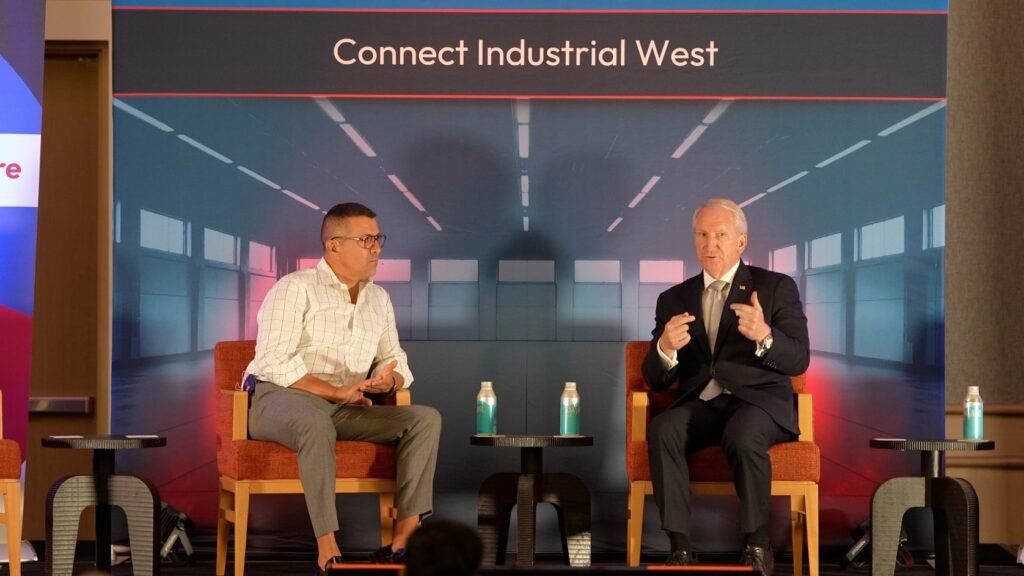
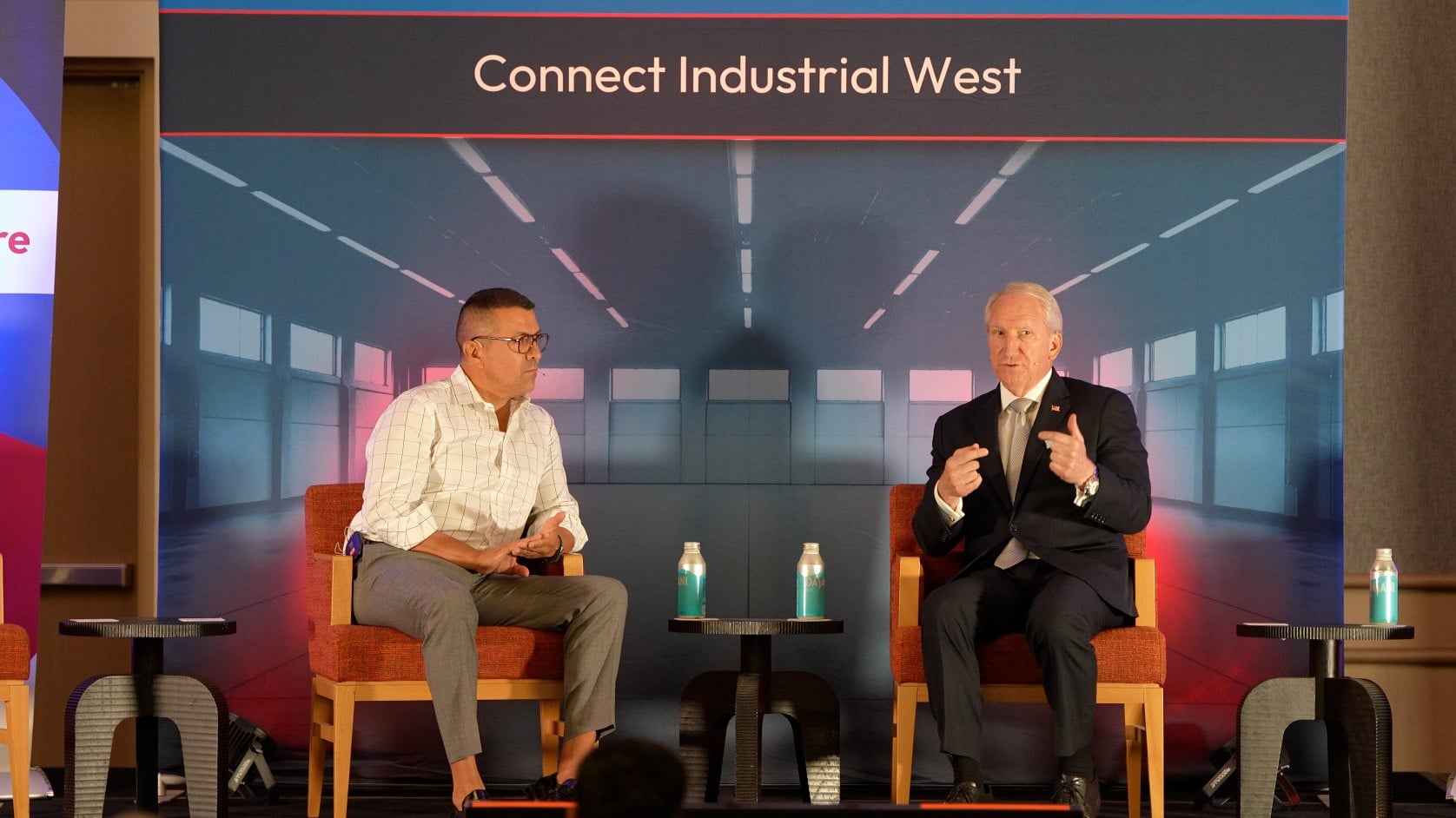
Amid the uncertainty faced by shippers due to looming tariffs and higher fuel prices, the Port of Los Angeles just had its second-best July on record for container volume, executive director Eugene Seroka told the audience at Connect Industrial West 2026. With the economy’s resilience as well as its sheer size, Seroka is bullish on industrial development.
“[The U.S. is] the most powerful economy in the world,” Seroka told Connect Media president and CEO Daniel Ceniceros in a one-on-one interview during the August 20 in-person event. “The ports of LA and Long Beach combined represent 40% of the nation’s containerized imports, 30% of the exports. The cargo that traverses our Port of LA not only goes to all 50 states, but it goes to each one of our 435 Congressional districts. That’s really powerful.”
Regardless of uncertainty, Seroka said, “What I’ve been talking with our staff, tenants, customers, and those who are interested in investing with us is that we’ve got to become a little bit more comfortable, a little bit more astute at investing through cycles. And I know that’s been common adage from business school to practical application, but it’s now investing through budget cycles where folks get a little bit tenuous at the top and in the boardroom. It’s investing through economic cycles, which many of us have seen–not easy, either.
“But now I think we have to invest through political and election cycles,” he continued. “I don’t think we can get wringing our hands every time we come up on an election. It gets so polarizing with discussions because at the end, as 70% of us kind of gravitate to the middle on what’s going to drive this country, it’s going to be that longer-range investment where money is safe, it’s going to produce cash flow, and it’s going to be meaningful.”
Seroka was candid about the near-term impact of on-again, off-again imposition of tariffs, noting, “The whipsaw effect of announcements on policy related to international trade has kept everybody at the simulation table. ‘If this goes into effect, what do I do? If that happens, how do I react?’ And most importing companies tell me that it’s very difficult to get really prescriptive on exactly how their supply chains are going to weather this particular period in time and how better they can do with any range of certainty because the planning horizon has become just so short.”
As disruptive as the tariffs may be, “the biggest bugaboo that we’ve seen is our traditional trading partners or buyers of [agricultural] products making deals with other countries,” Seroka said. “Soybeans are now coming from Argentina and Brazil. Almonds are coming from Australia. And then a whole host of other products being sourced, leaving the United States behind on those trade deals. That makes the import more expensive because the importer is now paying to return that container empty back to its Asia origin. It’s another 500 bucks or so, and that gets into the cost of the good,” which ultimately gets passed on to consumers.
The discussion also turned to ongoing expansion at the Port, which has seen more container terminals and added capacity for more cruise ships as well as a proposal to build a higher bridge to enable larger vessels to pass through. It’s all part of a long-range move toward public-private partnerships at the Port. “We’ve found that for every dollar invested on the public side, it’s two-and-a-half times that on the private side,” Seroka said.”I think what we’re seeing now is while we’ve had great public-private partnerships to this point, we’re really going to see it accelerate.”
The post At Connect Industrial West 2026, Port of LA’s Seroka Charts New Course appeared first on Connect CRE.