
Apple used its WWDC 2026 keynote to officially address the elephant in the tech room: its digital assistant needed a massive upgrade. The company showcased an ambitious vision for Apple Intelligence that never fully materialized for consumers—and eventually cost the company a $250 million class-action lawsuit settlement for misleading buyers about its availability. Now, Apple’s mobile assistant is getting a massive second chance as it rebrands to Siri AI, and it is using a very familiar engine under the hood.
Apple arrived late in the race to build its own massive frontier models from scratch. So, the company leaned on its multiyear partnership with Google to power this next generation of Apple Intelligence using Gemini. This allows Apple to focus heavily on system integration, user interface, and on-device utility while leaving the heavy algorithmic lifting to Google’s established models.
A visual and vocal transformation
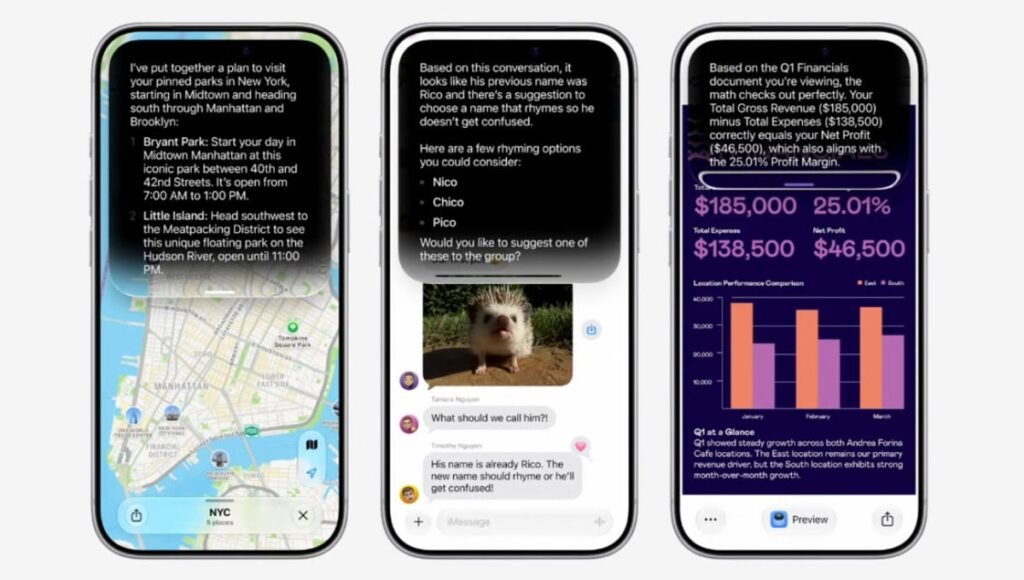
The most immediate change for iPhone users is where Siri AI lives. Instead of taking over the entire display or sitting as a glowing orb at the bottom of the glass, the assistant is now embedded directly into the Dynamic Island. Users can trigger it using the classic voice command, holding the power button, or performing a new swipe-down gesture from the top center of the screen. This opens a “Search or Ask” window capable of executing multi-turn conversations and text inputs.

When the assistant delivers an answer, it pops out as an interactive card from the top of the device. Swiping down on this card expands into a larger, dedicated space for follow-up questions. Furthermore, Apple’s vice president of Siri engineering, Mike Rockwell, highlighted a completely re-engineered voice system. Users are no longer stuck with rigid pre-recorded options. Instead, setup menus include micro-adjustable sliders to customize the exact pace, expressivity, and accent of the assistant to make it sound far more human.
Deep integration and visual intelligence
During live keynote demonstrations, Apple showcased Siri AI handling chained, multi-step requests across different applications. In one sequence, the assistant tracked details about a concert from real-time world knowledge, noted that tickets required a lottery entry, and instantly created a reminder for when the window opened. In another presentation, Siri pulled details about an event mentioned deep in a user’s Messages history, compiled the text into a formal watch-party menu, and drafted an email to a group of contacts automatically.
The assistant is also gaining visual intelligence via the iPhone camera and on-screen photos. Users can point their camera at a plate of food to pull immediate nutritional estimates. They can also ask Siri to identify a landmark in an old photo, map navigation to the spot, and automatically add relevant images to an iCloud shared family album.
The standalone Siri app
To compete directly with third-party tools like ChatGPT and Claude, Apple is launching a dedicated Siri application. This app provides a clean interface to converse with the AI via text or voice, review private conversation histories synced securely through iCloud, and upload complex documents or images for deep analysis. The upgrade is also rolling out to watchOS, macOS (via Spotlight integrations), and even visionOS. The assistant manifests in Apple’s XR headset as a floating 3D visualization.
Senior Vice President of Software Engineering Craig Federighi emphasized that privacy remains core to this rollout. He stated that data is strictly utilized to execute immediate requests, with architecture open to independent verification.
Siri AI will launch as an English-only developer preview immediately. A broader public beta will hit US consumers later this year. Due to regional regulatory hurdles, the updated assistant will not be available in the European Union or China during its initial release phase. This launch marks one of the final major software roadmaps delivered under CEO Tim Cook before he transitions to executive chairman this September.
The post Apple’s Siri AI Is Finally Here—Now for Real—Powered by Google Gemini appeared first on Android Headlines.