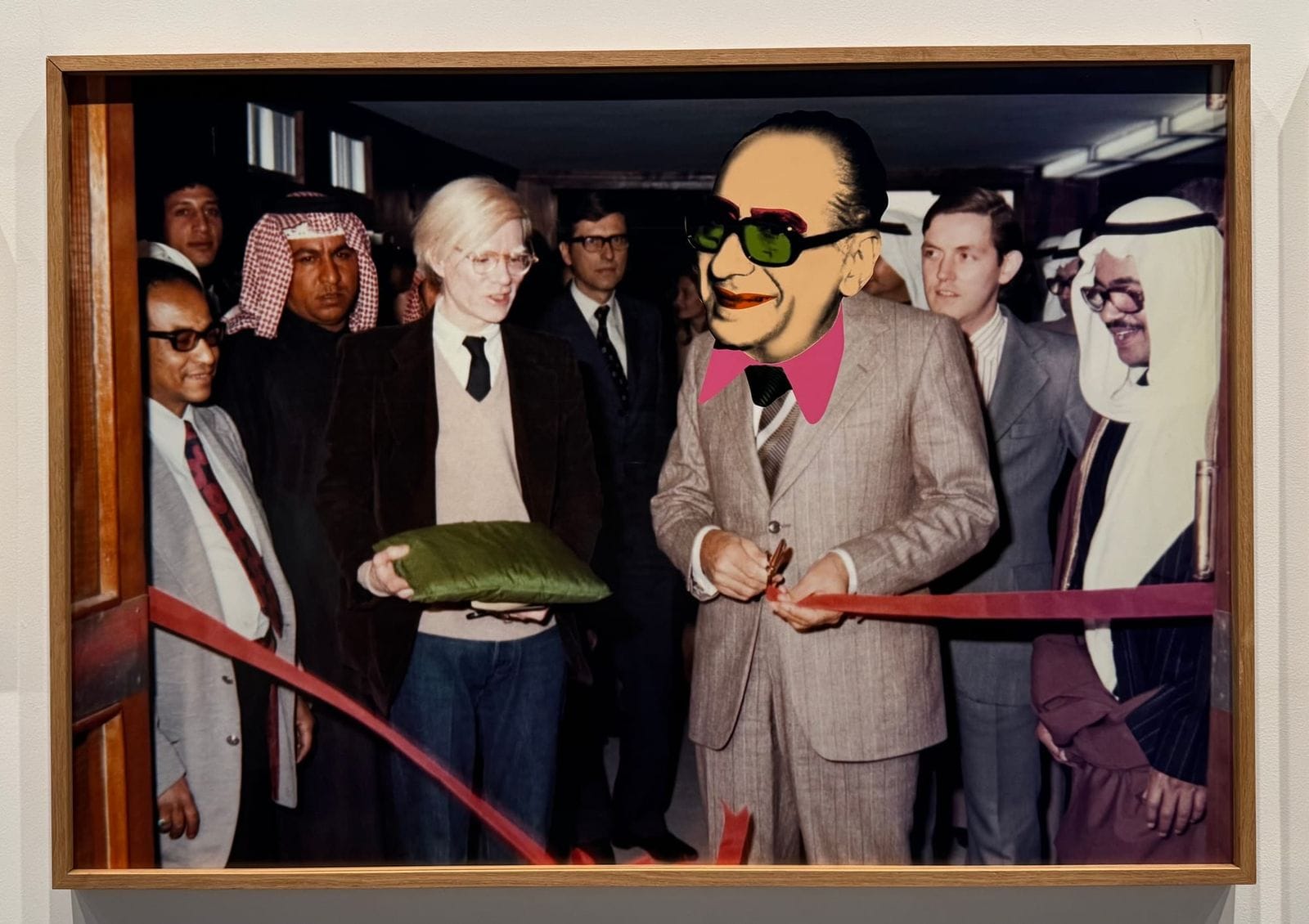
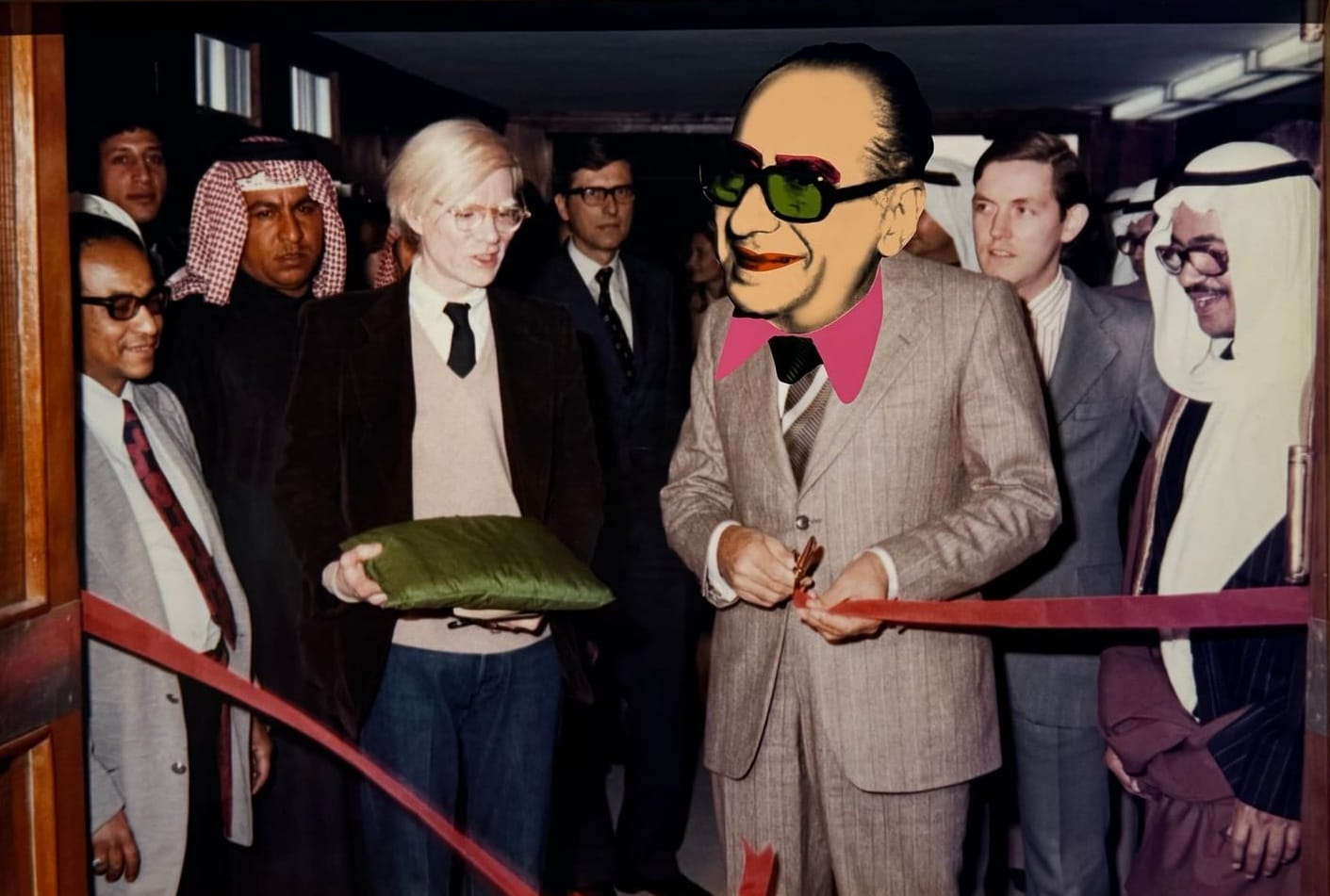
VENICE — In January 1977, Andy Warhol skipped President Jimmy Carter’s inauguration to spend a week attending tea parties and dinners in Kuwait. He was invited by the country’s national arts council and held a solo exhibition at the Salat Al Funoon gallery, featuring portraits of Mao Zedong and Marilyn Monroe and an array of flower prints. Domestically, his star was fading; with fewer patrons willing to meet his high asking prices, Warhol was under pressure to enter new markets. In Kuwait, where the recent oil boom had brought an influx of cash and a tether to the West and its cultural exports, he found more than a few interested buyers.
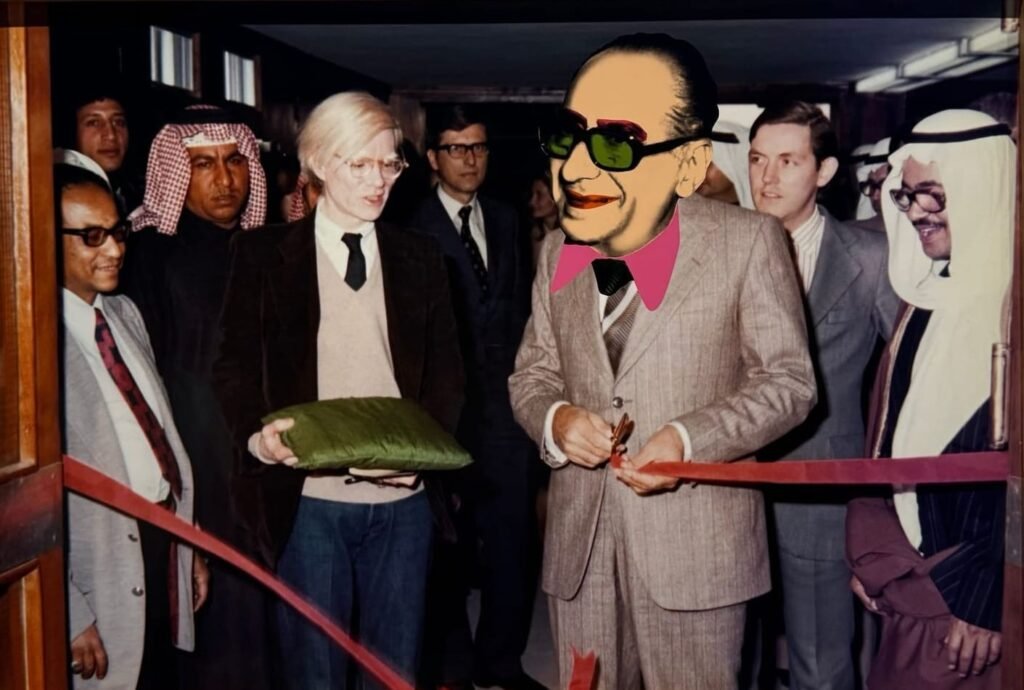
Nearly 50 years later, contemporary artist Raed Yassin has mounted a selection of photographic mixed-media works for the 61st Venice Biennale’s main exhibition, In Minor Keys, inventing scenes from that trip from the perspective of a fly on the wall.
“Warhol of Arabia” (all works 2016–2018) uses a real event as its anchor to paint a rich fiction using Pop aesthetics. In “The Party XII,” Warhol is depicted on the floor between a sheikh and a stylish kaftaned woman; Yassin painted only Warhol in color, making his hair pink and his glasses yellow, marking him as an outsider. “The Exhibition XIII” stamps four primary-colored headscarves onto a photo of Warhol with his Campbell’s soup can multiples, modifying the super-Western imagery the artist typically favored.
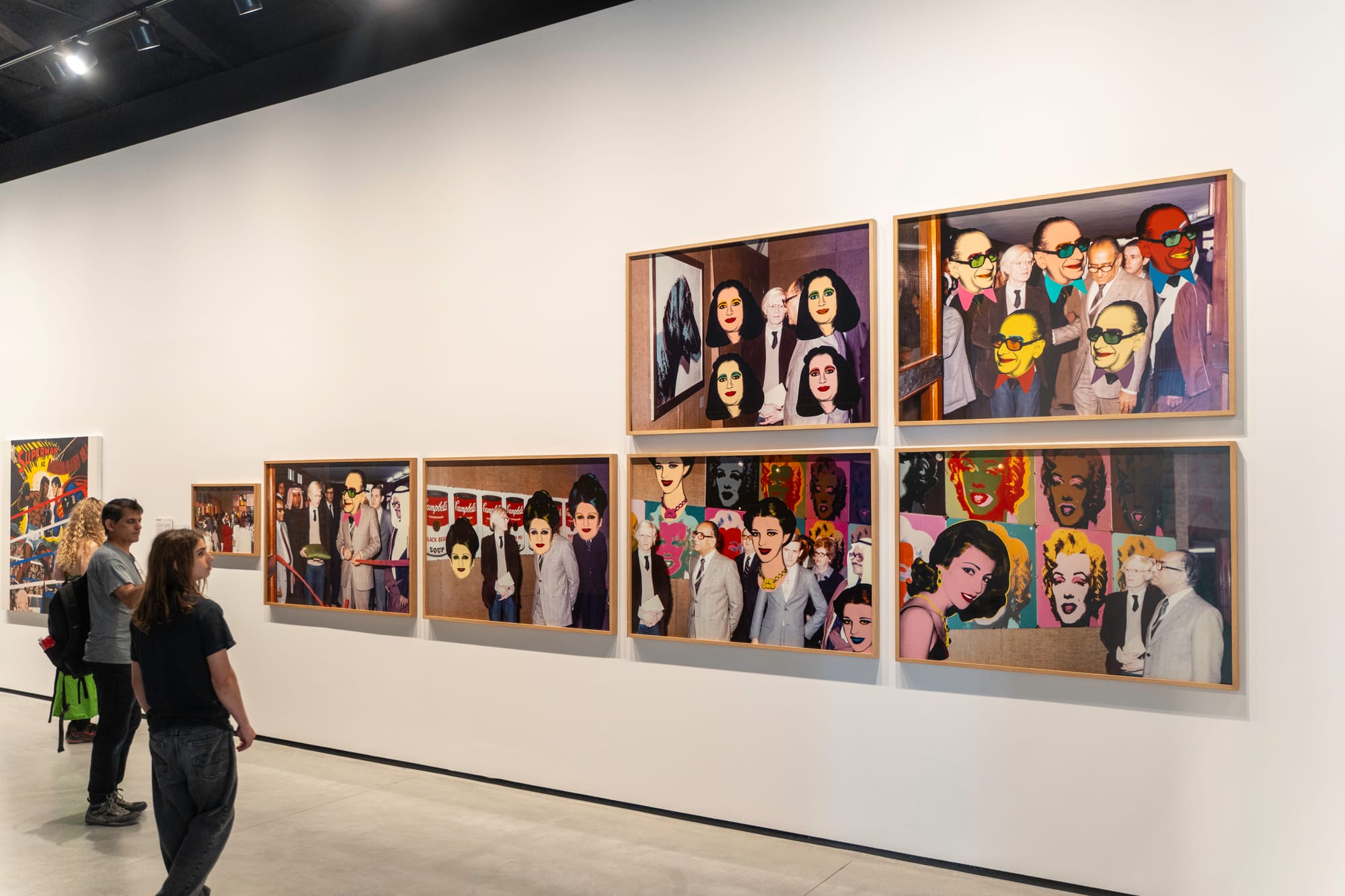
“The Gulf region in the 70s was kind of a black hole. No one knew what was going on, especially culturally,” Yassin told Hyperallergic. “You hear about oil and that kind of industry, but I was interested in what was beyond, what was happening in society. This is my imagination of it, which creates a different world entirely.”
Berlin- and Beirut-based Yassin discovered Warhol’s Middle East trip during a residency in Amsterdam, where he met Sultan Gallery’s current director Farida Al Sultan, whose older siblings opened the first art gallery in Kuwait in 1969. Al Sultan remembers that era of champagne toasts and the “row of Marilyns” hanging in the house of Sheikh Mubarak Fahad Al Salem Al Sabah. “There were poetry readings all the time, and the arts council was very active then,” she recounted in 2010. “Kuwait was the place to be.”
Yassin was curious about the textures of a place no longer accessible. “This work has to do with a forgotten past — what was once glamorous and now is gone. A so-called golden era,” the artist said. “For many years, my interest was in how pop culture shaped our collective unconscious.” His interest in the era’s collective memory is personal. Also on view at the Biennale is work from Yassin’s 2018 series “Yassin Haute Couture,” where staged portraits and neon signage attempt to get closer to the truth of the artist’s father, a famous fashion designer in 1970s Beirut who was murdered, in Yassin’s words, “in mysterious ways.”
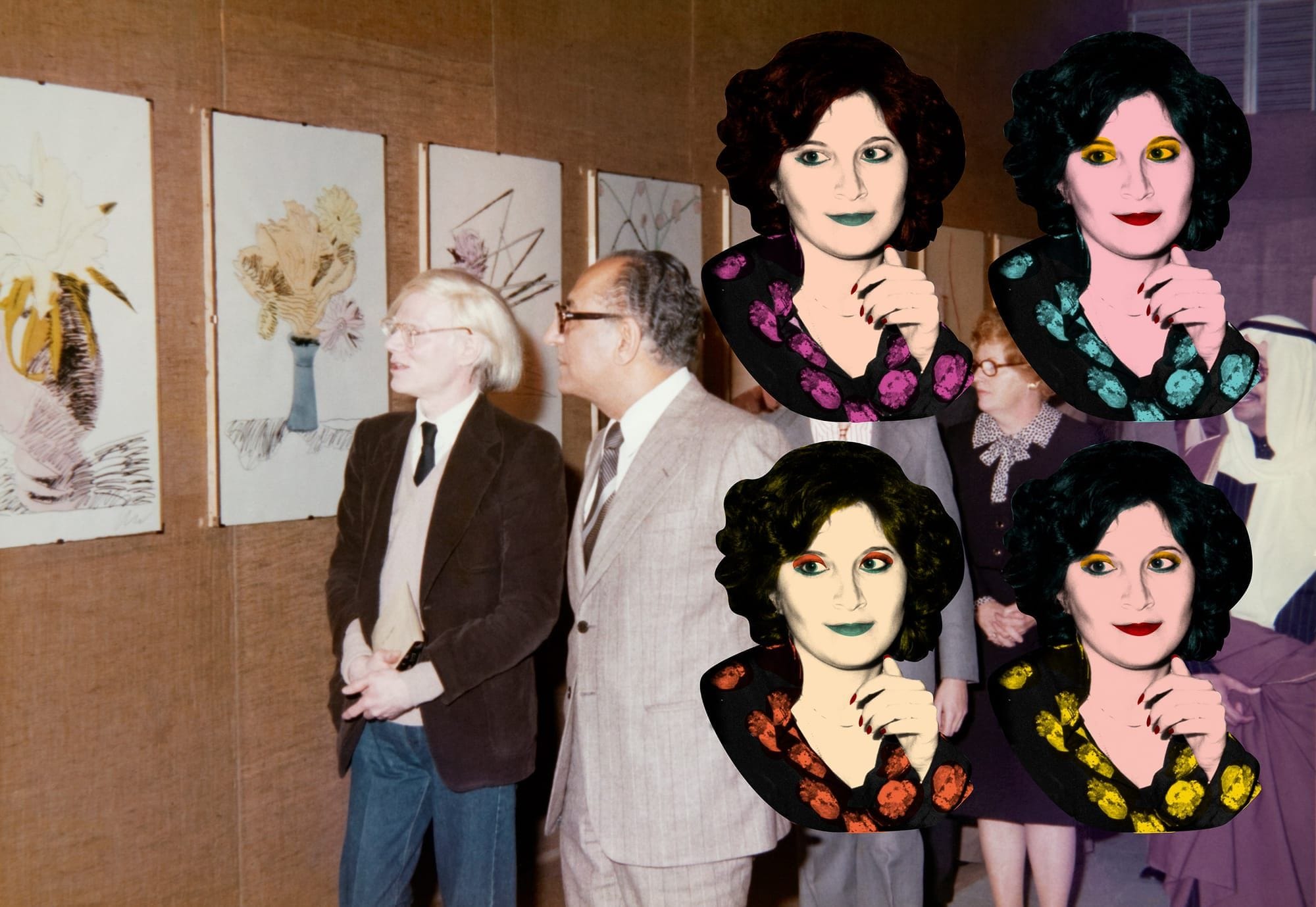
Though his research in the Sultan Gallery archives raised rumors that Warhol made silkscreen portraits of Kuwaiti royals, celebrities, and even their pets, Yassin couldn’t find any documentation confirming it. Instead, he created fictional versions of theoretical commissions, superimposing copycat Warhols — a woman in bright red eyeshadow and green lipstick; keffiyehs rendered in plain primary colors — onto copies of real images from the exhibition opening. In an accompanying text, Yassin takes liberties with facts: “His opening was a pompous affair,” Yassin wrote. “People were clamoring to have a photo taken with him.” That is probably about right.
Yassin injects a playfulness into the concept of this trip that Warhol’s own diaries are missing. Warhol fastidiously recorded the prices of coffee, laundry, and soap, while drily jotting down less than flattering details from his itinerary: “Spent time looking for antiques, but there are none in Kuwait — just a few old pots from a couple of years ago. We were the only foreigners in the marketplace.” Of these entries, Yassin told Hyperallergic, “I came to the conclusion that he was a stranger, an alien, someone out of context… His reason for being there was totally commercial.” Yassin added color to the photos of Warhol at the afterparty precisely to highlight his status as a passing attraction.
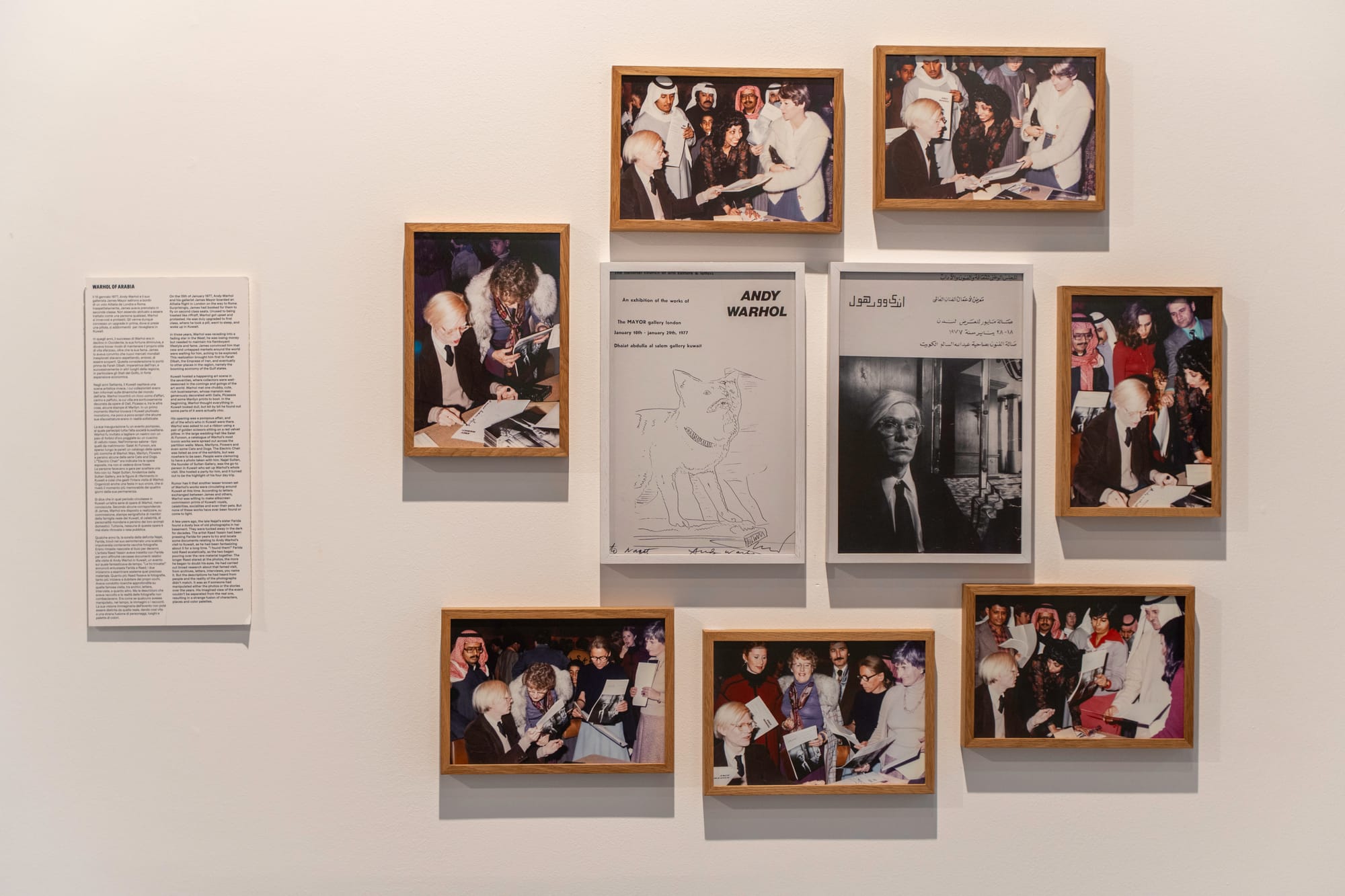
“Warhol of Arabia” is a delightfully swirling mythology that asks more questions than it gives answers. And we are unlikely to ever get them. “This was happening at a very particular time,” Yassid said. “For example, these women would not want to be seen in photos without the veil now.”
The inherent element of the unknown, the impulse to fill in the blanks — did Warhol get into any political discussions? Was there tension sizzling on the surface, or is that my 2026 brain talking? — mirrors Yassin’s early experiences of art as vast and mysterious. “I grew up in Lebanon in the 80s, and for my generation, pop culture was a way to run away, to feel what was going on in the world besides the war,” he said. “Warhol of Arabia” runs toward a version of reality where art can change history.
Warhol of Arabia continues at the Central Pavilion of the Venice Biennale (Arsenale di Venezia Campos de la Tana, Venice, Italy) through November 22. The installation was curated by Koyo Kouoh.