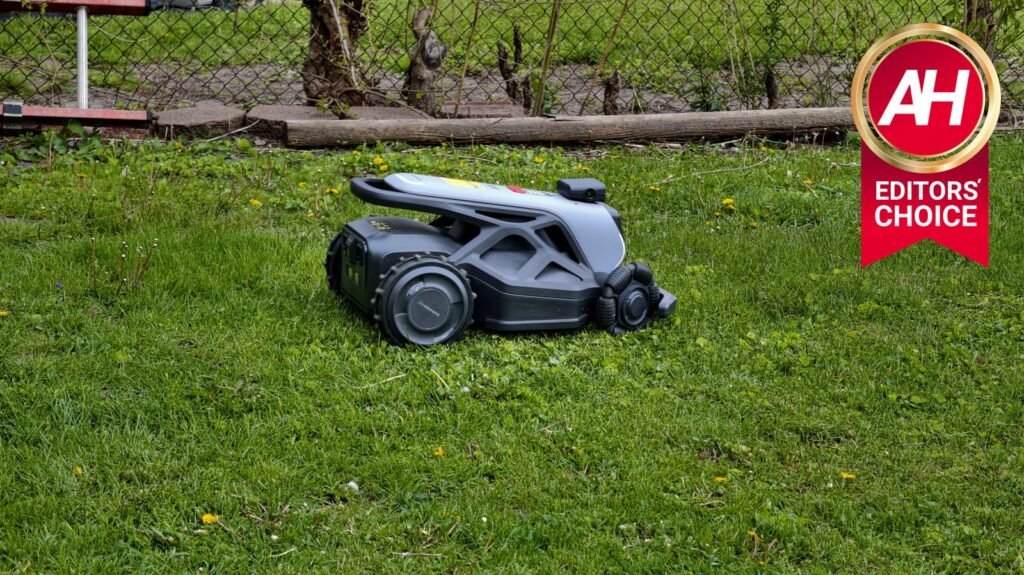

The Airseekers Tron is, without a doubt, one of the most unique and coolest-looking robot lawn mowers on the market today. It looks like a tank from a sci-fi movie. It also has some pretty unique features among robot lawn mowers, like mulching. Unfortunately, it’s not all good news. This mower uses RTK for navigation, which isn’t as seamless as that of competing robot mowers right now. Making setup take longer, and navigation not quite being as good as you’d expect, especially if you have trees in your yard.
But let’s jump into the full review and tell you everything you need to know before you purchase the Airseekers Tron.

The Airseekers Tron is one of the coolest-looking robot lawn mowers on the market, and it cuts grass just as well as it turns heads.
Pros
- Unique, sci-fi tank-like design that stands out from typical robot mowers
- Rugged build quality, you can yeet it off a curb with no issues
- All-terrain wheels with segmented front design that won’t tear up wet grass
- IPX6 rated so it can sit in the rain
- Dual-blade system delivers excellent mulching for a healthier lawn
- Cuts taller grass better than the competition, thanks to the unit being taller
- Removable battery makes winter storage easy
- Two sets of replacement blades in the box
Cons
- App isn’t localized for the US (everything’s in metric instead of imperial)
- No settings for how to handle rain
- No mounting arm for the RTK antenna, so you have to stick it in the ground
- Doesn’t get quite as close to the edges as some competitors
- No Apple Find My or Google Find Hub support
This is an express review, Airseekers did send us the Tron robot mower to review and they did see the review before publication. However, they did not sway our opinion at all. You’ll be able to notice that in parts of this review, as it’s not entirely a glowing review.
Airseekers Tron vs Tron SE
Airseekers is a fairly new company, founded in 2022; it had only a single robot lawn mower until this year. When they introduced the Tron SE, which actually just went on sale this month.
So what’s the difference between the Tron and Tron SE? The Tron is a higher-end robot mower, which can cut a larger lawn in 24 hours, with a larger battery and faster charging current. Both models work with either razor blades or a larger blade disk, which is now shipping with the older Tron as well. There is also a second set of blades above the disk that is used for mulching the cut grass.
The Tron is able to cut 0.6-acre (or around 26,000 square feet) in a 24-hour period, while the Tron SE is able to do only 0.44-acre (or around 19,000 square feet) in the same 24-hour period. Now, the likely reason for this is the larger battery in the Tron as well as the faster charging speed. Tron has a 15Ah battery with a 7A charging current, while the Tron SE has a 10Ah battery with a 5A charging current.
Essentially, the Tron is built for larger yards, making it the more high-end model. Though I feel like most people who live in cities will be able to use either robot mower with ease. I’ve been testing the Airseekers Tron on a yard that is just under 2,000 square feet.
Setup takes a bit longer than I expected
Let me preface this by saying that the other two robot lawn mowers I’ve been testing out this Spring are LiDAR-based, while the Airseekers Tron is RTK-based. So there’s a bit more setup involved here. RTK, which stands for Real-Time Kinematic, is a satellite navigation technique that is able to enhance GPS accuracy down to the centimeter. Which means it should work really well for lawns, especially lawns that don’t have a defined boundary like a gate or fence.
With RTK, you do need to set up the antenna, which needs to be away from your house, and somewhere that doesn’t get shade. This is because trees can affect navigation. In the box, Airseekers includes a trident to stick into the ground. However, I was a bit surprised to see that there was no arm included in the box to mount it to the side of your house or on a fence. Many other RTK robot mowers do include that in the box.

With Airseekers, you can opt to power the antenna separately or connect it to the power in the robot mower’s base, which is what I opted to do. That way, I don’t have to use two outlets for the same mower. It’s a nice choice to have, which not every robot mower includes.
Now, to be clear, Airseekers does also include NRTK, which is Network RTK. Meaning you don’t need to use the antenna. Which is what I fully intended on using; however, due to all the shade in the side yard, NRTK couldn’t get a good signal to work. If you have a large yard, without much shade or any trees, NRTK might work better for you.
After you set up the RTK antenna and unbox the mower, it’s actually a pretty easy setup. You just need to bind the mower to your account in the Airseekers app, and then bind the RTK antenna to it. Now, it is worth mentioning that if you move the base or the antenna, you will need to remap your yard entirely, as the mower won’t know where it’s going. Since the map is entirely based on where the antenna is located.

Once everything’s connected, you can start mapping. Some lawn mowers have an auto-mapping feature, but Airseekers has not included that here. So instead, you’ll map it out yourself, which I actually prefer for this yard. Especially the front yard, as there are no real defined boundaries, unfortunately. So you’ll need the mower to be on the base, with at least 50% charge, and connected to either NRTK or RTK. Now, keep in mind that with these two different technologies, maps made on RTK can’t be used on NRTK. So it’s likely best to stick with one technology for mapping your yard.
Once you’ve mapped out your zone, you can then create a channel to the next zone and map that out. The software here can use a bit of help, though. I did have some issues setting up channels, and ended up setting up three different channels, when I wanted a channel, a zone, and then a second channel going to the third zone. It’s just not as straightforward as some of its competitors.
After you’ve mapped out your yard, you’re now free to set it free to start cutting your grass.
Hardware and build quality
Most robot mowers look like overgrown computer mice scooting around your yard. The Airseekers Tron is not that. At around 27.6 inches long, 18.5 inches wide, and 13.8 inches high, weighing roughly 52.9 lbs, this thing has presence. The curved surfaces, exposed framework, and unique-looking tires all contribute to the “robot from the future” aesthetic. It kind of looks like something Batman would own.
The design isn’t just for show, though. Airseekers built the Tron on what it calls the RuggedRide Chassis, and the spec sheet reads like an actual off-road vehicle. It’s a high-clearance frame sitting 2.6 inches off the ground, with a reinforced suspension system, all-terrain traction wheels, and triple shock absorption built into brushless hub motors. That setup is what lets it crawl up slopes with up to a 65% gradient without spinning out or chewing up your grass.

The front wheels are the real party trick. With no power to the front wheels and an innovative segmented design, the Tron can make tight turns without putting any pressure on the grass. This means you can still cut your grass while the ground is wet without worrying about the Tron digging holes in your lawn. And because it carries an IPX6 rating, you can leave it out in the rain without panicking.
The build quality is definitely top-notch here. It looks like something made for the outdoors, rather than a robot vacuum with blades underneath. It looks like it belongs in your yard.


Obstacle Avoidance
There are cameras and sensors around the Tron, which allow it to identify obstacles and avoid them. In my testing, I found that it was able to identify objects moving around like balls, so that if your kids or pets are outside playing while it’s mowing, you won’t have to worry about it running over their toys. It does have a little bit of trouble with glasses, especially if there’s no frame around the glasses. So it’s still a good idea to check out your lawn before you send it out to be mowed.

Thanks to the bumper on the front, it is able to figure out that something is in the way and that it can’t go any further. If the cameras don’t pick up the item that is in its way, the bumper might tap it, then figure out how to get around it.
Overall, obstacle avoidance is pretty good and works as intended. Though some of its competitors do a better job in this instance. And I’m sure Airseekers will continue to improve its Obstacle Detection.
Cutting Effectiveness and Mulching
The most important aspect of a robot lawn mower is definitely how it performs. How well does it cut the grass? It does a pretty good job, even with taller grass, around 3-4 inches high. A lot of robot lawn mowers prefer shorter grass, but since it’s currently Spring in Michigan and it’s raining every other day, the grass is growing quite quickly.
Admittedly, the yard I’m testing this robot mower in is not the most perfect yard. It has plenty of bumps and is anything but flat. It also has a lot of crab grass, dandelions, and the works. But I will say, it did a good job of cutting the grass, with lines that you can see very easily.

It doesn’t quite get as close to the edges as I’d like, and it does that at the end of the cycle in that zone, by default. Luckily, in the app, you are able to change the order in which it cuts your grass. The default sequence is Bow Mowing (the up-and-down S-pattern that cuts the majority of the zone), then edge mowing, restricted-area mowing, and patch mowing. You can drag-and-drop these to be whatever order you like. I prefer to do edge mowing first, as that’s how I’d cut the grass myself. So, you can drag that up to be done first.
When it comes to mulching, the Airseekers Tron does a pretty good job here, too. Airseekers is using a dual-blade setup here. So on the cutting disk, you have the lower set of razor blades that is cutting the grass, with a set above it, which cuts that grass into very small particles, giving you a “carpet-like” finish, according to Airseekers. And I have to say, they were right. The grass was cut up quite nicely, though the dandelions not so much. In the finished lawn photos below, you can see that there were quite a few dandelions cut up and left behind.
The mulching is actually really good for your lawn. Leaving the cut grass on your lawn puts nutrients into your lawn, it acts as a natural fertilizer, and can help reduce your fertilizer needs by around 25-30%. Mulching also helps with better moisture retention, healthier soil, and less waste. Since you’re not bagging those clippings and throwing them out. You’d be surprised at how much lawn clippings make up of yard waste.
Now, I haven’t had the Tron long enough to see a massive difference in the yard, I’ve only had it a couple of weeks, and ran it a few times. But I can see that it makes a difference. It’ll be interesting to see the changes in the yard after a full season of running the Tron a couple times a week.
Run it every few days, instead of once a week
If you’re new to robot lawn mowers, one thing you have to remember is, that you should have it cut your grass more often than once a week. Since a lot of robot mowers use razor blades to cut the grass, it’s best to have it cut the grass a couple of times a week. Some people will have it cut the grass every day. And that’s actually healthier for your lawn. Cutting a tiny bit every day or two is much less stressful on your lawn versus cutting a couple of inches off once a week. This results in a better-looking lawn. And the best part? Just schedule your robot mower and forget about it.
I have the Airseekers Tron scheduled to run twice a week right now, because it is raining so often. Once we get into June and July, that will likely be upped to three or four times a week. The Airseekers Tron does have a rain sensor which is designed to sense when its raining and make Tron go back to its dock for protection. Once it stops raining, it’ll finish the job.

With a lot of robot lawn mowers, you’ll want to replace the blades about every two months. This is because you’re using razor blades instead of the traditional lawn mower blades, and you’re typically running it more often. I haven’t needed to replace them yet on the Airseekers Tron (again, I’ve only had it for a couple of weeks), but they do include two sets of replacement blades in the box. And it’s pretty easy to swap them out.
Maintenance is a breeze
What makes robot mowers so great is, the fact they require very little maintenance. Really, the only maintenance you need to worry about is replacing the razor blades, as I mentioned in the last section. If the robot gets dirty or has a lot of grass built up underneath, you can take your garden hose and clean it off, as it is IPX6 rated. Which is needed anyway, as this is meant to sit outside all summer long.

When it comes time to get it ready for the winter, you can easily pull the battery out and keep it conditioned for next season. Unlike some other robot mowers I’ve used, the battery is removable and doesn’t have a connection you need to tighten. It just snaps into place.
The Airseekers App could use some work
My biggest complaint with the Airseekers Tron is actually the app. Firstly, it isn’t really localized for the US. Things like grass height are in millimeters, and the size of your yard is in square meters. You’d think there would be a way to switch this over to imperial units, or for it to be done automatically once you select your location as the US. Now, of course, these aren’t deal-breakers. I know that 30mm is pretty short, that’s about 1.18 inches, and that’s the most it can cut. So it’s still easy to use, just takes a little bit more thinking.
The Airseekers app does also have a good amount of settings for the mower. As mentioned already, there is a mowing sequence that you’re able to change, so it can do the perimeter first and then the main part of the zone. But you can also change the grass height, the interval, how it turns, and so much more.

For grass height, you can choose from 30mm up to 90mm in 10mm increments. So that’s 1.18 inches up to 3.54 inches. You can also change the cutting width from 130mm to 180mm. Airseekers recommends keeping it below 150mm; it can miss some grass. I kept it at 130mm during my testing, just to make sure nothing gets missed. It did still result in some pretty nice-looking lines in the yard.
One of the settings that not a lot of robot mowers have is the Angle. Airseekers lets you choose the angle in which it’ll cut your grass, from -90 degrees to 90 degrees. So you can do it diagonal, left to right, front to back, however you want to do it. And it does a really good job with this. Airseekers does let you choose different angles for each zone as well. So maybe you want the front yard to be a different angle from the backyard.
The app also lets you set priority for each zone, so maybe you want the front yard done first, it can do that. Finally, it has a few other options available too, like turning on AI Obstacle avoidance, which I’m a bit surprised that it’s just either on or off. Most other mowers will have a more sensitive option, to allow it to see smaller things like your dog’s tennis ball. You can also change the mowing efficiency, mowing shape, and the turning method.


There are a lot of options in the app, but honestly, I’ve seen even more in other robot mower apps. I feel like the app is mostly good; it’s probably 85% of the way there. The issues I have are pretty small and are really just a learning curve. Like when you want to do area mowing, you have to unselect what areas you want to mow, versus selecting the areas you want to mow. It’s just little things that Airseekers should fix or change, then the app would be virtually perfect.
Theft detection
This is actually a very important aspect for any robot mower, as it’s sitting outside all the time. Anyone could walk by and grab it and keep on going. Especially with these robot mowers getting to be pretty light. The Airseekers Tron isn’t really that light. Airseekers says its 18kg, or about 40 lbs, but it does have a built-in handle, which makes it really easy to pick up when needed.
A lot of robot mowers will have an alarm go off when it is picked up off the ground, and the Tron is no different. It can also lock itself, so even if someone stole it, it wouldn’t work without putting in your PIN.
Something I’d like to see Airseekers add here is, Find My support. Some robot mowers have added support for Apple’s Find My network, so you can easily track it in the Find My app. I’d really like to see all robot mowers add support for both Apple’s Find My and Google’s Find Hub, so no matter what ecosystem you’re in, you can track your robot mower and make sure no one has stolen it.
Should you buy the Airseekers Tron?

I’m fully aware that robot lawn mowers are still quite pricey. The Airseekers Tron is $1,999, though you can save $700 on the Tron right now, which does make it a lot more affordable. But let’s compare it to a riding lawn mower. Most riding lawn mowers (not counting zero-turn models) are running for over $2,000 right now. Which is about the same price. While yeah, it might do a better job cutting your grass, it still won’t get as close to the edges as the Airseekers Tron will.
What really makes the price worth it to me is the Summer temperatures. If you’re somewhere that’s going to be over 100 degrees, with a ton of humidity in the heat of the Summer (think July, August time frame), being able to sit inside in the AC and watch your robot mower cut your grass without lifting a finger makes it worth the price.
So, should you buy the Airseekers Tron? I’d say yes. If you don’t want to spend your weekends cutting the grass and would rather spend that time with your friends, family, pets, whatever the case might be, go ahead and pick up the Airseekers Tron. It makes for a great first robotic lawn mower.
The post Airseekers Tron Review: The Robot Mower That Actually Looks Cool appeared first on Android Headlines.