Across job listing sites over the past few months, you might have noticed something curious. Alongside traditional titles like “designer,” “engineer,” and “product manager,” a new crop of roles is appearing. They have names like “designer engineer,” “builder,” or “design crafter,” and they represent a tipping point in the design industry that’s just beginning to play out.
That tipping point is captured in the second annual AI in Design report, published by the investor firm Designer Fund and the venture capital firm Foundation Capital. This year’s report draws on a survey of over 900 designers across 60+ countries, including partners like Stripe, Framer, Linear, Notion, Sierra, Shopify, and Anthropic.
According to Ben Blumenrose, the managing partner of Designer Fund, last year’s inaugural survey showed that designers were beginning to experiment with artificial intelligence. Just a year later, it’s become integral in nearly every designers’ workflow—and it’s rewriting the definition of “designer.”
“For the past two decades, the way we built software was the same for the most part,” Blumenrose says. “Someone came up with a concept of what they wanted to build, they’d work with a PM [project manager] to figure that out, they’d bring on a designer to give the visuals to that thing, then pass it to the engineer to build.”
Today, he explains, AI is rewriting the process. “We’ve started seeing that there’s a shift. It’s happening quickly, and it’s quite big,” he says.
Ultimately, Blumenrose says the data shows that the concept of a “designer” is getting blurrier, but at the same time, it’s a role that’s more important than ever.
New year, new tools
Over the past year, the design industry has undergone a paradigm shift in how it views the utility of AI. Where AI tools were once viewed as assistants for brainstorming and ideation, they’re now integrated into nearly every part of the design process.
In the 2025 report, only 54% of AI in Design survey respondents said that they were using AI more than once a week. This year, 91% of respondents reported using it multiple times a week or every day.
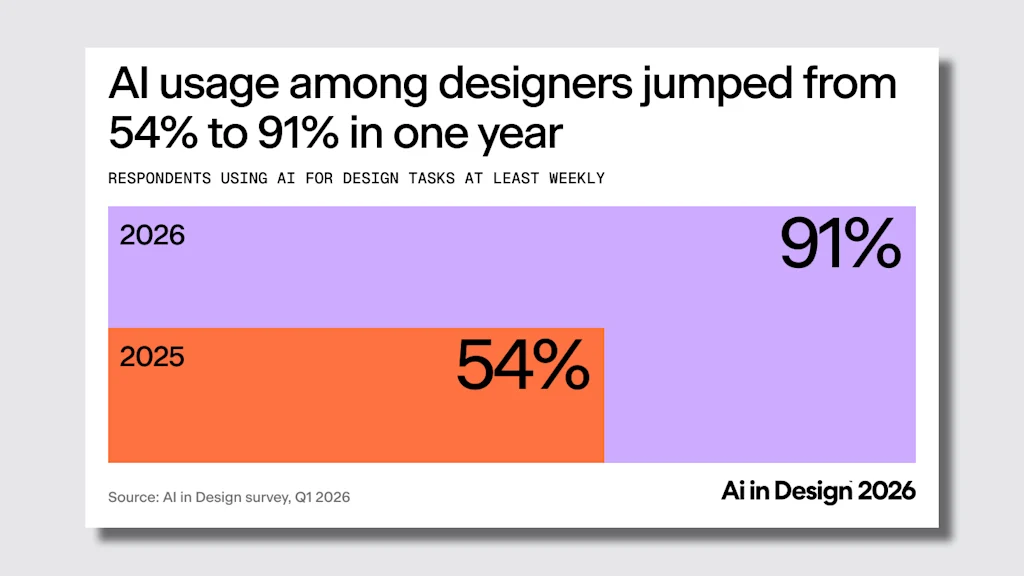
“I think we almost forget how quickly this has taken over and become a staple of our day-to-day work,” Blumenrose says, adding, “AI shifted from enhancing a few parts of the process to being instrumental in almost every part of it.”
A greater reliance on AI tools among designers has also meant that tool stacks are becoming more complex. Whereas designers in 2025 used an average of three AI tools, that figure more than doubled to seven in 2026. And, following the release of Anthropic’s Claude Code last October, Claude overtook ChatGPT as designers’ favorite general AI tool: 78% of respondents used Claude, compared with 65% for ChatGPT. Almost two-thirds of overall respondents—65%—reported using Claude Code, which due to its recent debut wasn’t even a part of the 2025 survey. Other popular tools include Figma (a favorite for design-specific tasks), Cursor (for coding), and AI notetakers like Otter and Fathom.
Many design teams are moving beyond the existing tools on the market and opting to build their own bespoke, internal AI systems. The survey data shows that 63% of designers at enterprises reported using internal company-built AI tools, compared with just 13% of designers at startups.
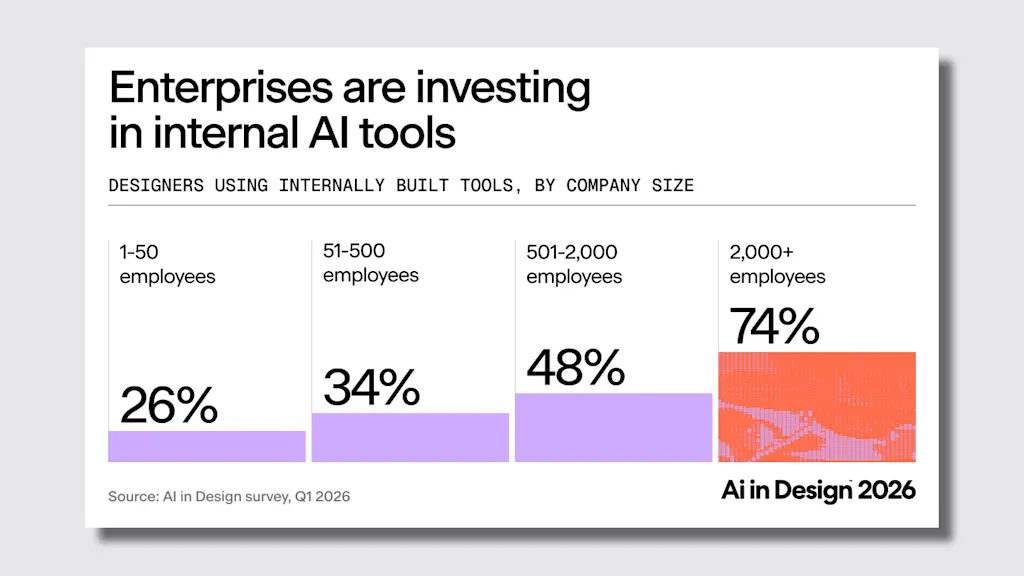
Robyn Park, Designer Fund’s head of platform, says her team has found that these types of niche investments in AI are leading teams to begin instituting new learning rituals to keep up with the pace of change. That could mean more weekly check-ins, specific mentorship programs, and devoted AI-centric days (Stripe calls these “AI-cation days”).
“Inevitably, if you just keep going this direction, more designers are going to spend time building their own stuff in their own tools,” Park says. “I think a lot of design leaders are realizing that and creating more space to get together.”
How AI is changing what it means to be a designer
As use of AI tools broadens among designers, so does the definition of “designer.”
Today, the survey found, many designers are using AI to expand into areas of software development that would previously have been categorized as work for engineers. Fully 50% of designers reported shipping AI-generated code to production. Park explains that they’re using tools like Figma or Claude Code to code elements like motion graphics, back-end systems, and in-app tools that are making it into their products’ final interfaces.
For context, Blumenrose says, that would’ve been almost unheard of two years ago, when coding and visual design were considered distinctly siloed skill sets.
“If you told someone at a tech company two years ago that half of working designers would ship code to production, they couldn’t even fathom it,” Blumenrose says. “They’d say, ‘What are you talking about?’ It used to be that only the top 0.1%, 0.5% of designers that were truly, truly technical and very savvy could do that. For the most part, 99% of designers didn’t even have the login credentials to do that.”
Steve Vassallo, general partner at Foundation Capital, says he’s noticed that at the hiring stage, Foundation Capital’s companies are now looking for designers who show up with prototypes built through AI. They want to see that candidates are able to implement these skills right away, not just via mock-ups. Park at Designer Fund adds that companies may also be seeking candidates with side projects where they’ve demonstrated “AI fluency” by using multiple tools throughout their AI workflows, often including shipping code to production.
As expectations for designers become more all-encompassing, organizational structures are lagging to catch up. Only 28% of leaders surveyed for AI in Design said they’d implemented formal changes in their organizations, while just 13% of leader respondents had updated their performance review metrics or hiring practices.
The rise of AI design Frankenjobs
Blumenrose predicts that the broadening and blurring of “designer,” “engineer,” and “product manager” categories will mean individuals have to become domain experts who master a niche in their category to guide the rest of the team. Motion designers, for example, will need to dive even deeper into the craft of motion elements while also adopting a wider AI-based toolset.
At the same time, he says, the AI-powered design shift is likely to spawn its own new batch of position titles. This is a shift that’s in its early stages, but already appears to be emerging in glimpses. The report found that positions like “UX designer” or “UI designer” have faded out in favor of descriptors like “product designer” or “designer engineer” that indicate a broader skillset.
Some companies, Blumenrose explains, are also considering design-centric positions dedicated to streamlining a company’s AI workflows and building bespoke tools—a concept he calls the “AI imagineer.”
“We’re already seeing titles like ‘deployed engineer,’ ‘designer engineer,’ ‘design builder,’ or just ‘builder,’” Blumenrose says. “We’re going to come up with terms for someone who has depth in one thing, but also these two or three other skills, in the next three, six, nine, 12 months.”
Why designers are more important today than ever before
In an era when the definition of “designer” is blurring and broadening, some have argued that the entire role is becoming obsolete. But Blumenrose believes the data from AI in Design tells the opposite story. As AI tools make it easier to bring an idea from prototype to production, the role of the designer becomes even more integral.
“Designers were starting to question, ‘Where in this process do I fit?’” Blumenrose says. “What we saw was that the designer becomes more important in this world, because there’s more software.” With more software comes a need for more systems thinking, more empathy, and more taste-making—essentially, more guardrails to ensure that the final software is genuinely helpful for the end user.
“What you are responsible for as a designer is shifting and changing,” Blumenrose says. “But that does not mean that we need fewer designers. We need more designers, and they need to do things differently than they did. If we evolve, we should be a very key part of building software for the next 10, 15 years.”