For most of the world, a purple New York City apartment with eclectic decor and a sassy blue-eyed brunette might sound like a scene straight out of the ’90s sitcom Friends.
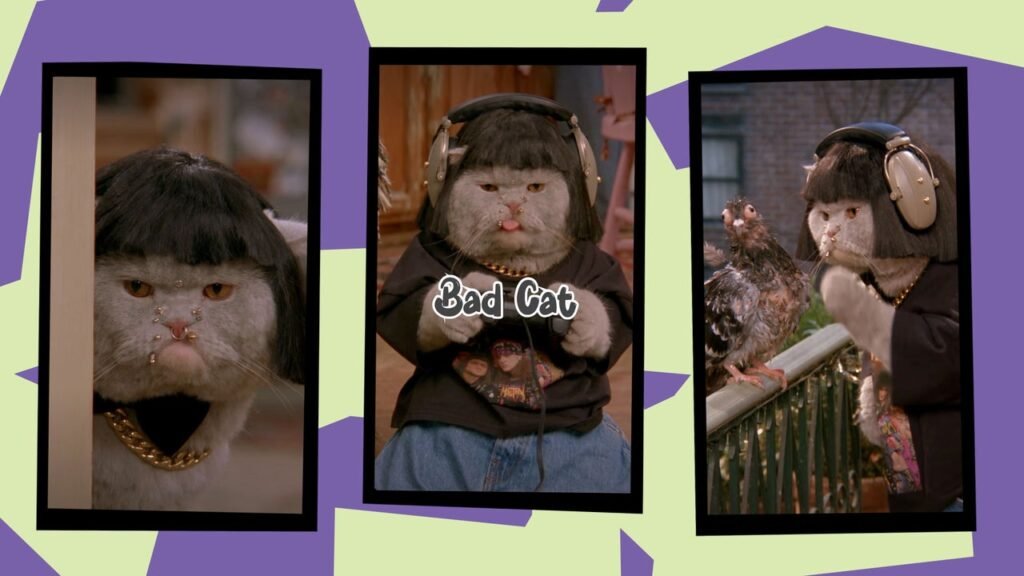
But in a strange corner of the internet, the familiar set hosts a different set of characters: a grey Persian cat wearing micro bangs, and its Monica Geller-looking owner. Despite looking eerily nostalgic by emulating the warm and muted color grading of the 1990s, the clips are all recent.
In fact, they are made using AI.
The clips are part of the “Bad Cat” series, an AI-generated sitcom made by creator Daria Zabnieva. Published on her Instagram and Threads accounts, the series has four one-minute clips in total, with each garnering millions of views.
In one with 9.9 million views, the owner informs the cat—which is wearing a band t-shirt and headphones, and smoking two cigarettes—that she is stepping out for groceries. The cat then goes to try on a pair of red heels and dances in front of a mirror, only to be surprised by the owner returning.
In another, the cat is joined by two other cats as they play a card game on the balcony, while the owner is inside with a suspected love interest.
A pigeon, which has appeared in other clips, then disrupts the game table, inciting a cat fight. This clip has over 2.2 million views.
Social media users aren’t just watching the bizarre series but engaging with, with hundreds flocking to the comment section of every new video.
“Can you please make this a show? I want to binge watch all of it,” one user commented in one of the clips.
No one told us life was gonna be this way
The popularity of the show comes at a point of tension between social media users and AI content—or slop.
From bunnies jumping on a trampoline to micro-dramas of cheating fruit characters, the onslaught of AI slop has altered the way users on social media consume content, leading to a sort of fatigue and rejection of AI-created content.
And social media platforms are taking notice. Earlier this year, LinkedIn announced a new “Seems like AI slop” button, allowing users to flag suspicious content.
Other platforms, like TikTok and Instagram, are also flagging content they believe to be AI-generated, all in an effort to keep the platforms from being saturated by slop.
Still, even as a broader slop fatigue has permeated social platforms this year, “Bad Cat” appears to be reeling people in despite being openly AI-generated.
In fact, some commenters have acknowledged this apparent contradiction, admitting they can’t look away despite the AI-related origins.
“I hate when I like something made by AI, but this is so good I can’t stop watching,” a user commented on one of the Instagram videos.
As the clips find their way outside of Instagram, reactions have been mixed at best.
“We’re now getting incredibly watchable AI sitcoms,” a16z partner Justine Moore said on X. “‘Bad Cat’ may be my favorite yet – we’re four episodes in and I’m eagerly awaiting the next one.”
However, not everyone matched Moore’s enthusiasm.
“If i had a lobotomy i would find this watchable yes,” one user replied. Another added, “You got anything for people with eyes?”
For others, pushing the content is part of a broader issue, one in which AI slop—despite the public’s apparent rejection of it—is becoming an increasingly acceptable guilty pleasure.
“Whenever I see anyone pushing AI, I check their bio and it’s virtually a guarantee that they work in an AI industry,” a user said on X in response to Moore. “These people’s livelihoods rely on us loving this slop, I don’t think they actually believe it’s good.”