Omar Marques/Getty Images
- A major Ukrainian naval drone maker predicts navies will increasingly rely on cheap, AI-powered vessels.
- NATO allies like the US and UK are building hybrid fleets with crewed and uncrewed vessels.
- Ukraine has used naval drones to hit Russian warships, aircraft, and defenses, and allies are watching.
The maker of a Ukrainian drone that has been hammering Russia at sea predicts that pretty navies worldwide are going to swell with cheap, AI-powered vessels, making them an element of modern naval warfare.
UFORCE, a Ukrainian-founded and London-headquartered company, makes products like the Magura drone, which has helped Ukraine combat Russia’s Black Sea Fleet despite lacking a conventional surface fleet of its own.
“Pretty much every navy on the planet is going to be scaling itself using cheap, attritable, unmanned assets that are AI-controlled,” Oleg Rogynskyy, the founder and CEO of UFORCE, told Business Insider.
It’s a future that UFORCE, which is expanding its manufacturing and exploring international interest, stands to benefit from. The company recently raised $700 million in funding, bringing its total valuation to $6 billion.
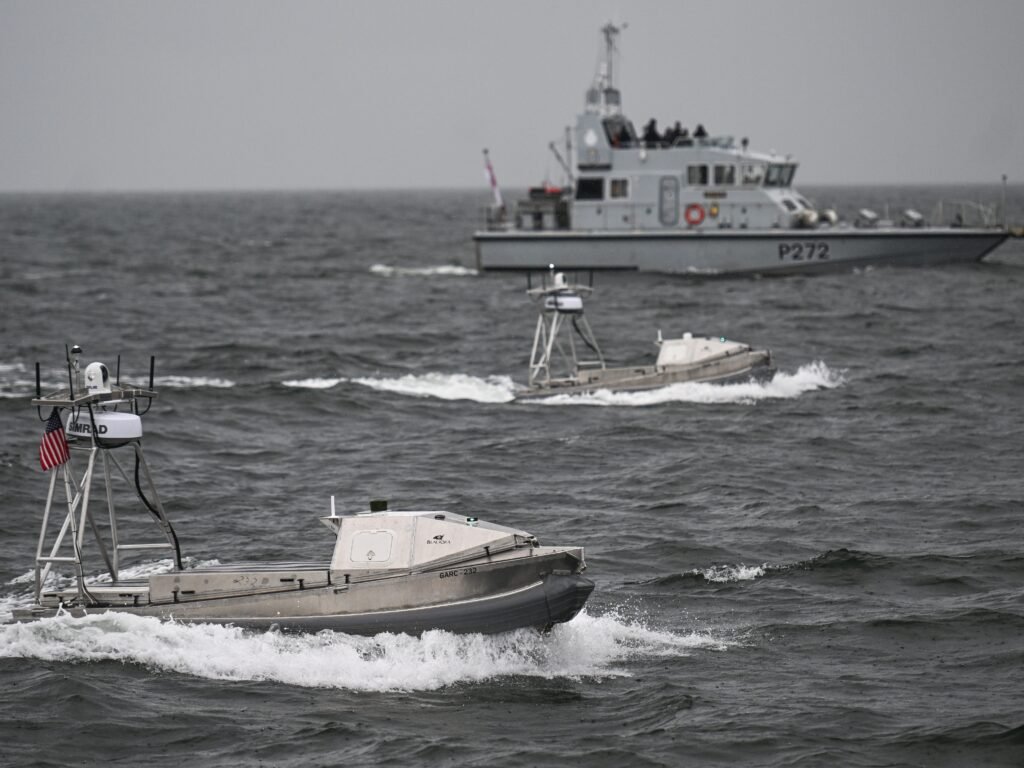
Partner nations are already looking at “integrated coordinated operations” involving crewed vessels and naval drones, he said.
He said the more distant future could be uncrewed navies, autonomous maritime patrol, and so on.
Many partners are investing in uncrewed naval capabilities that can take over some roles in dangerous waters that once required human crews, at far lower cost than some traditional naval assets.
Andrew Kravchenko/Bloomberg via Getty Images
The US Navy, for instance, has used uncrewed vessels to launch weapons. It has also employed naval drones in patrols, reconnaissance, rescue, and strike operations.
The Navy has long talked about the value of being able to expand the size of the fleet with cheaper, attritable uncrewed warships for dangerous missions, especially as China’s shipbuilding juggernaut rapidly constructs new vessels.
Adm. Daryl Caudle, the US chief of naval operations, said in September that medium uncrewed surface vessels “give commanders a Tailored Offset — additional capacity and capability that can be rapidly adapted to the threat, distributed across the battlespace, and placed at risk without placing Sailors at unnecessary risk.”
He said that they also “give us a platform for rapidly integrating new sensors, weapons, and other mission payloads as technology and operational requirements change.”
Naval drones are not new, but Ukraine has employed them at an unprecedented scale in modern naval warfare and rapidly expanded their roles beyond one-way attacks on ships. The US and other partner nations have pointed to Ukraine’s experience as they expand their own investments in the technology.
UFORCE’s Magura drones do not only attack ships. They’ve also downed Russian jets and helicopters with mounted missiles and helped launch FPV drones for attacks on land targets, like air defenses.
The UK plans to create a hybrid navy, combining a network of uncrewed systems with crewed ships and submarines, with the aim of expanding its capabilities without relying solely on expensive crewed warships.
This month, the Royal Navy created its first-ever autonomous squadron. “For generations, the Fleet has been built around ships, submarines, and aircraft, manned by sailors and Royal Marines,” Fleet Commander Vice-Admiral Steve Moorhouse said. “From today, an autonomous squadron takes its place alongside them.”
He said having these tools “will help make the Fleet more lethal, harder to knock out of the fight, and quicker to adapt.”
Other navies across Europe are also operating or testing uncrewed vessels, from mine-hunting to surveillance drones, though most are still a long way from AI-powered fleets.
NATO military officials have said that allied operators learning how to build and operate naval drones are drawing lessons from Ukraine, including from joint exercises and specialized training efforts.
Commander Magill, who oversees the UK-led Interflex Maritime mine countermeasures training program, told Business Insider that although the training is for Ukrainian forces, the Royal Navy is learning as well.
“There is so much that we learn from our Ukrainian colleagues, their current operational experience being chief amongst them, and their ability to operate in contested environments, incorporating autonomy, using some of the newer systems that we are also bringing into service,” he said.
“When we get to use those systems, we don’t need to relearn the same lessons that they have forged in combat,” he said.