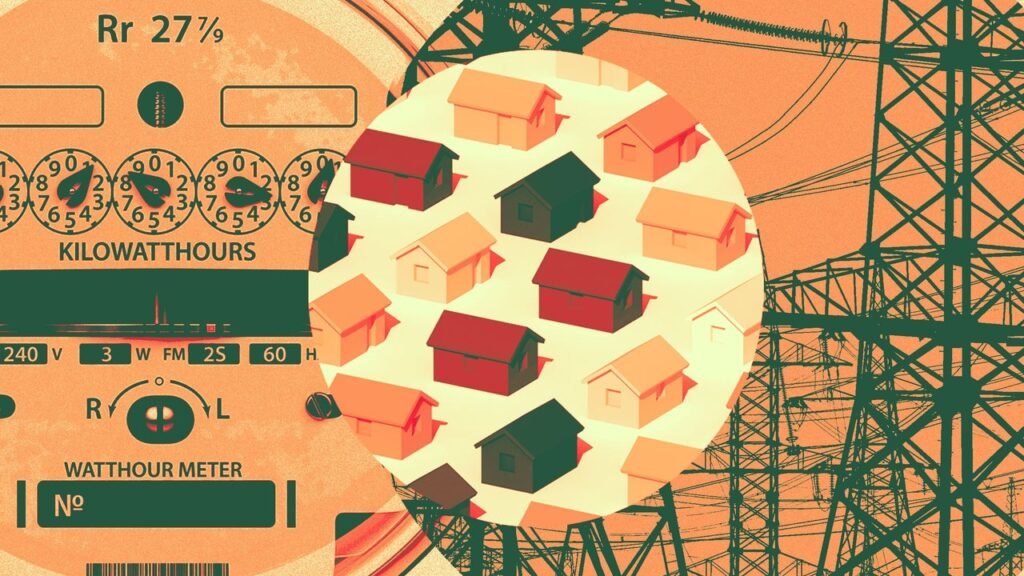
What if the solution to the energy crunch exacerbated by data center expansion wasn’t building more power plants—and investing in gas turbines and dirty fossil fuel power—but instead, simply upgrading people’s homes?
A number of advocates and clean energy wonks believe there’s another way forward. By creating choreographed networks of batteries and smart devices, called virtual power plants (VPPs), utilities can lower power usage and create a well of excess power they can unleash during periods of high demand. Batteries can store energy during off-peak hours to deploy later, and smart thermostats can cut air conditioning by a few degrees to moderate periods of high usage. All could be paid for by leveraging the billions of dollars being spent by the energy-hungry data center sector.
“This is a bridging technology, one that can help remake the American energy system,” says Chris Walker, vice president of power and platforms for Grid Alternatives. It’s one of the nation’s largest nonprofit clean energy providers, and it’s working on pilots seeking to prove this approach can work at scale.
“We’re hearing more and more sort of advocacy for this approach, not least because you know the data center developers really need social license, but because communities are demanding actual benefits from this,” he adds.
Home renovations may seem like an inadequate solution to the massive, and growing, energy footprint of data centers. The demand is unprecedented; Goldman Sachs predicted that data center energy use would more than double from 31 gigawatts in 2025 to 66 gigawatts by 2027. (For comparison, 66 gigawatts is enough to power more than 50 million homes.) Increasing power generation by constructing new gas power plants is costly, both financially and environmentally, and takes time; gas turbine deliveries are backed up until 2028. It’s also broadly unpopular. Americans widely rejected data center development during the 2026 midterm election cycle, when energy costs were a constant refrain.
But by using the money set to be spent on the data center energy build-out, and instead electrifying homes, adding batteries and installing solar, advocates argue it’s possible to create a distributed power system. This web of decentralized generating and power storage sites can cut energy bills, quickly create excess grid capacity that can be utilized by data centers, and build a better electrical system. It’s also much quicker to get running. These virtual power plants can be stood up in months, and at less cost.
“You’re setting up a win-win solution where a hyperscaler is able to make investments in communities that make their lives better, and they’re able to get something valuable to them in return, which is speed to power,” says Annie Gilleo, vice president of the Ad Hoc Group, an energy industry consultancy. “If we’re aligning interests with the hyperscaler, the sky is the limit.”
The virtual power plant experiment
A number of pilots and programs are testing how to dispatch and measure distributed power systems. When proven and scaled up, this is the kind of technology that may be able to support an additional data center without requiring new power generation.
In April in Minnesota, the state’s public utilities commission approved a $430 million utility-owned, battery-based virtual power plant, called the Capacity*Connect program. Xcel Energy, the local utility, will work with Sparkfund, a utility services company, to deploy 200 megawatts of small batteries across homes, local businesses, and nonprofits. These will help store energy to be used during periods of high demand.
In Virginia, Google is partnering with Voltus, a distributed energy platform, to create a 1 gigawatt virtual power plant. Announced in June and recently expanded, this system will consist of a network of flexible power assets—batteries, smart thermostats, even adjustable industrial processes at factories—that can be tapped into during times of high demand. When the grid is under strain, Voltus sends signals to those assets to either release stored power or cut usage, freeing up capacity. The system is expected to save consumers energy, and it’s being tested in the PJM grid, which runs through the nation’s Middle Atlantic region and into the Midwest. PJM’s coverage area includes Virginia, a data center hotbed.
“We really see virtual power plants as a critical short-term solution,” Ellen Zuckerman, head of energy market development for North and South America at Google, told The New York Times. “It’s a way to invest in our communities, really double down on our clean energy ambition, but also meet capacity at speed and scale.”
And in September, Pacific Gas & Electric announced it was working with Google and Rewiring America, a home electrification nonprofit, to enroll tens of thousands of customers across its Northern California user base—and their home batteries—in a program called SHARE (Smart Home Assets for Reliability and Efficiency). Proponents argue this can cut the energy bills of participating households and create a reliable grid resource.
In addition, Grid Alternatives is collaborating with Google in Fort Wayne, Indiana, where Google operates the massive, $2 billion Project Zodiac data center. Consisting of 12 buildings spread across 700 acres, the center continues to draw community pushback and protests over its local and environmental impacts.
The partnership is funding energy retrofits, battery storage, and solar power for roughly a dozen homes, which should all be upgraded by the end of the year. A ribbon cutting will take place on December 1, says Walker, Grid Alternatives’ power and platforms VP. It’s a very small pilot aiming to gather data and prove a larger project can be possible.
“This is 12 homes, but we want to talk about 1,200 houses,” he says.
Unlocking power that’s already there
Research shows that efficiency and grid flexibility may be potent allies in meeting growing demand and even saving money. A recent study by the Brattle Group, an economic consultancy, found that improving system utilization by 10% could cut electricity rates by roughly 3.4%; that would add up to $100 billion in a decade. VPPs also cost much less to operate.
Many such systems are already in use. The U.S. Department of Energy estimated that about roughly 30 gigawatts of VPP capacity is deployed today, and the nation could hit 160 gigawatts by 2030. Instead of spending money to add generating capacity to the grid, and racing to do so with dirty sources of power, why not increase efficiency and put the power already being generated to better use?
“We’re not going to be able to build power plants fast enough to serve demand,” says McGee Young, founder and CEO of WattCarbon, a marketplace that tracks demand-side energy resources. “How we fund and finance the deployment of distributed energy resources over the next 10 to 15 years is literally the trillion dollar question.”
Increasingly, there are policy and regulations that make this possible, says Gilleo of Ad Hoc Group. In addition, other groups have already started laying out a roadmap for where these programs could work: GRID Alternatives has built its Distributed Community Power Program on the back of work it did for the now-cancelled federal Solar for All program. Grid worked with Accenture, the technology consultancy, which created tools, including a searchable database of opportunities for distributed solar and other investments that can be deployed across Grid’s coalition of numerous partners and housing providers. The database can also help data center developers identify investable community-benefiting energy projects to support, including ones that could relieve grid congestion near their facilities.
The challenge of making it work at scale
The problem remains figuring out how to carry out the transfer of capacity. Does it work during energy peaks, and is it certain that there’s a balance of energy savings and utilization? Often, high power demand gets concentrated on a specific power line; are there enough other customers or energy usage on that line that can be freed up through these investments to feed data centers during peak usage? Gilleo was especially excited about the way the SHARE program created by PG&E, Google, and Rewiring America will study how these programs work, and within a year, provide data and insights into how to scale up the concept.
These may, at first, seem like simple shifts to the energy system. But effectively tracking the demand and usage across a real-time grid and accurately making sure everything is balanced requires extensive testing, regulations, and proof. Young at WattCarbon says that it takes a lot of convincing to get utilities, data center developers, and Big Tech to sign off on something like this.
“The lights are going to stay on because a whole bunch of random people are putting on solar panels and batteries and heat pumps,” he says. “That’s a terrifying idea.”
Right now, as the tech industry formulates its response to the midterms and the drubbing felt by data center advocates, there is a renewed push for more community benefits. In October, Amazon announced its Built Together framework, which put $1 billion into benefits over the next five years, including energy affordability. Advocates want to see that money go toward more pilots and distributed energy projects.
Gilleo hopes that soon, as distributed energy trials and pilots prove themselves, more of that kind of community funding gets diverted towards energy efficiency and a more responsive grid, not merely community investments. Research shows this kind of program and messaging work; a survey by the energy advocacy group Good Power found that two of the most effective promises data center developers can make are pledging to cut utility costs and use renewable power.
“I do think that we are at a pretty critical inflection point where we can do everything right, or we could not,” Gilleo says. “We have a really good chance to deliver a lot of benefits to communities and homeowners, but it does require us moving quickly to get the rules right.”