My mother would have you know our lineage the minute you meet her. I am the eldest daughter of the eldest daughter of the eldest daughter, going eight times back. She is proud of it, this freakish line of vaginas slotting neatly into one another back into time and space, like Russian dolls. I always doubted her assertion that this was true, until an Ancestry.com test allowed me to access the family tree portion of the app, and I counted one, two, three, four… all the way back to eight. What could this all mean? A curse? A superpower?
The eldest daughter trope is known far and wide, mostly only to firstborn daughters. We are parentified young, destined to become the second mother. We learn to anticipate needs, predict moods; we are the latchkey to the latchkey kids. I am a people pleaser, and sure, I like to be right. Firstborn girls have a light toxicity to them. These traits make eldest daughters desperate to branch out, and I was no different. I got married young, had kids young. How much of this was by choice, how much by training?
As the eldest daughter, my boundaries are frequently trampled over, yet I am the queen of respecting boundaries. My younger brother is someone who never hides his emotions; you will know his feelings the second they emerge. I love that about him. I envy it. I am someone who holds them in, cheeks full with unspoken words I can’t seem to swallow, until the inevitable happens and I vomit them out all over you. I live at the polar caps — silently accepting or sobbing uncontrollably, depending on where in the digestion process I am.
Firstborn daughter: Is this where I am in the birth order of my family, or is this also womanhood? We are conditioned by society, our parents, and our peers to take what they give us, to hide the ugly, accentuate the good traits. Boys will be boys, we are told. He hurt you because he likes you, we are told. Beauty is pain, we are told. Perhaps the superpowers I was concerned with inheriting have nothing to do with being one in a long line of eldest daughters, but rather, a product of feminine expectation.
I don’t know much about many of my ancestors (though my debut novel explores the possibilities of ancestral hand-me-downs), but I know my grandmother, Nanny Goat, was a typical mother hen as an older sister. My mother was the same, a woman not good at clearly outlining her feelings because they hadn’t been prioritized as a child. Thanks to research and books on epigenetic trauma like Bernice McFadden’s Firstborn Girls or Dr. Joy DeGruy’s Post Traumatic Slave Syndrome, we know that the experiences of a future mother are felt, ripples across a pond, throughout generations.
Am I carrying the weight of my foremothers? Can I put it down?
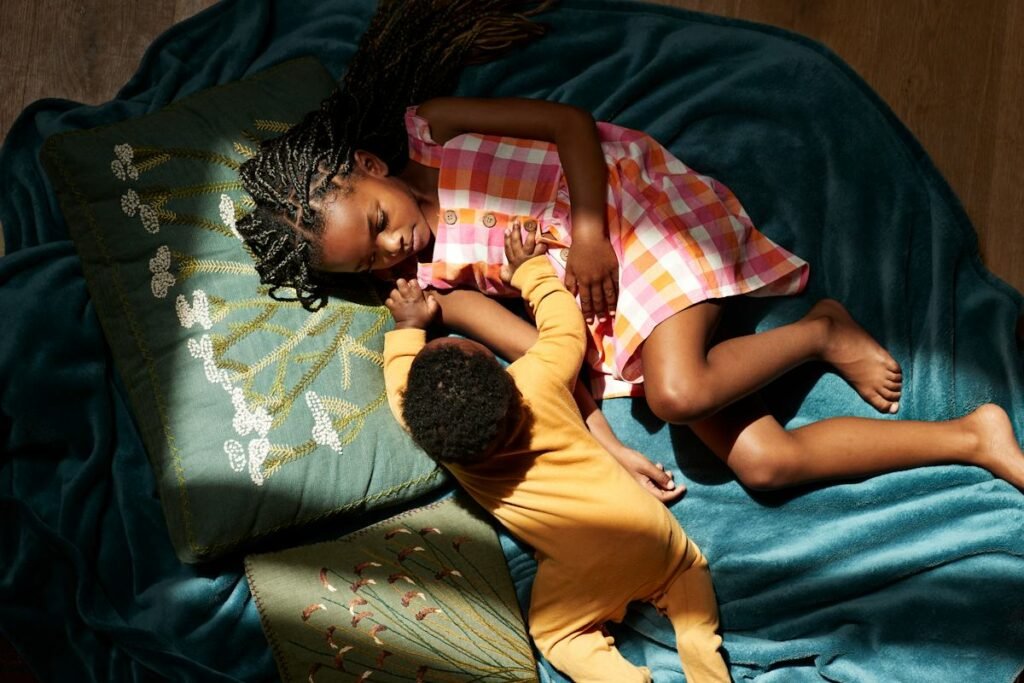
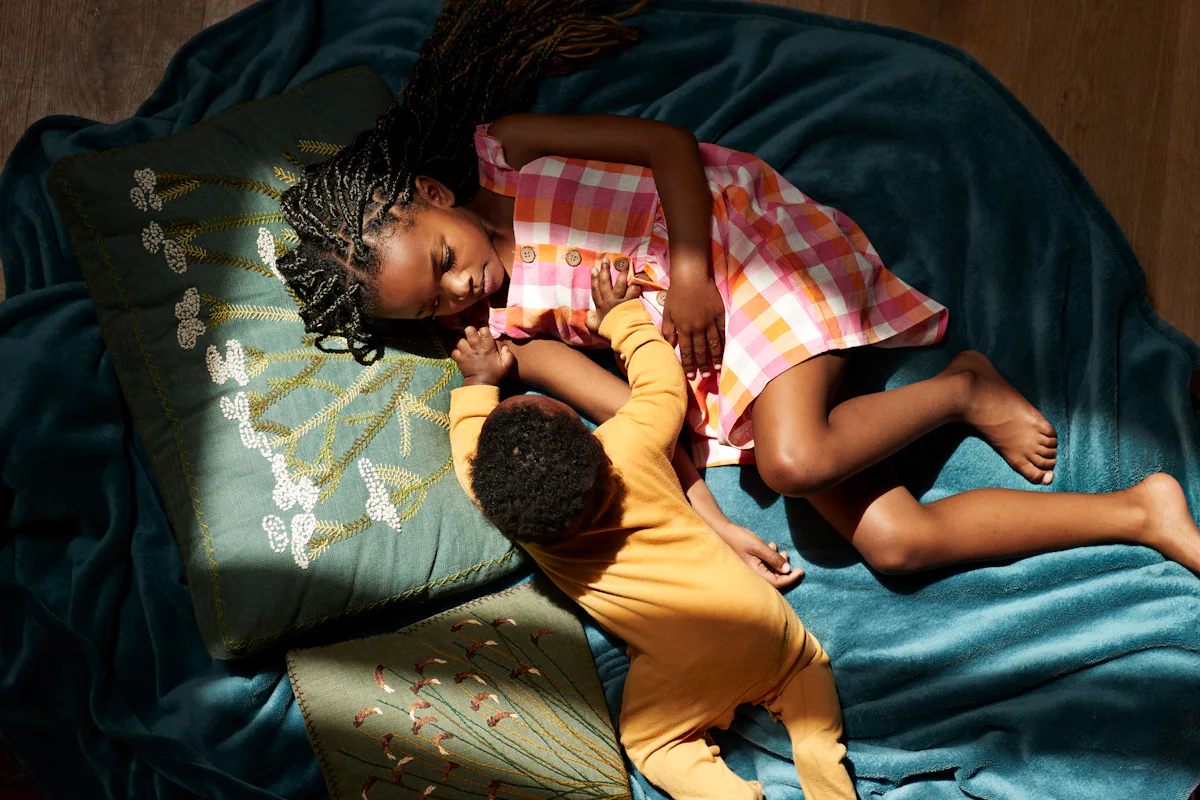
My own firstborn daughter is a sweet, doe-eyed 8-year-old named Luka. Although she is growing up in a vastly different household to mine — she has doting parents who love each other, a house and a yard and a quiet community-led town to grow up in — I have noticed some eldest daughter tendencies.
She comes by these honestly; I have never made a point to give her more responsibility than appropriate, but somehow… I find her trying to feed her sister breakfast so we can sleep in. If I am unwell, she insists on being given a job to do, to help. These could be viewed as just the characteristics of a sweet, loving kid, which she is, but I worry.
I worry that the curse of the eldest daughter has found her, pure and innocent, and sought to parentify her. That is her destiny. That is who she will be, whether she (or I) like it or not. I encourage her to be selfish, to think of her own needs first. To not worry about what she looks like to others, what other people may say about her actions.
What if we invert the notion of feminine expectation? Flip the patriarchy completely, leaving capitalism’s desire for a ladder, dog-eat-dog, one-ring-to-rule-them-all behind? As we discover more about the men at the top’s penchant for corporate (and literal) cannibalism (allegedly), it is alluring.
Despite copious propaganda about the race of the sperm to the egg, it is actually the egg that chooses. It isn’t a passive victim. It is selecting, carefully. We know that DNA is favored by the maternal line. Mitochondrial DNA is passed down only from the maternal DNA, not the paternal. From NPR’s Allison Aubrey: the X chromosome contains far more genes, so that even male humans have more genes from their maternal line. The maternal line, therefore, is the one evolution is desperate to preserve.
No accident then, that my matriarchal lineage forges on. Eldest daughters, yes, but certainly not a curse.
After reading the viral Threads by author and influencer Gabrielle Blair on how patriarchy isn’t an evolutionarily sound format for society, I wondered if the repetition of eldest daughters wasn’t some meek-making trad wife factory but rather evolution’s way of putting us forward as leaders. My mother is not a traditional woman. An artist and an intellectual, she has never been one to be told shit by anyone, which is another eldest daughter trait. My grandmother was quiet and Catholic, a mother of four, but she didn’t suffer fools; she was often the smartest person in the room, even if it went unnoticed.
Each seed of my ancestors that came before me brought me closer to Luka, the purest of us all. My darling Luka. An empath for sure. I asked her what she hopes for the future. She told me, “A planet where money isn’t important, where everyone has a house and food and the things they need.” I reiterated, “But Luka, what about you?” And she, with the wisdom and innocence we only ever have at 8, said, “That is about me, Mama.”
Not to place too much importance on my absolutely, positively perfect child, but isn’t that what this is about?
We need an eldest daughter. We need a matriarch-centric society. If my own family has taught me anything, it is that a lineage of eldest daughters carries the possibility of alternative futures. Our DNA is demanding it. We need empathy and leadership, and a society with the ability to see the bigger picture, to predict our needs in 10, 15, a hundred years’ time. Because the planet is changing and, hopefully, so are we.
Eirinie Carson is an award-winning Black British writer and college dropout living in California. She writes about sexual taboos, death and dying, illegal substances, hauntings both real and imagined, and ancestral inheritance in a world desperate to sever the connections between what came before and what is to come. Her first work of fiction, the maternal gothic novel Bloodfire, Baby (2026), has been named one of the year’s best debuts by Debutiful.